People now learn about brands secondhand, through machines that interpret or skip them without leaving a trace. Crawlers index, assistants summarize, agents act. Machine experience is the discipline of owning the moment a machine meets your brand.
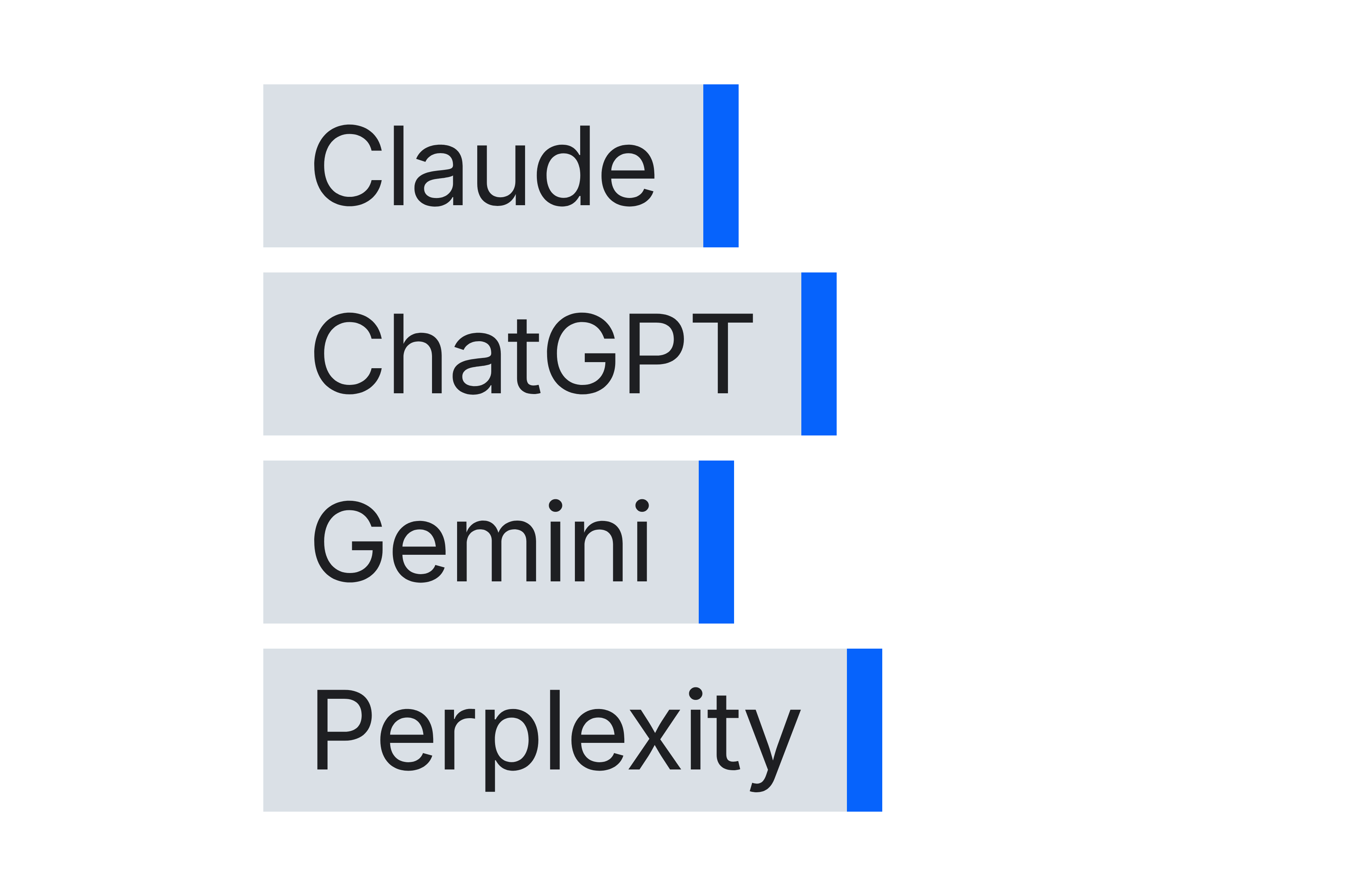
Discovery has scattered across machines you can't see
Machines have decided what people find since the first search engine. For a long time there was a map: Google ranked the web, and you could track the clicks.
That map is gone. Discovery now runs through models and agents that hand back a single answer and rarely leave a trace in your analytics. As machines move from reading the web to acting on it, being found is only the price of entry. In the machine economy, being usable is what counts.
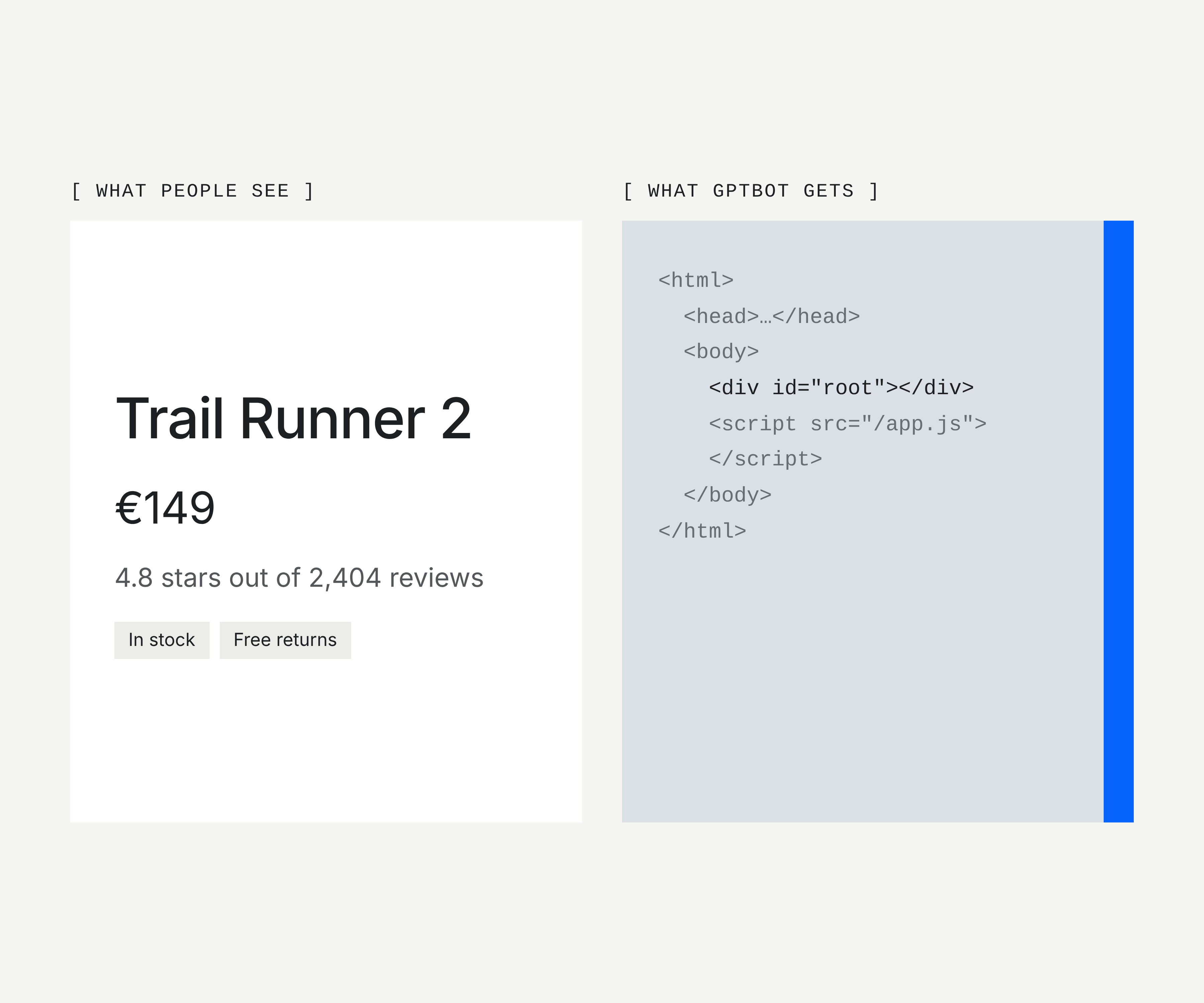
Human visitors can see your site, but machines may come up empty
Most sites are built for people: menus open on click, prices load live, reviews sit behind tabs, and specs appear as you scroll. All of that runs on JavaScript.
GPTBot, ClaudeBot, and PerplexityBot don’t run JavaScript. They read the first HTML response, so a site that works for every visitor can reach them as an incomplete page, an empty shell, or nothing at all. Machines can’t choose what they can’t understand.
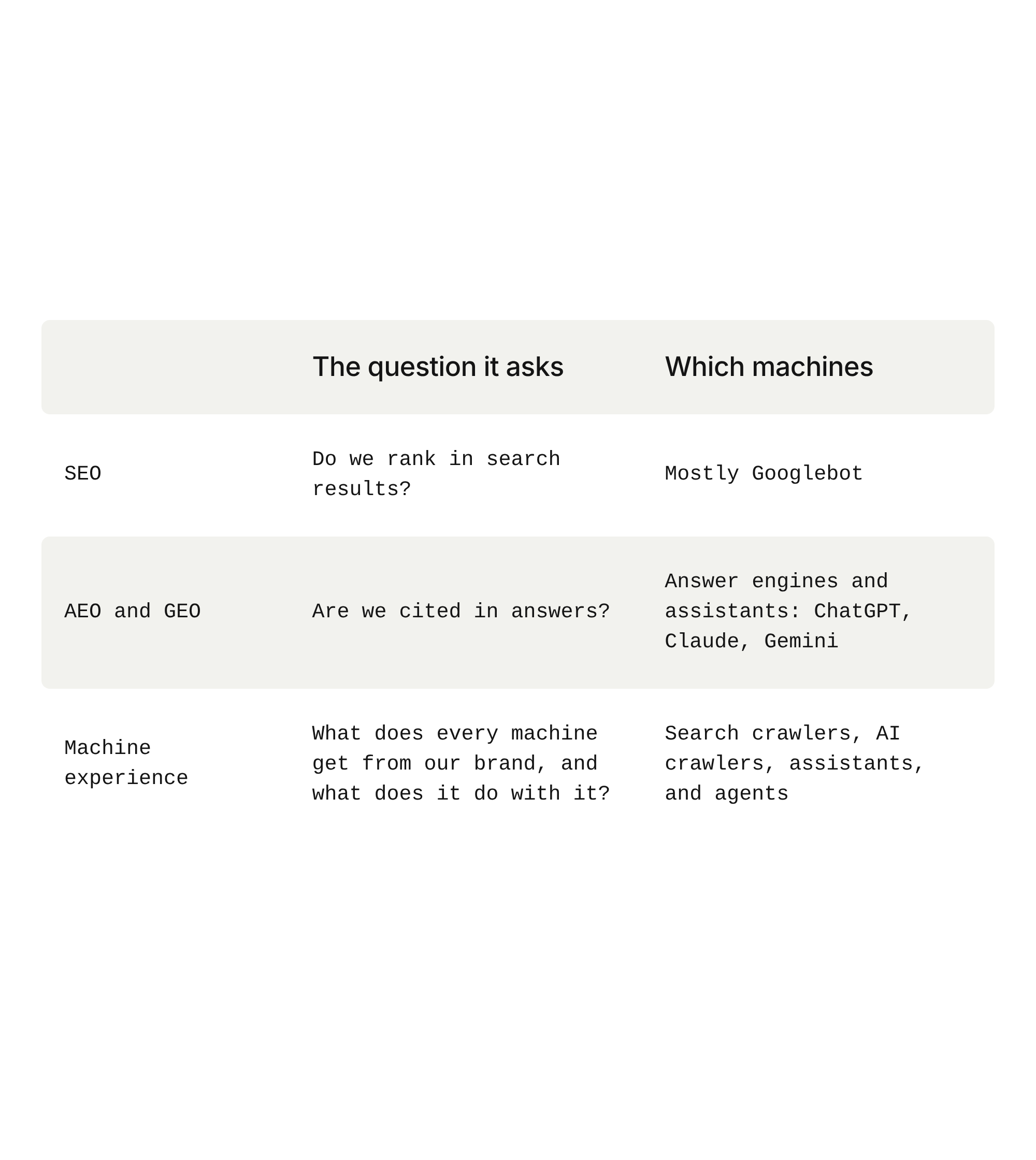
The question has widened
For most of its history, SEO meant optimizing for Google. AEO and GEO are the industry's attempts to name what changed: answer engines and assistants now decide what gets cited, not just what ranks.
Each describes an outcome. All three depend on the same input: a machine reading your page and understanding it. Machine experience covers that input for every machine, whatever it does next.
If a machine can't read the page, no amount of optimization downstream can recover it.
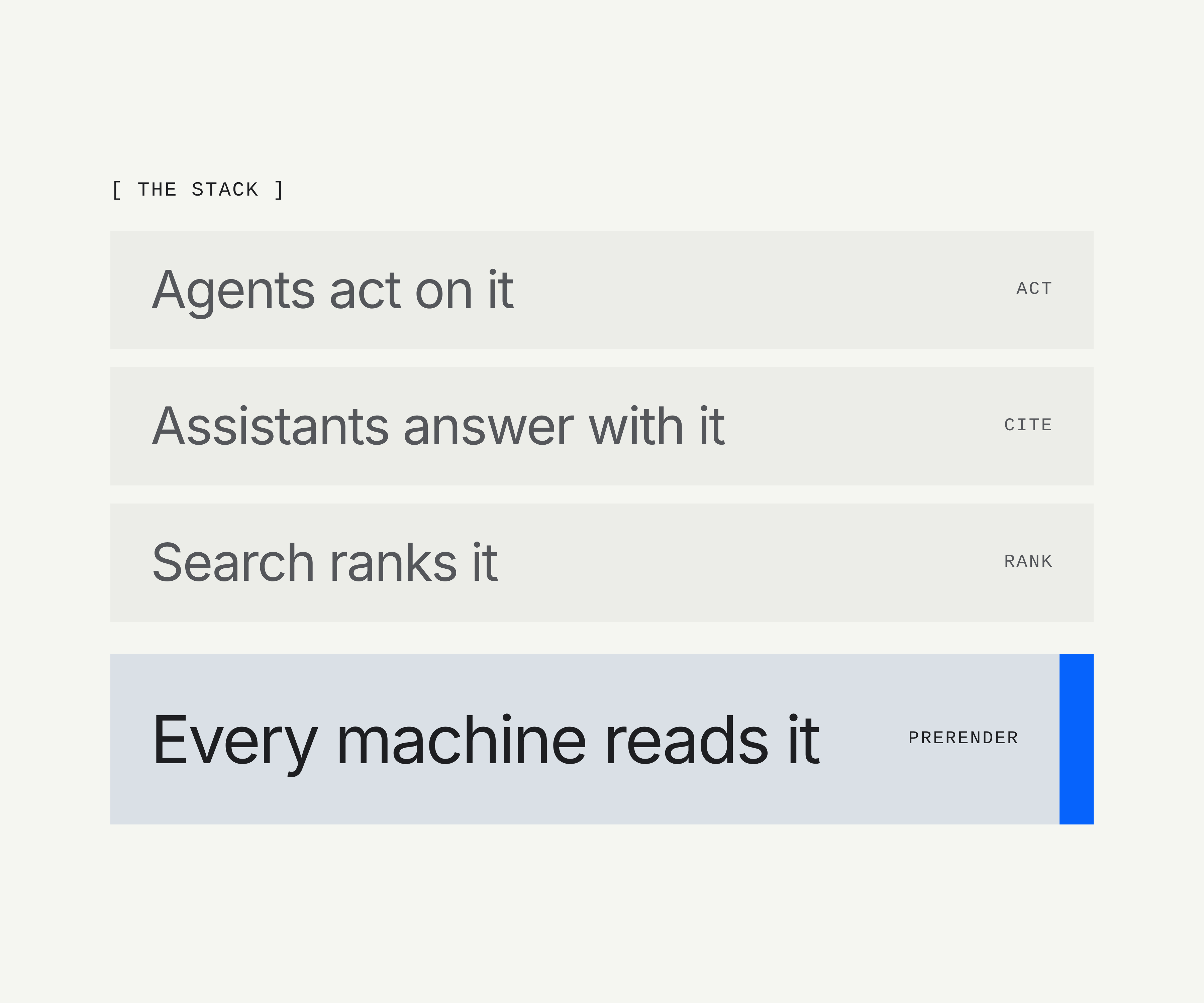
Prerender is the first layer of machine experience
We've been giving machines the full page for a decade, since before anyone called it machine experience. Our team of search engineers and business scientists built the layer that search now depends on.
Prerender delivers the full page on request. No SSR project, no framework migration, no dev ticket; it runs alongside the site you already have.
Then it shows you what every machine got, so you can see where reach is leaking and which pages to fix first.
Take the first moment back
See what machines get
Server logs show that a request happened, not what came back. Crawler Analytics shows each visit page by page, including what every crawler actually received and which ones never came.
Give them the page your customers see
Prices and reviews that load with JavaScript often never reach the machine. Prerender serves the complete page to every crawler, with no rebuild and nothing to change on your site.
Prove what it’s worth
Reach only matters if it shows up in your numbers. Search Performance puts the pages Prerender served next to what Google Search recorded, so you can see which pages earn impressions and where to look first.
Machine experience, examined
Machine experience is how machines see, understand, and interact with your brand. SEO, AEO, and GEO are each named after a channel or an output: rankings, answers, generated results. Machine experience is named after the reader. The channel will keep changing; the fact that a machine reads your brand before a person does won't, so the discipline should be defined by that.
People increasingly experience information secondhand. They ask an assistant rather than search, read a synthesized answer rather than the source, and let an agent narrow the options before they look. Each step puts a machine's interpretation between your brand and the person, and the person rarely sees the original. Before a customer ever sees you, a machine decides whether you exist.
A crawler that misreads a page costs you a ranking or a citation. An agent that misreads a page can't complete the task: it can't confirm a price, check availability, or finish a booking, so it moves on to a site it can understand. The cost of a poor machine experience goes from visibility to transactions.
Yes, in three layers: which machines arrive, what they receive, and what that turns into. The first two can be measured directly, page by page. The third is where the industry is still building methods, especially for assistants that don't send traffic back, and it's where we're focusing our research.
No. It's a discipline, like brand experience, and we deliberately didn't trademark the term. Any team can practice it. Prerender is the platform we built to make it measurable and fixable.
At the start. Prerender began in 2014 as an open-source project to help search engines read JavaScript sites, and it's referenced in Google's own documentation. We've spent a decade on the first layer: making sure every machine gets the full page. Content quality and authority still decide rankings and citations, but they can only work on a page a machine has actually read.