Make React sites visible to search and AI crawlers
Content rendered client-side in Angular can be missed by search engines and AI crawlers. Prerender serves complete, cached HTML from your public Angular pages, making content, links, and metadata accessible without JavaScript execution.
Improve Angular SEO and support AI search visibility without migrating to Angular SSR or changing your visitors’ experience.

Why client-rendered React can create SEO and AEO gaps
Client-rendered React applications may return an HTML app shell before JavaScript loads the page’s content, links, and metadata.
Googlebot can render JavaScript, but many AI crawlers cannot. Crawlers that don’t execute JavaScript or finish rendering may miss:
- Headings, product descriptions, prices, and other page content
- Internal links rendered through React Router
- Canonical tags and page-specific metadata
- Structured data added after the initial response
- Content loaded through APIs, lazy-loaded components, or third-party scripts
Missing content limits what search engines and AI systems can evaluate for indexing, search results, and AI answers.
Improve machine experience for your React site
Prerender improves the machine experience of your React site by giving search engines and AI crawlers complete, readable HTML. Content, links, and metadata rendered by React become accessible without crawlers running JavaScript, helping your public pages get evaluated for search results and AI answers while visitors keep the same interactive experience.
Make React website
crawler-ready
Serve complete HTML
Give crawlers the rendered content, links, metadata, and structured data from each public route, not just the initial app shell.
Reach search and AI crawlers
Serve ready-to-read pages to Googlebot, Bingbot, recognized AI crawlers, social bots, and other configured user agents.
Keep your current frontend
Prerender integrates with your CDN, reverse proxy, or web server. Human experience is untouched.
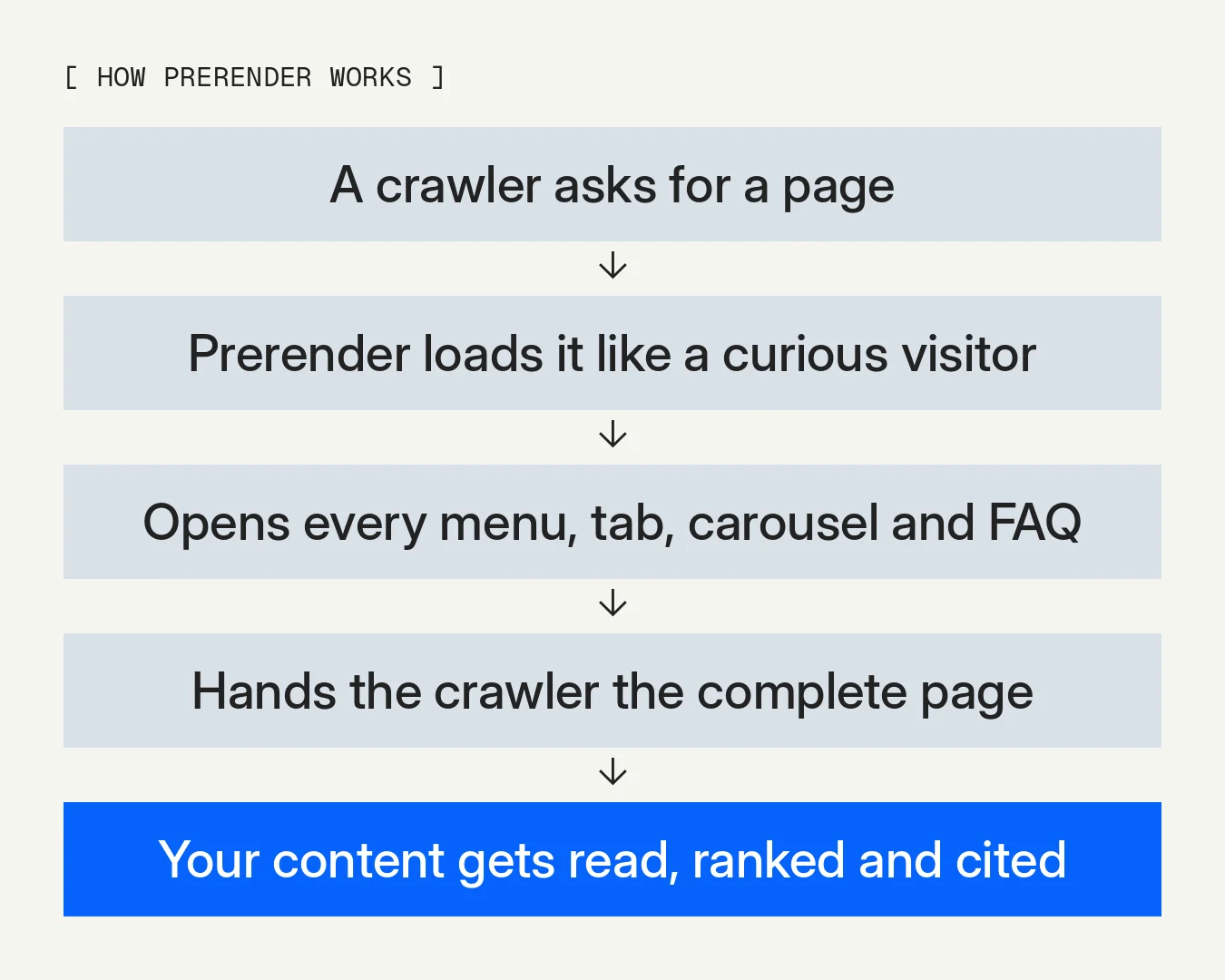
How Prerender works with React
Prerendering gives crawlers the finished HTML without changing the React application served to visitors.
- A search engine or AI crawler requests a public React URL.
- Your CDN, reverse proxy, or web server identifies the crawler’s user agent.
- Prerender loads the page in a browser, waits for the React content to render, and caches the resulting HTML.
- The crawler receives a complete response containing the page content, links, metadata, and structured data.
This is different from React’s native `prerender` API, which generates static HTML through a build or server-rendering pipeline. Prerender works outside the React component tree, making it practical for an existing SPA.
Prerender vs React prerendering vs SSR
Prerender, React’s prerender API, and server-side rendering (SSR) all produce HTML, but differ in when rendering happens and who receives it.
| Approach| Best fit|
| --- | ------ |
| Prerender | Full support |
| React native prerendering | Public pages can be generated ahead of time, with your team managing generation, deployment, and hydration where needed. |
| SSR | Pages need HTML generated on request, with your team managing server infrastructure, data loading, and hydration. |
How to add Prerender to a React application
Integrate Prerender where incoming crawler requests are handled. The setup depends on your hosting infrastructure, whether your React app uses Vite, Create React App, or webpack.
1. Choose public routes with search value
Prioritize product, category, listing, article, documentation, and landing pages. Exclude authenticated dashboards, account pages, checkout flows, and personalized content.
2. Connect through your CDN, proxy, or server
Add Prerender at your CDN or edge layer, an Nginx or Apache reverse proxy, or middleware in the Node.js server serving your app. For static React builds, use the CDN or hosting layer.
3. Configure URL discovery and caching
Submit a sitemap or URL list to render and cache priority pages early. Other public URLs requested by crawlers through the integration can also be rendered and cached.
Set recache rules to match content changes. Use URL and query-parameter rules to exclude low-value variations.
4. Verify the HTML crawlers receive
Test the homepage and representative deep routes with a crawler user agent. Confirm each response:
- Includes the
x-prerender-request-idheader - Returns the correct HTTP status
- Contains the page title, canonical tag, content, links, and structured data
- Matches the public content visitors see after React renders
Check cached URLs in the Prerender dashboard and inspect priority pages in Google Search Console.
5. Maintain crawler coverage
Review failed renders after routing changes or deployments. Keep your sitemap current, ensure firewalls and bot protection allow rendering, and configure additional AI crawler user agents as needed.
AI visibility starts with machine access
Product details, documentation, and articles on your React site can help answer the questions people ask AI assistants. But that information must be accessible before an AI platform can evaluate it as a source.
Prerender gives supported AI crawlers access to your public React content, including information loaded through APIs and dynamic components. This supports discovery for AI answers without changing your application.
Access is the first step; content relevance, quality, and each platform’s systems determine whether a page is cited or recommended.
Before Prerender, our AngularJS single-page app faced indexing issues. Prerender’s easy integration quickly led to thousands of our pages being crawled and indexed, boosting our organic traffic significantly. Their responsive support was a bonus!
Keep ReactJS.
Fix crawler access.
Serve search and AI crawlers complete HTML without rebuilding a React application that already works for your users.
FAQs about React prerendering for SEO and AEO
Your React pages may not be indexed consistently because meaningful content is often added only after JavaScript runs. To handle JavaScript, Google needs more time and processing power compared to static HTML files, which can deplete your crawl budget faster. This bottleneck creates a domino effect, causing missing content, low page speed scores, and in many cases, URLs getting ignored from the index. React complicates the rendering step, whereas Prerender eliminates that issue.
Prerender.io works with any React setup because it operates independently of the frontend build tool. The integration is added at the CDN, reverse proxy, hosting, or web-server layer that receives crawler requests. This supports React applications built with Vite, Create React App, webpack, React Router, and custom toolchains, provided the public URL can be loaded and rendered. Explore the available Prerender.io integrations.
You do not always need Prerender.io if you use Next.js. Routes rendered through SSR or SSG already return HTML, so a second rendering layer is optional there, although serving that HTML from cache can still get it to a crawler a few milliseconds faster. Prerender.io is worth adding when public routes remain client-rendered, depend on browser-only data loading, or return incomplete HTML to crawlers. Test the initial and rendered HTML route by route, then pick the integration option that fits — Next.js has its own middleware integration.
How quickly React SEO results change after implementation depends on when search engines recrawl and reprocess your pages. Crawler-ready HTML becomes available once the integration and cache are working, but indexing and ranking timelines remain under each search engine’s control. Verify the Prerender.io integration, then monitor Search Console for changes in crawling, index coverage, impressions, and clicks.
Vite does not automatically make a React app SEO-friendly. It improves the development and build experience, but a standard Vite React build is commonly still client-rendered. If meaningful content is absent from the initial HTML, crawlers must execute JavaScript or receive a rendered version of the page. You can add SSR or SSG, adopt a framework that provides those modes, or integrate Prerender.io with the infrastructure serving your SPA.
React Helmet does not solve JavaScript rendering problems by itself. It helps manage titles and meta tags inside a React application, but crawlers may still need to execute JavaScript before receiving that metadata or the rest of the page content. Check the crawler-visible response rather than assuming client-side metadata is available. Our React SEO guide explains how metadata management fits into a broader rendering strategy.
Prerender.io can handle React Router routes when each public route has a stable URL that can be requested directly. Add important URLs to your sitemap or caching workflow, make sure deep links return the correct status, and test several nested routes with a crawler user agent. Avoid treating hash fragments as separate indexable pages where possible.
You should not prerender every route in your React application. Focus on public URLs with search or crawler value, such as product, category, listing, article, and landing pages. Exclude authenticated dashboards, account areas, checkout flows, personalized views, and URLs that should not be indexed. This keeps the cache focused and avoids exposing user-specific content. The Prerender.io getting-started guide covers URL discovery and caching.
You can test what Googlebot receives from your React site by switching the user agent to Googlebot in Chrome DevTools and inspecting the main document response. A hosted Prerender.io response should include the x-prerender-request-id header. Confirm that the HTML contains the correct title, canonical, body content, links, structured data, and status code. Follow the complete integration-verification walkthrough, then compare the result with Search Console’s URL Inspection tool.
Prerender.io can make public React content technically accessible to recognized AI crawlers by serving them rendered HTML. Additional crawler user agents can also be added to the integration, helping bots access the text, links, metadata, and structured data without executing the React application. This does not guarantee indexing or citation by an AI platform. Learn more about AI search visibility and how to add AI crawlers to an integration.