Sixty-eight percent of US Google searches in the first months of this year ended without a click. So if machines can see your site but most people never visit it, does it matter?
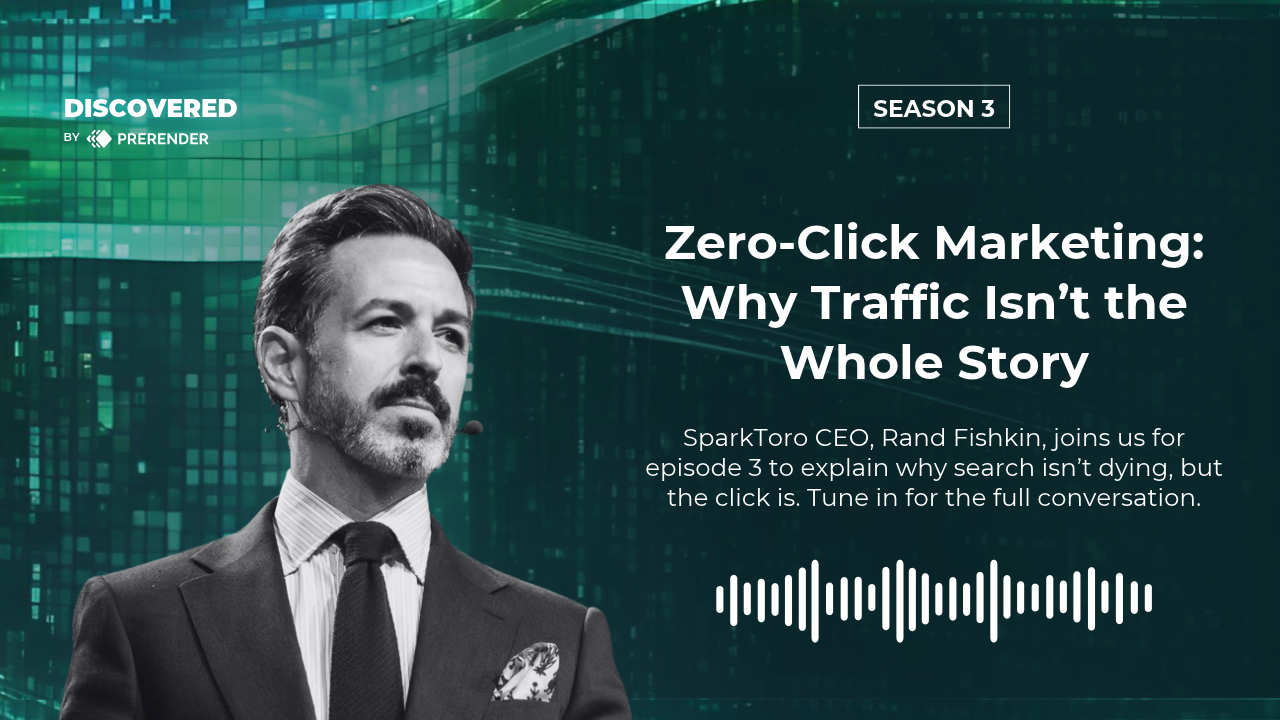
In our latest episode of Get Discovered, host Joe Walsh sat down with Rand Fishkin, Co-Founder and CEO of SparkToro, who built and ran Moz for 17 years. His research on search traffic is some of the most cited in the industry. His verdict: search isn’t dying. The click is.
Is AI replacing Google search?
The myth Fishkin corrects most often, even with experienced marketers, is that ChatGPT, Claude and Gemini are replacing Google. SparkToro’s clickstream data, drawn from more than 10 million US devices, says otherwise. Almost 20% of Americans now use an AI tool 10 or more times a month. Yet Google searches keep growing.
He calls the opposite belief business mythology, and it’s shaping budgets. Most businesses, he argues, over-invest in ranking for ChatGPT prompts and under-invest in the social platforms where their audience already spends time.
Why AI visibility is hard to measure
Unlike Google, AI platforms don’t reveal how often any prompt is run. Nobody knows whether thousands of buyers ask for the best product in your category, or none do. That makes AI visibility easy to sell and almost impossible to disprove.
Joe has seen this firsthand. When Prerender explored building a prompt tracker, official API calls matched what real users saw only about 10% of the time. He calls the rush to these numbers a metric security blanket: something to show leadership while organic traffic falls, but not tied to revenue.
Zero-click marketing: why traffic is falling
If more people are online than ever, why is traffic down 20–30% from 2022 highs? Fishkin’s answer is simple. Google, Instagram, LinkedIn, Reddit and YouTube all earn more when you stay put. So they answer questions in place and penalize links that send you elsewhere.
That shift is being mistaken for AI cannibalization. And it isn’t all bad news. If Google’s AI Overview describes your product accurately, the visitors who do click arrive ready to buy. Traffic down, revenue up.
How to measure marketing without perfect attribution
Fishkin’s fix is a correlation dashboard. For each channel, track signals at every stage: exposure (impressions), familiarity (branded searches, follows), intent (pricing page visits, sign-ups) and conversion. Then ask an AI assistant which channel, if scaled, would most likely lift conversions.
It’s correlation, not causation, and he’s fine with that. A 1950s ad agency never followed drivers past an Oreo billboard. It compared sales in Santa Fe against Phoenix, saw the lift and rolled out the winner. Election campaigns spend billions the same way, with no attribution at all.
For the CFO who wants proof, his answer is blunt. He’d rather see numbers going up than a perfect attribution model on a business in decline.
How to choose the right marketing channels
Fishkin doesn’t sugarcoat it: independent brands have it harder than ever. His advice is to find where three things meet. Where your audience pays attention, the format you’re good at, and value nobody else on that platform offers. Then invest, knowing returns take time.
And widen your definition of value. Attention increasingly goes to content that entertains, holds a point of view and picks a fight, even if the enemy is an outdated process. He also expects PR to matter more, because what others say about you shapes both AI answers and Google.
The takeaway
Traffic was always a vanity metric. AI search didn’t break marketing measurement; it exposed it.
The brands that pull ahead will measure sales, show up where their audience pays attention, and stop waiting for proof that will never come.
Tune in to the full conversation
Listen to the full episode of Get Discovered and subscribe across YouTube, Spotify, and Apple Podcasts so you don’t miss any conversation on the fundamentals of online discovery and machine experience.
Rand Fishkin is co-founder and CEO of SparkToro and co-author, with Amanda Natividad, of Zero-Click Marketing. Find his research at sparktoro.com.