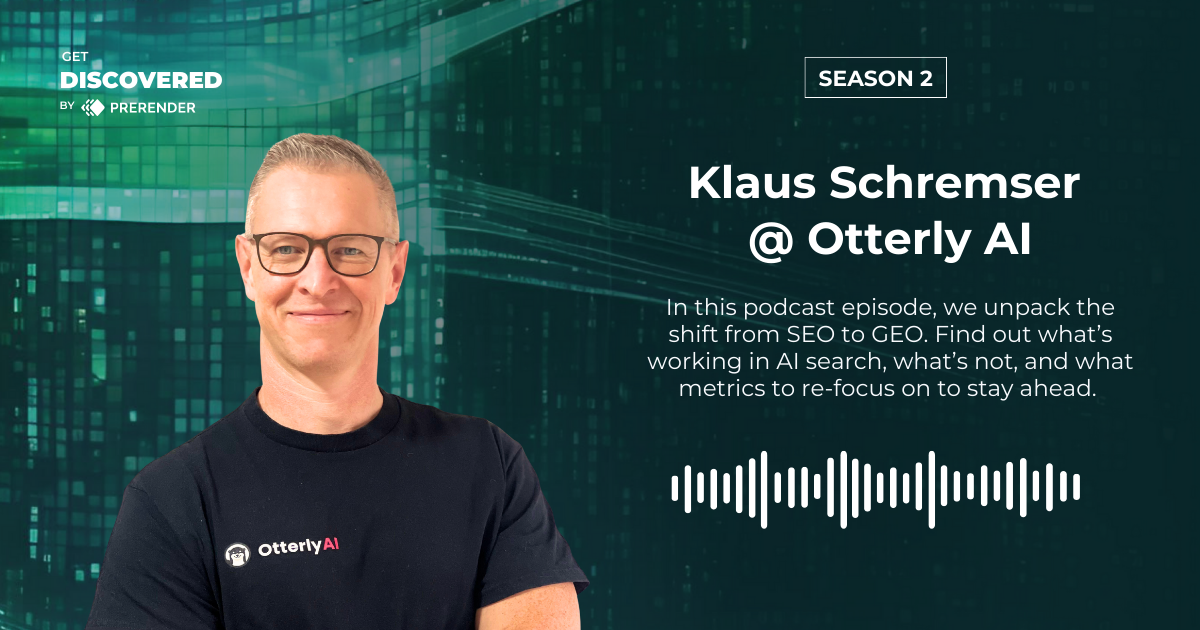
The rules of online discovery are being rewritten in real-time, and most businesses are still playing by the old playbook. Klaus Schremser, co-founder of Otterly AI, joins us for the first episode of Season Two of the Get Discovered podcast. In this inaugural episode, we dive into what he’s seeing on the front lines—both as someone helping companies navigate AI search and as a founder struggling with the same challenges.
This conversation is about identifying gaps, calling out misconceptions, and pinpointing what actually works when traditional metrics start falling apart.
Watch the full conversation, or read on for a summary.
The Market Is Shifting Faster Than Anyone Expected
Remember when everyone thought ChatGPT was going to completely dethrone Google? That narrative has gotten a lot more complicated. According to recent data from SimilarWeb, Gemini’s web traffic has jumped from around 6% to 22%, while ChatGPT dropped from 90% to 65%.
“Google is coming back. Or, comeback is maybe a little bit of a big word because Google is already so huge,” Klaus said. “But as ChatGPT picked up the chase and was really after them, now Google is trying to put some countermeasures into it.”
The takeaway? The market is too volatile for confident predictions. What works today might not work next month. And that uncertainty is exactly why businesses need to start learning the rules of this new game now, not later.
The False Comfort of Familiarity
One of the biggest problems Klaus sees with clients is that they’re bringing SEO assumptions into a completely different playing field.
“It should never have been named SEO. It should have been ‘Google optimization,’” Klaus says. “There was only one search engine that you really had to care for. Now businesses have to refocus on several AI engines.”
And it’s not just multiple platforms. Google itself now consists of three different approaches: traditional search with blue links, Gemini, and Google AI Overviews. The old playbook of ranking #1 on Google doesn’t guarantee visibility anymore.
The problem gets worse when teams start measuring their AI visibility. According to Klaus, many companies ask AI search engines about their own brand, and as a result, get their brand back—assuming they’re doing great.
“We have a very nice saying in Austria. It translates badly, but I’m still saying it,” Klaus explained. “How you shout into the woods, it echoes back. If you’re asking for your brand, you get your brand back. So it gives you a false impression that you’re super visible.”
Further reading: why Popken Fashion Group uses Prerender.io for their AI visibility.
What SEO/GEO Metrics Still Matter? And What Metrics Don’t?
The metrics that drove SEO strategy for two decades are losing their predictive power.
Klaus pointed to several metrics that teams still cling to, even though they don’t reflect the full reality.
What Matters Less
- Page rank: Being #1 in traditional Google search doesn’t mean you’re ranking high in AI searches. The correlation has broken down.
- Organic traffic: The old way of looking at traffic data in Google Analytics doesn’t capture what’s actually happening. “We have 70,000 to 80,000 visitors per month and only 700 to 800 visits from ChatGPT where people clicked on the citation,” Klaus said. “However, there are studies that say this is actually only 1% of the people who had a conversation on ChatGPT. So if you multiply it by 100, you come to 80,000 people discussing topics that are relevant for.”
- Conversion rates: Attribution is messier than ever. Klaus shared his own experience: “I bought my electric vehicle recently. I didn’t buy it over AI searches—ChatGPT didn’t give me a buy link—but I researched it. When I had my three favorite ones, I only took the ones that ChatGPT referred me to. Then I just opened the browser and typed in the brand name. The conversion is gone.“
So what should teams focus on instead?
- Brand mentions over URL rankings
- Citation frequency, or how often your content is being pulled into AI responses
- Share of voice across different prompt categories
- AI crawler traffic, not just traffic from human web visitors. (Prerender.io is a way you can do this.)
Further reading: SEO vs. GEO vs. AIO: Understanding the New Search Landscape
A Hack for LLM Visibility: Wikipedia
Getting onto Wikipedia isn’t easy for a small startup. Most entries get deleted quickly. But Klaus and his team made it happen. And it had an immediate impact.
“AI confused us with another company that has a similar name,” Klaus explained. “We hired a consultant to get us onto Wikipedia. Since then, AI better understood what we are because it always looks to Wikipedia—not first, but very often.”
Cost? $250 plus the effort of working with the consultant and securing the news coverage to support the entry. For a bootstrap startup, that’s a bargain compared to traditional marketing channels.
The Problem with Attribution
“I’m legitimately clueless about how we do attribution now,” host Joe Walsh admitted during the conversation. “It’s not that traditional metrics aren’t relevant anymore, but I think it’s something where we need to figure out how we fill out more detail in the picture.”
Klaus agreed: “The conversion rate is the biggest problem because there is not really a specific conversion rate replacement when you talk about AI search. The only one is someone who clicked on the citation links and came to my website, but that only covers 1% of users.”
This is the uncomfortable truth: we’re flying blind on some of the most fundamental business questions. How do we measure ROI? How do we attribute the investments we’re making into content? How do we know what’s working?
The answers aren’t clear yet. But waiting for perfect clarity means ceding ground to competitors who are learning by doing.
Why JavaScript Rendering is Crucial for AI Search Visibility
Here’s something most teams aren’t thinking about: AI crawlers don’t render JavaScript the way Google does.
“OpenAI has around 100 partnerships with huge media companies,” Klaus pointed out. “But when it comes to crawling your site, AI is not good at rendering JavaScript. Software solutions like Prerender.io come into play, where you should think about pre-rendering and making it easily accessible for AI crawlers to read your content.”
And it’s not getting better anytime soon. “These are companies whose profitability is nonexistent,” Joe added. “The idea that they’re going to add compute resources to start pre-rendering for their web search, which they’re already losing money on, is just not going to happen.”
Bottom line: if your site is JavaScript-heavy and you’re not pre-rendering, AI crawlers probably aren’t seeing your content properly. That’s a fixable problem, but only if you know it exists.
What Gets Worse Before It Gets Better
Klaus didn’t sugarcoat the challenges ahead.
- Smaller brands will struggle more. “What gets harder for smaller brands is that bigger brands automatically get better cited. You are working against billions of data sets.”
- Data accuracy remains questionable. Without access to something like “ChatGPT Search Console” showing real user prompts, teams are making educated guesses about what questions their customers are actually asking.
- The paid ads question. At some point very soon, advertising will become part of the AI search revenue model. What that looks like—and whether it destroys user trust—remains an open question.
“What happens if a competitor appears in an answer about you because they paid for it?” Klaus asked. “Can you trust the answer? I don’t know. We will see another disruption—or maybe eruption—of how AI visibility works.”
The Agentic Website Future
One of the most interesting ideas Klaus shared was about agentic websites: sites that don’t just serve static content but actually communicate with AI agents.
“Imagine pre-render as the middleware between the user or the agent coming to your website,” Klaus suggested. “You’re not just giving them a pre-rendered website, but you’re actually able to talk to the agent that is visiting you.”
Picture this: an AI agent from ChatGPT comes to your surfboard shop looking for the best board for a specific user. Instead of just scraping static data, your site acts as an agent itself—engaging in a conversation, understanding the specific needs, and making a case for why your product is the right fit.
“Your websites become agentic websites. They can talk back,” Klaus said. “If your website becomes an agent and talks back to the agent that comes from OpenAI and says, ‘Hey, we have the best surfboards in the world, especially for Joe because Joe has this right leg in front and does these crazy tricks on the waves,’ then the seller says, ‘Yeah, you’re right. We are buying with you.'”
Given how fast things are moving, it’s closer than we think.
Klaus’ Key Takeaway? Start Now, Even If You’re Not Ready
If there’s one message Klaus hammered home throughout the conversation, it’s this: waiting for perfect clarity is a losing strategy.
“Start early or start now. Learn and stay ahead of the game,” Klaus said. “Even if you can’t commit the full budget or time, write an article, try something, look into the data, try some tools, do some smaller initiatives, and see if it changes somehow.”
The reality is that AI search “is unfortunately harder than SEO,” as Klaus put it. But the alternative—ignoring it until you’re forced to pay attention—is worse.
“The best time to plant a tree was yesterday,” Joe Walsh said. “The second best time to plant a tree is today.”
Klaus agreed: “Absolutely. It will come. Or, it is here.”
Want to learn more about AI search visibility? Subscribe to the Get Discovered podcast for more conversations.
To connect with Klaus, find him on LinkedIn, where he regularly shares insights about what’s working in AI search. Or check out Otterly AI for a free trial to see how your brand actually shows up across AI platforms.
And if you’re running a JavaScript-heavy site, make sure those AI crawlers can actually read your content with a solution like Prerender.io.