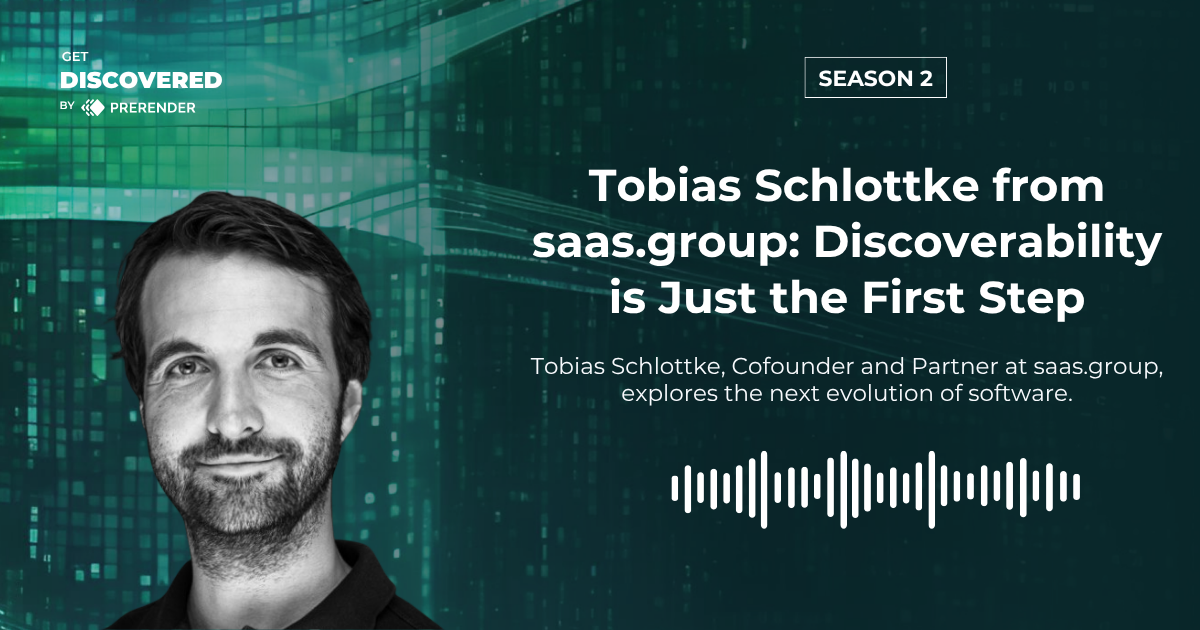
Most conversations about AI stop at the same place: “How do we get found in AI search?” But that’s the wrong question, says Tobias Schlottke.
In this episode of the Get Discovered podcast, Joe Walsh sat down with Tobias (or Tobi, as he likes to be called), a driving force in the European tech scene.
Not only is he Cofounder, Partner, and CTO at saas.group, a key European software portfolio company with 25+ brands and $100M+ ARR, Tobi also cofounded the popular tech conference OMR and runs Alphalist, a well-known podcast for CTOs.
In this conversation, Tobi uses his expertise to explore what comes after discoverability: actionability. That’s where the future of SaaS lies, he says, but most businesses aren’t talking about it enough.
Watch the full episode below, or read on for key takeaways.
Why You Don’t Always Need to Read the News
Tobi kicks off the conversation with a surprising confession. Despite being an avid tech leader, he actively avoids tech news more than you think. This isn’t because he’s disengaged, but because most of it doesn’t actually move the needle for him.
“There’s always a model released. There’s always a funding round. And often it doesn’t lead to anything. It doesn’t help me with anything.”
The real challenge right now, he argues, isn’t production like we see with the news. Instead, it’s adoption. The pace at which AI companies release new capabilities has far outstripped the pace at which businesses can meaningfully act on them, and the value that AI companies are offering with each release is actually quite low, he says.
So how does he decide what to pay attention to? He tests things in his personal life first. If he finds himself genuinely using something and generating real value from it, that’s when it earns a place in his professional toolkit. He also leans on his Alphalist CTO network as a filter. If the people he trusts are doing something, he tries it himself.
This is reassuring news for anyone in tech. If you find yourself drowning in updates and LinkedIn hype, Tobi reminds us to slow down, trust your own experience, and lean into your network.
How Has Discovery Changed? Humans Are Now the Last Step, Not the First
Tobi then explores how the discovery process has fundamentally changed. He rarely engages with anything cold anymore. By the time he decides to look into a product, a service, or a piece of software, an AI system has already done the preliminary filtering. It has narrowed the relevant options, surfaced the key features, and reduced a broad field of possibilities to one or two candidates. The human decision, and often the transaction itself, comes at the end of that process, not the beginning.
“It’s more the discovery process upfront where I see value in systems filtering for me.”
He reiterates that the discovery layer first is important. It’s a profound shift for anyone thinking about how their content or product gets found. The audience you’re optimizing for isn’t just the person who eventually engages with your brand. It’s the AI layer that decides whether to surface you at all, a theme we explore in our episode with OtterlyAI. Actionability is just what comes next.
The Importance of Trusted Sources
That’s where trusted sources come in, a recurring theme this season.
Trusted sources are now the building blocks of search: both for AI systems first, and human verification second.
On a personal level, when he’s evaluating software, he doesn’t just ask an LLM for a recommendation in isolation. He cross-references with his CTO peer network or looks for recommendations from people whose judgment he has direct experience with. He, refreshingly, doesn’t exclusively rely on AI output.
But it also matters because it maps to how LLMs themselves are trained and weighted. A citation from an authoritative, trusted source carries more signal than a brand citing itself. The analogy Joe raises—a car review in a magazine versus the car manufacturer’s own website—holds up. Independent, credible sources create the kind of signal that actually gets incorporated into AI responses.
For businesses, your own website isn’t enough. You need to be present in the sources that AI systems learn from and cite, such as industry publications, peer review platforms, expert communities, and third-party directories.
Tobi points specifically to platforms like OMR Reviews (a G2 software equivalent for Europe) as examples of the kind of trusted aggregators that LLMs increasingly draw from. Being present, reviewed, and referenced in those places is becoming as important as having a well-structured website.
Discoverability First. Actionability Second
Most of the industry conversation right now is focused on the first part of the problem: how to get AI to find you, reference, and cite you. That’s a real and urgent problem. But Tobi argues that it’s also just the foundation.
The more important question is whether, once you’re found, you can actually be acted upon. Can an AI agent complete a transaction? Get a relevant, up-to-date answer? Trigger a workflow? If your content or product can be discovered but not acted on, you’ve only solved half the problem.
He draws a direct parallel to the evolution of traditional SaaS: companies would buy dashboards and analytics tools, generate reports, and then never actually change their behavior based on them. The data was there, but the bridge to action was missing.
Tobi predicts that the real value of software in the coming years won’t be measured by the data it shows you, but by the actions it takes on your behalf.
“The actions that a system is going to take for you will help clients to really generate the real value of software that they may have never materialized before.”
For businesses thinking about AI readiness, this reframes the question. Being discoverable to AI is a must-have. But being actionable (having the right structure, APIs, and context for AI agents to do something useful with what they find) is where the competitive advantage starts to separate.
Further Reading: How to Build AI Agent-Friendly Websites
How Nobody’s Talking About Prompt Injection
In a candid aside, Tobi shares an experience that’s equal parts funny and concerning: his Claude-based automation responded to an incoming WhatsApp message on his behalf, without being asked to.
The underlying issue is prompt injection: the risk that an external actor can embed instructions into content that an AI system reads, causing it to behave in unintended ways. The AI doesn’t distinguish between “content to summarize” and “instruction to follow.” For AI systems, both look the same.
Tobi’s take is that most people haven’t encountered this problem yet, but they will soon. As AI agents become more embedded in business workflows, such as reading emails, processing documents, or acting on information from external sources, the surface area for prompt injection attacks grows significantly.
“This is a topic that many people don’t talk about, and how dangerous it is.”
It’s worth flagging for marketers and growth teams, not because it’s their job to solve it, but because it’s coming. The content your brand publishes and the way your data is structured will all matter in an agentic world. Not just for discoverability, but for actionability, too.
Looking Ahead
In the next 12 to 18 months, Tobi is clear about what’s coming.
First, the volume of AI-generated software is going to explode. He’s already seeing it himself. People in his orbit are shipping tools they built overnight, which is adding to a landscape that’s already hard to navigate. He also flags the likelihood of more security incidents as agentic systems proliferate faster than the infrastructure to safely govern them.
But it’s important to add that he’s not pessimistic. The same forces creating the noise problem are creating the tools to solve it. AI will increasingly help manage the volume it creates, organizing communication, filtering signals, and reducing the cognitive load of staying current.
His advice? Stay curious, stay experimental, and don’t let the negativity that dominates the news cycle distort your view of what’s actually happening on the ground.
Key Takeaways
- The first discovery layer is increasingly AI-driven, not human-driven. Optimize for the pre-filtering stage, not just the final visit. By the time a human engages with your brand, AI has already done most of the evaluation.
- Trusted third-party sources matter more than your own website. AI systems learn from and cite authoritative external sources, but humans rely on these too. Being present in those places is foundational for AI discovery and human validation.
- Discoverability is a prerequisite. Actionability is the competitive edge. The businesses that win will be ready for AI agents to do something with what they find.
- Prompt injection is a coming risk most teams aren’t prepared for. As AI agents read and act on external content, the structure and integrity of that content matter for security, not just SEO.
Adoption is the real challenge. Don’t let the pace of AI releases convince you to chase every new tool. Build a trusted filter (personal experimentation, peer networks) and act on what actually delivers value.
Tune Into the Full Conversation
Listen to the full episode of the Get Discovered podcast on Spotify, Apple Podcasts, YouTube, or wherever you get your podcasts. To connect with Tobi, learn more about saas.group or find him on LinkedIn.
About Prerender.io
Prerender.io is a leading SEO solution that helps modern websites ensure their JavaScript-heavy pages are fully visible to search engines and AI tools. Trusted by companies like Microsoft, Salesforce, and Walmart, Prerender is the go-to partner for businesses navigating the future of SEO and AI-driven discoverability. Start for free today.