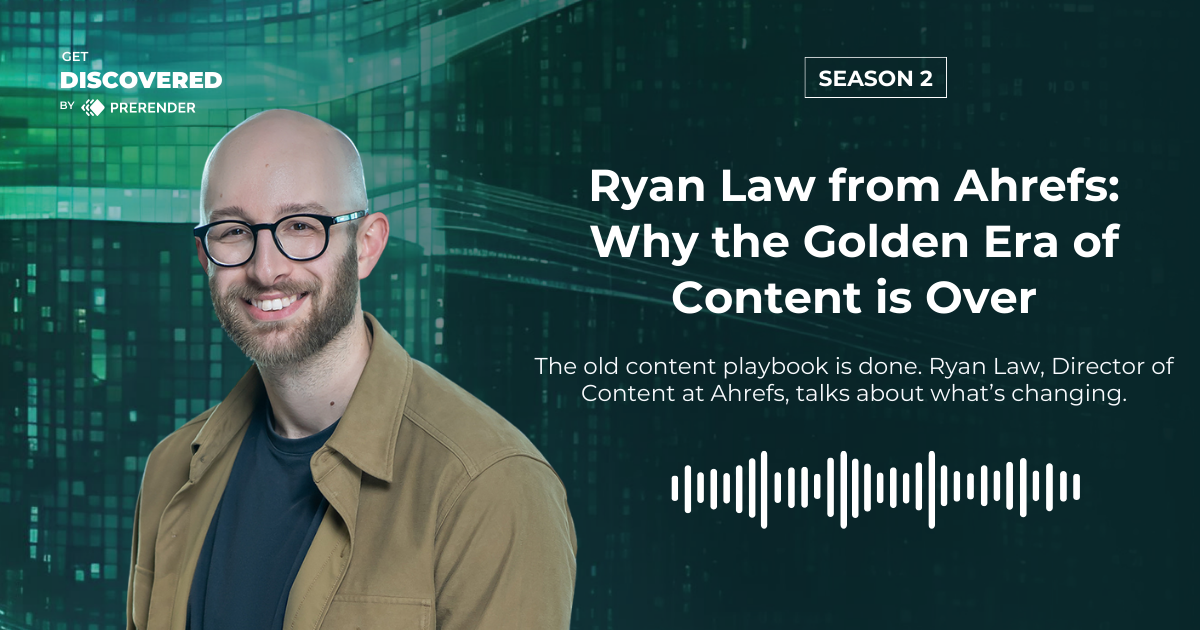
Ryan Law is the Director of Content Marketing at Ahrefs, one of the most widely read SEO blogs in the industry. It’s one of the clearest examples of a content empire built on the old model that really worked: high-volume, targeted keywords, and perfect on-page optimization.
But now, Ryan is saying this model no longer works.
In this episode of the Get Discovered podcast, Joe Walsh sits down with Ryan to talk about what’s breaking for content teams because of AI, why the attribution metrics everyone’s been reporting on are the wrong ones (and his unique take on this), and what content marketing leaders should refocus on instead.
Watch the full episode below, or keep reading for a summary of the conversation.
AI Overviews Are Killing Clicks, Even If You Rank First
If you’ve sensed that your content is working harder for less return, the numbers back you up.
Ahrefs’ own research shows that AI Overviews are intercepting clicks that previously went to ranked pages. The search position hasn’t changed, but now, people aren’t clicking through.
What’s actually disappearing is the URL click itself. Instead, AI tools are synthesizing the content and answering the question, but aren’t sending anyone to the source directly. You may still influence a purchase through AI tools, Ryan says, and people are likely buying heavily (himself included). But measuring any of these conversions through direct clicks, as we did before, is increasingly impossible.
Note: despite this, your rankings in search engines are still important. LLMs are increasingly pulling from the top five positions in SERPs.
The Content That’s Losing the Most Traffic to AI
Ryan is unusually well-positioned to understand who suffers most from this shift because Ahrefs is the archetype.
“Companies that are hardest hit are those that have historically had a ton of search traffic from very informational, top-of-funnel queries.”
As one of the top industry leaders, Ahrefs has published thousands of pages covering the full landscape of SEO education with near-perfect search optimization. Yet, despite doing everything right the old way, they’re seeing clicks go down every month. If that’s the situation at one of the most technically capable content operations in the industry, it’s an environmental shift for everyone else, too.
Key takeaways for content leaders: the volume-and-optimization playbook that drove traffic growth for the better part of a decade has fundamentally changed its unit economics.
How Ahrefs Is Adapting Its Content Strategy
Ahrefs isn’t abandoning content by any means. But Ryan is shifting the company’s content marketing strategy.
Here’s what he’s doing instead:
1. Research over volume
Ahrefs now has an in-house, full-time data scientist on the marketing team. The focus is on original data and proprietary insights that can’t be synthesized by AI because they didn’t exist anywhere before Ahrefs published them. As we’re hearing throughout the podcast from guests like Noah Greenberg, Alain Schlesser, and more, original research is the content that content marketers should double down on—rather than targeting keywords. Original data is the content being cited by LLMs, media, and other blogs, as it earns presence in a way that a well-optimized explainer article no longer reliably does.
Further reading: what 100M+ pages reveal about how AI systems choose your content.
2. Distribution beyond owned channels
Another key theme we’re seeing in the podcast: third-party presence over owned pages. Channels like guest posts, partnerships, review sites, creator collaborations, and LinkedIn are where Ahrefs’ team is seeing surprising traction. The logic is that if an AI search tool synthesizes content from across the web, being on your website is less valuable than being on many websites. Third-party presence is a must-have to prioritize, even over your own pages.
Why Click Attribution Is the Wrong Metric for AI-Era Content
Another aspect that Ryan focuses on is his unique approach to content attribution… not worrying too much about it. While this approach isn’t new for him, it’s an increasingly common take from others in the industry—and it’s aging surprisingly well in the AI era.
Ahrefs doesn’t obsess over attributing specific customers to specific content. They use self-reported attribution (i.e., asking new signups how they found out about the product) and a few directional heuristics. Ryan frames this as a feature rather than a limitation.
In his opinion, there’s an inverse relationship between how easily a marketing tactic can be attributed and how long it remains useful.
“If it’s very easy to say, yes, this is definitely working, then in short order, everyone is going to do that.”
The channels with the longest shelf life, like sponsorships, events, thought leadership, and brand, are the ones that require faith. You believe they work because the logic holds, not because the dashboard proves it. This has always been true. What’s different now is that the tactics that were easy to attribute (organic search clicks) have now become harder to attribute, which is forcing a reckoning on teams that built their reporting around traffic metrics.
And as Alain Schlesser from Yoast discussed in his episode, the fixation on clicks was always a proxy metric. The business goal was never actually to get clicks—it was to drive consideration, intent, and purchase. Perhaps AI has just broken the shortcut measurement of this that has existed all along.
Yes, AI Search Still Runs on SEO Fundamentals
One of the clearest points Ryan makes is about how companies are misframing their AI search strategy. Most businesses are thinking about AI SEO (or GEO, or AEO—whichever term you prefer) as an entirely separate channel. And while there are aspects of AI search that are certainly different, Ryan argues that this is the wrong approach. At the end of the day, it’s still very much SEO.
“I think people are downplaying the impact of traditional search indices on AI search in a very, very big way.”
When someone runs a query in ChatGPT or Perplexity and gets a web-sourced answer, that answer comes from a search index. The LLM is using RAG (Retrieval-Augmented Generation) to pull real content from the web. The infrastructure that makes AI answers possible is the same infrastructure traditional SEO has always worked with, and most SEOs speak openly about this, like Peter Rota on the podcast.
But this means that, despite Ryan’s shifting strategy, crucial SEO fundamentals like building topical authority, creating original content, earning high-quality backlinks, and distributing content across reputable third-party sites matter for AI search, too, of course. The tactics that sound newest (LLMs.txt, content chunking, entity optimization) are real, but they’re a second-order concern compared to the fundamentals.
This is also why certain technical SEO tools matter more, not less, in this environment. If AI crawlers can’t render your JavaScript-heavy site, they can’t index the content. And content that can’t be indexed can’t be cited. Making your content visible to AI crawlers is the baseline.
The Next 12-18 Months: Why AI Spam Will Be Harder to Filter Out
In every episode, we ask guests for their prediction of what’s to come over the next year or so.
In Ryan’s case, he’s worried about content volume. And specifically, he says that the scale of AI-generated content is already high quality, and it will only get better. His recent Claude Code experiments left him convinced that automating good, research-backed content is here to stay.
What does this mean for content marketers? A coming flood of content that sounds (even more) human, synthesizes ideas coherently, and occupies the same search positions and AI citation pools that hand-crafted content is competing for.
The people and teams who will navigate this well are those who hold something that can’t be automated: genuine original data, real institutional knowledge, earned perspectives, and the distribution networks to get those things seen.
What He’s Optimistic About
Despite everything, Ryan’s genuinely enthusiastic about what’s on the other side of this transition.
For him, the most exciting change is what AI enables for individuals. He’d wanted to learn to code for ten years and couldn’t break through the learning curve. Over the past few weeks, he rebuilt his personal website from scratch—the first time he’s ever built exactly what he wanted without being constrained by a CMS.
“I suddenly feel like I have superpowers.”
This new ability to build things you couldn’t before, learn faster, and move with more autonomy is real for content marketers, too. The people who will win are those who stop mourning the playbook and start experimenting with what the new environment makes possible.
About Ryan Law
Ryan Law is the Director of Content Marketing at Ahrefs, one of the most widely read SEO and content marketing blogs in the industry. Previously CMO at Animalz, he grew the blog to over 1 million page views on the strength of opinionated, perspective-driven content. He oversees Ahrefs’ blog, research, and a newsletter with 284,000 subscribers, and published the data showing AI overviews reduce clicks to top-ranking pages by 58%. Connect with Ryan on LinkedIn or listen to the full conversation.
About Prerender.io
Prerender.io is a leading SEO solution that helps modern websites ensure their JavaScript-heavy pages are fully visible to search engines and AI tools. Trusted by companies like Microsoft, Salesforce, and Walmart, Prerender is the go-to partner for businesses navigating the future of SEO and AI-driven discoverability. Start for free today.