The brands winning in AI search aren’t always the ones with the best content. They’re the ones AI systems can actually read and trust.
That’s the central finding from a study conducted by Prerender.io and OtterlyAI analyzing 100M+ pages across eight global enterprise brands. This article breaks down what the data shows, helping you pinpoint what content AI systems prefer, seven key findings to include in your content strategy, and the three structural changes that are moving the needle on AI search visibility.
The Dataset: Eight Global Brands and 100M+ Pages
To conduct this study, the Prerender.io team analyzed 100M+ pages across eight anonymized brands in Prerender.io’s database, pulling the URLs most frequently requested by ChatGPT over Q4 2025. These are real machine-to-site retrieval requests, as opposed to pageviews or rankings, which means every signal in this dataset reflects exactly what AI systems are actively looking for.
The brands were selected to represent a range of industries, company sizes, and geographies. Each brand averages a minimum of 75M+ page renders per year, ensuring the dataset is large enough to surface reliable patterns. The brands chosen span ecommerce, SaaS, automotive, sports, fashion, and government to evaluate a variety of industries.
| Brand | Industry | Most-Requested Page Types |
| Brand 1 | Multinational automotive company based in Europe | Informational blog posts, homepage |
| Brand 2 | Leading jewelry brand headquartered in the US (ecommerce) | Homepage, FAQs, comparison guides, product blogs |
| Brand 3 | International sports organization | Streaming pages, live event pages |
| Brand 4 | Global athletic leisure brand in 50+ countries (ecommerce) | New collection pages, homepage, FAQs, discount pages |
| Brand 5 | American department store (ecommerce) | Top-selling product pages, homepage |
| Brand 6 | Global API/SaaS platform headquartered in the US | Technical documentation (exclusively) |
| Brand 7 | Government / legal entity based in Europe | Documentation, homepage |
| Brand 8 | Global fashion retailer headquartered in Europe (ecommerce) | Homepages (US + international), store locator, product pages |
The OtterlyAI team then supplemented this retrieval analysis with citation data, examining how these brands actually appear in AI-generated answers across ChatGPT, Perplexity, and Google AI Overviews. Seven findings emerged. Here’s what they show.
Key Finding #1: AI Systems Reward Easily Answerable Pages
This is the clearest finding from the study across each brand. The most-retrieved URLs across all eight brands fall into a surprisingly narrow set of content types:
- Evergreen editorial content and buying guides
- FAQs and comparison pages
- Technical documentation and API references
- Category and collection pages
And these pages share a common characteristic. They answer a specific “what,” “how,” or “why” question without requiring the reader, or the AI crawler, to navigate anywhere else.
This is a significant reframe for marketing teams accustomed to thinking about content in terms of the funnel or site hierarchy. AI visibility is not about where a page sits in your navigation. Instead, it’s about whether the page can reliably serve as an answer on its own. Whether it’s a blog article answering a specific question, a comparison page performing a this vs. that analysis, or a product category page, the pages that AI systems return to repeatedly are the ones that deliver complete and clearly structured answers. This also supports why AI systems seem to prefer knowledge base and help center content: they typically answer a single question.
Key takeaway: write your content in a clear, question-answer format, focus on optimizing your knowledge base documentation, and ensure pages answer a specific “what,” “how,” or “why” question.
Key Finding #2: Address Questions Directly, Especially for Ecommerce Brands
This analysis also surfaced differences in how AI crawlers and humans navigate pages—especially for ecommerce. For example, when humans shop, they browse product detail pages in detail. But when AI systems research products on ecommerce sites, that’s not always the case.
Instead, AI systems consistently prefer:
- Category and collection pages to answer “what are the best options?”
- FAQ and sizing guides to answer “what should I get?”
- Store locators and availability pages to answer “where can I buy this?”
Individual product pages still matter, but far less than traditional SEO priorities suggest. The AI-driven shopping journey starts earlier and at a higher level of abstraction. Users receive AI-generated summaries before they ever visit a brand’s site, and those summaries are built from category-level and editorial content, not PDPs.
This means the pages most critical to AI visibility are often the ones least optimized for it. Category pages, FAQs, and buying guides tend to be JavaScript-heavy, dynamically loaded, and lower on the priority list for technical maintenance, precisely where AI systems are most likely to encounter incomplete or missing content.
Key takeaway: prioritize your category pages, FAQs, and buying guides for both content completeness and technical rendering. These are the pages AI systems are currently using to build shopping summaries. Focus your efforts here, rather than on PDPs alone.
Further reading: AI Indexing Benchmark Report for Ecommerce
Key Finding #3: Third-Party Sites Matter For Citations
This is the finding that should concern brand and growth leaders most.
In OtterlyAI’s analysis of one of the world’s top athletic brands, OtterlyAI looked at over 1,300 citations across 25 test queries. Here’s the breakdown of the share of citations per source:
- Independent review sites: 8.6%
- Reddit: 7.2%
- YouTube: 4.6%
- Brand’s own domain: 4.2%
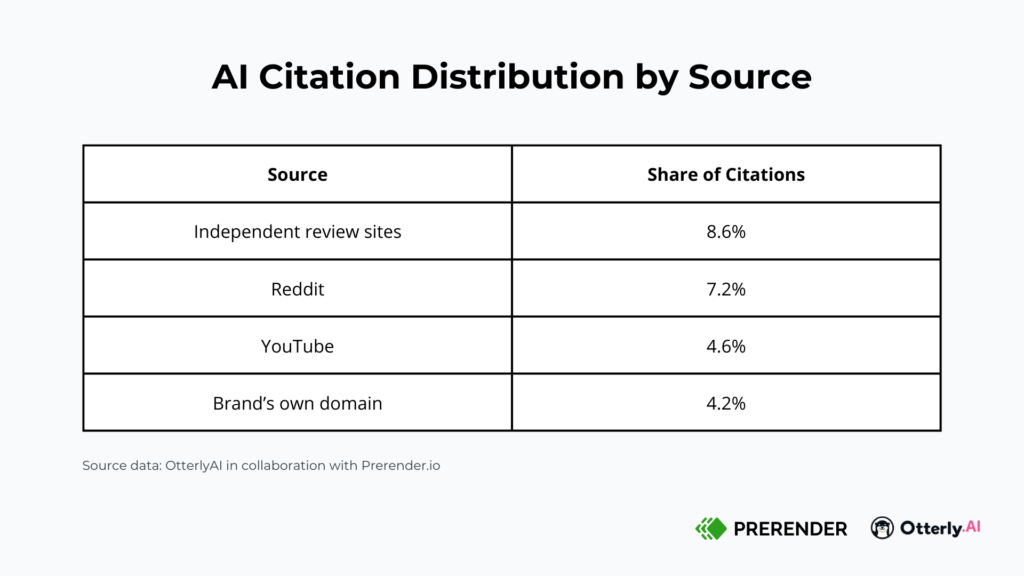
Evidently, the brand’s own domain holds less weight than community platforms like G2, Reddit, or YouTube. And this isn’t an isolated case. Broader research from OtterlyAI across 1M+ citations across ChatGPT, Perplexity, and Google AI Overviews confirms the same pattern across industries: community platforms and third-party sources capture the majority of AI citations, regardless of how strong the brand’s owned content is.
AI systems are designed this way. They increasingly want to sound confident in their answers, and often prioritize third-party validation and community consensus over brand-owned marketing content. That’s a newer structural difference with LLMs, and your strategy has to account for this.
Key takeaway: Build a deliberate third-party presence strategy. Identify the review sites, forums, and media outlets AI systems are already citing in your category, and prioritize earning coverage there.
Key Finding #4: Technical Accessibility Is Crucial for AI Visibility
Across this dataset, one issue emerged as the most consistent barrier to AI visibility. Brands were inadvertently blocking AI crawlers with configurations originally written for traditional search engines.
When AI crawlers can’t access your site, you’re not partially visible to AI systems—you’re completely invisible. This means no citations, no mentions, and no influence on AI-generated answers. This issue is more common now because AI crawlers are newer and less familiar to infrastructure teams than Googlebot, and they’re frequently caught by security policies that predate their existence.
Before any content or strategy work, confirm that your site is actually accessible to major AI crawlers. It’s the single highest-leverage action available to brands that have invested in content and are seeing no AI visibility, and it requires a conversation with your technical team, not a content brief.
For JavaScript-heavy sites specifically, the gap between what a human sees and what an AI crawler can read is often significant. Server-side rendering or prerendering (serving AI crawlers a fully rendered, stable version of each page) is often the most reliable fix.
Key takeaway: have your technical SEO team evaluate your technical performance, particularly your JavaScript rendering and robots.txt.
Further reading: How to Conduct a GEO Audit on your Site
Key Finding #5: Homepages Are Gateways, Not Destinations
Homepages appear frequently among the top-requested URLs, and sometimes as the single most-retrieved page. But the retrieval pattern tells a specific story.
AI systems hit the homepage and then fan out immediately. The homepage appears to serve a defined function to confirm brand identity, establish authority, and act as a starting point for deeper retrieval. However, the sharp drop-off in retrieval volume after the homepage means that what happens next determines the majority of your AI visibility. A strong homepage paired with inaccessible supporting content is nearly as limiting as no homepage presence at all.
Key takeaway: treat your homepage as a crawl entry point, not a destination. The real AI visibility work happens on the supporting pages it leads to.
Key Finding #6: You Need a Different AI Search Strategy for Each AI Platform
Not all AI platforms behave the same way, and this has direct implications for where marketing teams focus their energy.
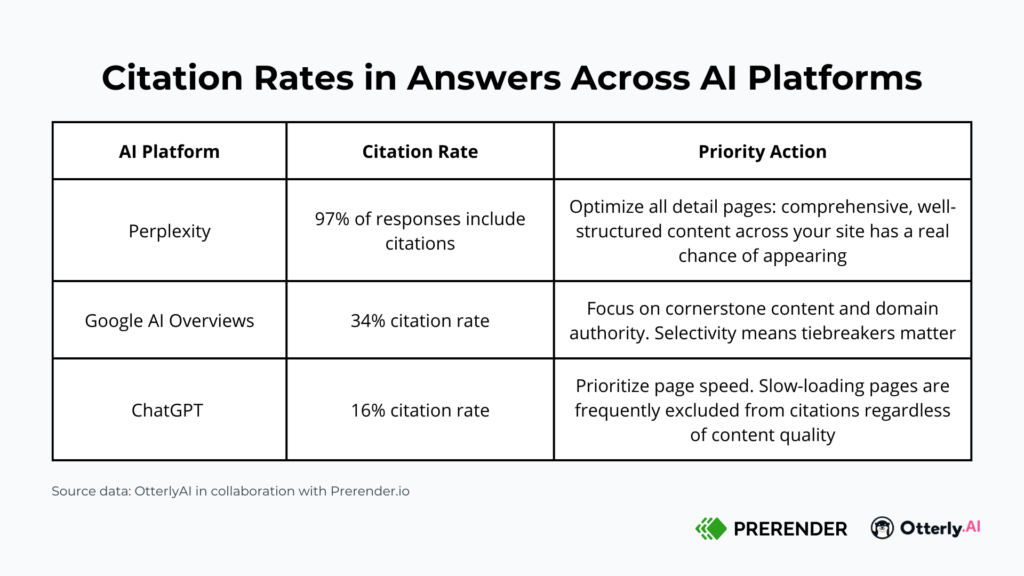
Proprietary data from OtterlyAI shows the following:
| AI Platform | Citation Rate |
| Perplexity | 97% of responses include a citation |
| Google AI Overviews | 34% of responses include a citation |
| ChatGPT | 16% of responses include a citation |
Perplexity has a near-universal citation rate, meaning that most answers include a citation, and that you have a higher chance of being cited in their response. This implies that, for a Perplexity-focused strategy, if you create comprehensive, well-structured content across all detail pages, it has a real chance of appearing.
However, this is not equally the same for other AI platforms: Google’s AI Overviews has a 34% citation rate, whereas ChatGPT only has 16%. This means that you may need to adapt your AI search strategy accordingly. For AI Overviews, focus on cornerstone content and domain authority. While for ChatGPT, prioritize page speed—it doesn’t like waiting around for slow-loading pages.
A single “AI search strategy” will underperform, and it may need to change every few months. A brand might have strong Perplexity visibility today and near-zero ChatGPT presence tomorrow—not because of content differences, but because each platform has different technical and editorial preferences.
Key takeaway: monitor AI visibility by platform, not in aggregate. A blended view of “AI traffic” will mask where you’re winning and where you’re invisible. You can use AI search analytics tools to do this.
Key Finding #7: International Brands Can Experience Greater Visibility Issues
For brands operating across markets, AI systems don’t default to your primary locale. They actively retrieve language-specific URLs, country variants, and localized pages, and appear to match content language directly to the user’s query language.
A French user asking about your product in French will receive an answer drawn from your French-language content, not an English page. If your localized pages are incomplete, slow to load, or invisible to AI crawlers, that market segment is effectively unserved by AI search—regardless of how strong your primary-market presence is.
Key takeaway: run an AI crawler accessibility check on your localized pages. Incomplete or slow-loading country variants may be entirely invisible to AI systems.
What Does This Mean for Revenue? A Note on Attribution
The reality is that clean attribution between AI visibility and revenue doesn’t quite exist yet. For now, AI systems remain a black box for most analytics stacks, and click-through rates on AI answer engines are significantly lower than traditional search.
That said, the directional evidence is building. Bain & Company’s February 2025 research found that 80% of consumers now rely on AI-written results for at least 40% of their searches. A separate Bain report from November 2025 found that 30–45% of US consumers already use AI specifically for product research and comparison, and that AI now accounts for up to 25% of referral traffic for some retailers. The research and purchase consideration stages are already happening inside AI platforms before buyers ever reach a brand’s site.
And in this specific dataset, the directional data continues: one ecommerce brand saw AI crawler requests more than double from Q1 to Q3 2025. Over the same period, publicly reported earnings increased by 109.7%, accounting for nearly $80M in additional revenue. We’re not claiming causation, but the parallel is consistent with a model where AI visibility amplifies demand rather than directly creating it.
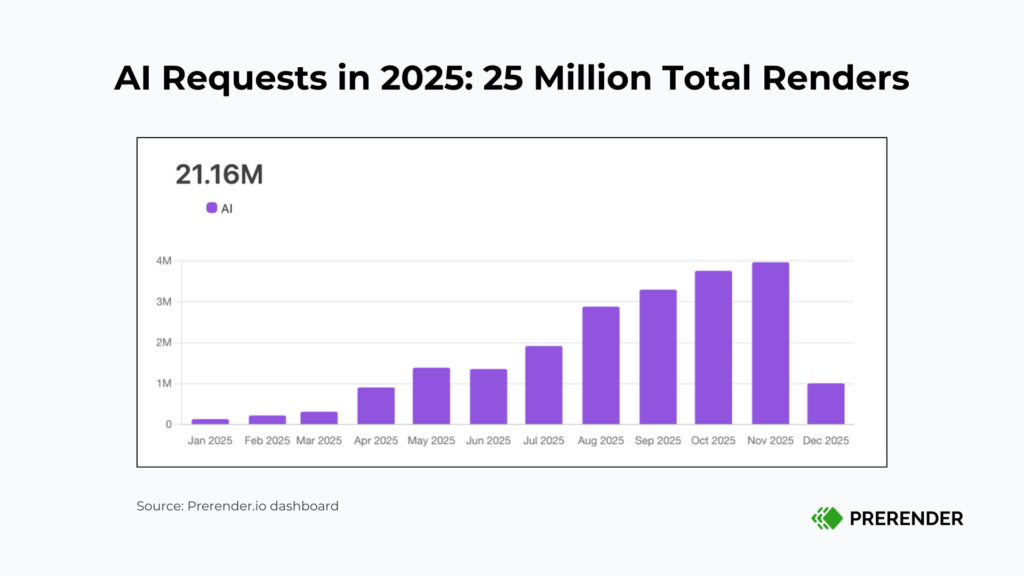
Data source: Prerender.io dashboard of a key enterprise client.
The more useful frame: think of AI visibility as revenue protection and a growing acquisition channel, even if it’s not entirely attributable yet. If AI systems retrieve your content incorrectly, partially, or not at all, your brand is excluded from the consideration set before the funnel begins. Buyers arrive at competitors already shaped by AI summaries your brand had no part in.
A Measurement Framework
Given the current attribution gap, here’s a framework for how you can track AI visibility:
1. Brand share of voice across AI platforms.
Track how often your brand is mentioned across ChatGPT, Perplexity, Gemini, and Copilot relative to competitors. This upstream signal predicts downstream revenue influence before it shows up in your analytics. OtterlyAI is the most practical tool we’ve seen for making this measurable.
2. Citation monitoring on owned pages.
This tells you whether your content is being accurately represented. Being cited with incorrect pricing or outdated product details is actively damaging at the moment decisions are being formed. Use Screaming Frog to surface a full URL list, then audit your presence on third-party platforms like G2, Capterra, and Trustpilot.
3. AI crawler behavior.
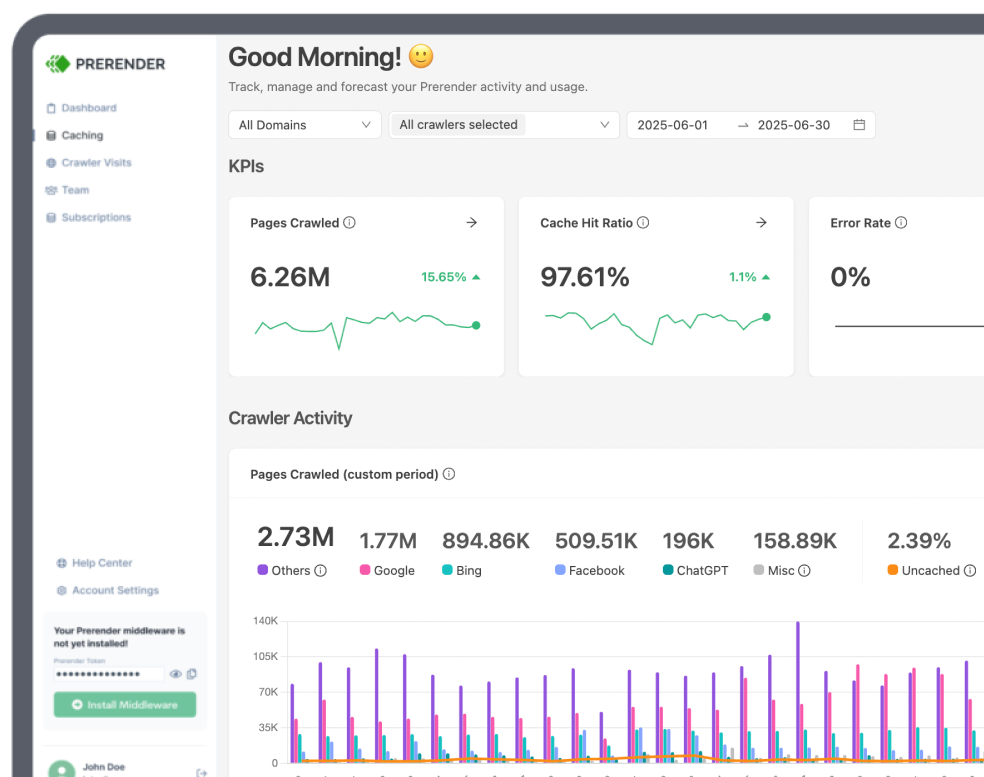
Measuring AI crawler activity shows whether your site is being actively retrieved by AI systems at all. Growing retrieval volume—like the doubling observed in our ecommerce case—is a directional signal worth tracking alongside business outcomes. You can use a solution like Prerender.io to provide visibility into your AI bot behavior, particularly in comparison to search or social crawlers, and identify whether pages are being served to AI crawlers in a fully rendered state.
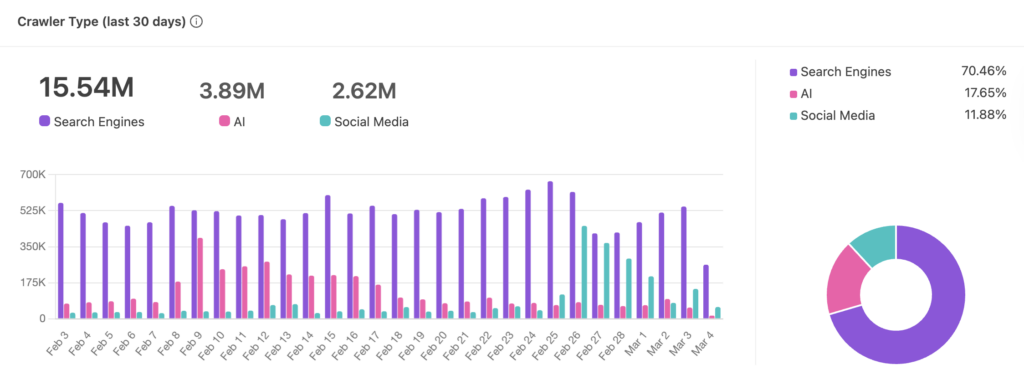
Prerender.io dashboard of an anonymized client
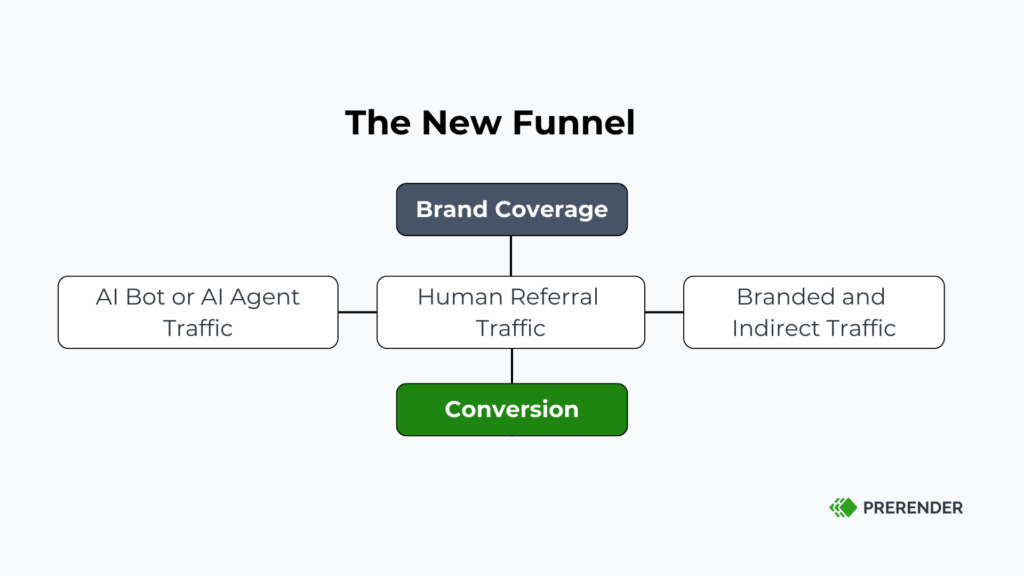
4. Branded and direct traffic.
This captures the indirect effect. Users who encounter your brand in AI-generated answers often don’t click through immediately—they find you later via direct or branded search. Correlating share of voice trends against branded traffic growth gives you a reasonable proxy for AI-driven influence, even without direct attribution.
Summing Up: Three Things That Impact Your Presence in AI Search
1. Technical retrievability is a must-have, not a nice-to-have.
AI systems can only work with content they can access and read completely. For JavaScript-heavy sites, serving a fully rendered, stable version of each page to AI crawlers isn’t optional. It’s table stakes for everything else.
2. Content needs to answer, not just attract.
The pages AI systems return to are self-contained, clearly structured, and genuinely useful. If a page can’t serve as a complete answer to a specific question on its own, it’s a weak candidate for AI retrieval.
3. Third-party presence isn’t optional.
The majority of AI citations come from outside your owned properties. Brands that earn coverage in the review sites, community platforms, and media that AI systems trust will win disproportionate attribution—regardless of how strong their own content is. Influence without attribution still influences. But it’s more valuable when it’s yours. Ensure that you are prioritizing your third-party presence as a core foundation of your marketing strategy.
FAQs
What types of pages does ChatGPT retrieve most often?
Self-contained pages that answer a specific question without requiring additional navigation: FAQs, buying guides, technical documentation, category pages, and evergreen editorial content.
Why is Reddit cited more than brand websites in AI search?
AI systems are built to prioritize third-party validation and community consensus. Reddit provides peer-generated, question-and-answer content that maps directly onto how AI systems construct responses.
Does page speed affect AI search visibility?
Yes, particularly for ChatGPT. Faster-loading pages are more likely to be included when an AI system has limited time to retrieve and render content.
What’s the biggest technical barrier to AI visibility?
There are a few: bot-blocking configurations and JavaScript rendering. Many enterprise sites inadvertently block AI crawlers with security rules originally written for traditional search engines, resulting in complete invisibility. JavaScript-heavy sites also block AI crawlers from accessing your pages in the first place. Server-side rendering or prerendering with Prerender.io can be a solution here.
How do I track whether AI systems are citing my brand?
Monitor brand share of voice using an AI search analytics tool like OtterlyAI. For citation accuracy, combine a Screaming Frog URL crawl with manual audits of third-party review platforms.
Does strong SEO automatically translate to strong AI search visibility?
In many ways, yes, but this isn’t guaranteed. The brands winning in AI search aren’t always the ones with the strongest content, which is a core ranking factor for traditional SEO. They’re the ones whose pages are technically accessible, structured to serve as direct answers, and with a strong third-party presence.