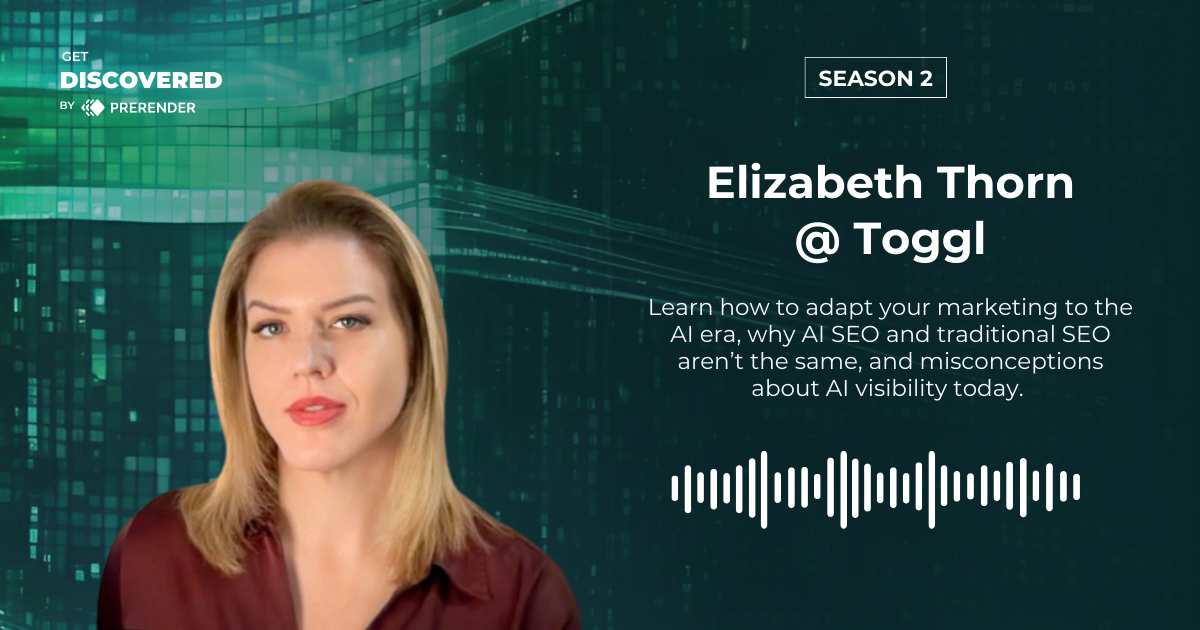
AI is impacting every business department, but arguably, marketing has been one of the hardest hit. For Elizabeth Thorn, Head of Marketing at Toggl, a suite of productivity tools, this shift has been anything but gradual. Speaking with host Joe Walsh on the Get Discovered podcast, Elizabeth breaks down what marketing looks like now for her and her team, how they’re adapting to the AI era, and why SEO is more about brand management than ever before.
Watch the full episode below, or keep reading for a summary of the episode.
The Core Problem: You’ve Lost Control of Your Message
For the past 15 to 20 years, the SEO playbook was clear. Optimize your site, build authority, earn backlinks, and you could largely control how your brand showed up in search. That model is broken, Elizabeth says. Good SEO has always been about ecosystem marketing. But it’s different now.
AI models don’t just read your website. They synthesize information from Reddit threads, G2 reviews, YouTube teardowns, LinkedIn posts, third-party blogs, and more. If there are 50 Reddit forum posts or YouTube videos saying your customer service is poor, no amount of on-site optimization will fix how an LLM describes your brand.
“I think the misconception is that we have more control than we do,” Elizabeth said. “We’re used to controlling our message on our owned properties. That’s just not the case anymore.”
This is one of the fundamental challenges of AI search visibility that many marketing teams are still catching up to. The question isn’t just whether search engines can find your content. It’s what are they saying about you when they find it?
What Toggl Is Doing Differently With Marketing
Elizabeth joined Toggl in late 2023. In less than two years, the content strategy shifted dramatically. Here’s what changed:
1. They narrowed their keyword focus
Instead of chasing hundreds of terms across broad topic clusters, Toggl now focuses on what Elizabeth calls “tier one keywords.” These are high-intent terms that are actually tied to revenue.
The research behind those terms goes beyond traditional tools. They’re looking at subreddits, LinkedIn conversations, and customer interviews to understand the language their ICP actually uses, not just the terms that rank well in Ahrefs.
This is the kind of practitioner insight that aligns with AI SEO optimization best practices: AI search rewards content that genuinely matches how real people talk about their problems, not just how marketers have historically framed keywords.
2. They killed high-volume content production
Toggl used to publish 30–50 blog posts a month. That era is over. “We’d rather publish one phenomenal piece per month that gets cited everywhere than 12 mediocre posts,” Elizabeth said.
The research backs this up. A significant portion of the sites that show up in LLM citations rarely rank in Google’s top results, suggesting that volume doesn’t equal visibility in AI search. On the other hand, quality, citability, and authority do.
3. SEO became an ecosystem, not a silo
This might be the most important shift. At Toggl, the partnerships manager now sits in on SEO and content strategy calls. Paid, content, partnerships, and product marketing all coordinate around shared campaigns. SEO has always been holistic, but omnichannel SEO is taking precedence.
Why? Because how AI synthesizes your brand reputation depends on what’s being said about you everywhere, not just on your own site. Third-party mentions, influencer content, and review platforms all feed into the picture that an LLM builds of your brand.
“SEO isn’t just SEO in isolation anymore,” Elizabeth said. “It has to be integrated with our partnerships manager, our content manager, our product marketing… All of it.”
Metrics That Are Losing Meaning
Elizabeth and Joe also discuss metrics that may not have as much value anymore—organic traffic being an obvious one. With the rise of zero-click search, users get answers without ever visiting your site. Traffic numbers that once signaled success can now be misleading signals, a similar topic we explored in our conversation with Klaus-M. Schremser, cofounder of AI search tool OtterlyAI.
But Elizabeth highlighted something more actionable: Toggl built AI referral tracking into their CRM to actually measure what’s converting, not just what’s clicking. The result? About 50% of deals closed last quarter came from AI search. And they tend to be larger accounts (teams of 50+ users). Organic traffic dropped roughly 10% year-over-year, but the pipeline held steady.
That’s only visible if you have the tracking in place. For JavaScript-heavy SaaS sites, this starts at the foundation: making sure AI crawlers can actually access and index your content in the first place. Most AI crawlers can’t execute JavaScript, which means a significant portion of your site may be invisible to them by default. Winning in the AI search era may mean shifting focus from vanity metrics to technical foundations.
Common Misconceptions About How AI Impacts SEO
Elizabeth further delved into her misconceptions about AI visibility today.
Misconception 1: AI search is the same as traditional SEO.
At least not entirely. The fundamentals of quality content and technical foundations apply, but the playbook has changed. Technical factors like structured data, semantic markup, and dynamic rendering are more important than they were before. But increasingly, factors like brand management, new channel monitoring, and cross-functional collaboration are fundamental for a strong AEO presence. The content checklist that worked in 2022 won’t produce the same results in 2026.
Misconception 2: If AI recommends you, it’s a quality lead.
Not always. Elizabeth referenced a point from SEO agency Growth Plays, which noted that a significant portion of leads coming in via AI search are unqualified because users are blindly trusting what LLMs tell them without doing their own research. AI answers can hallucinate pricing, misrepresent features, and recommend products based on outdated information.
This is exactly why making sure your content is crawlable and up-to-date for AI matters so much. If an AI model is pulling cached or incomplete information about your product, it affects the quality of leads coming through the door.
What Gets Worse Before It Gets Better
When asked what part of the discoverability landscape she expects to deteriorate first, Elizabeth didn’t point to a technical factor. She pointed to internal panic.
“There’s a lot of time being wasted on things we just don’t have answers to,” she said. “Teams are going to waste resources trying to game a system that isn’t fully defined yet.”
Her advice: form a hypothesis, take three concrete next steps, communicate proactively with leadership, and adjust as you learn. Don’t wait for a perfect playbook that doesn’t exist yet.
The teams that will win in AI search are the ones who get back to first principles now: building genuine authority, creating content that answers real questions, and making sure their technical foundations are solid enough to be discovered in the first place.
The Takeaway
AI discovery isn’t about hacking a new algorithm. It’s about building genuine brand authority consistently across every surface where your audience is paying attention.
That means great content. It means a product that actually delights users. It means showing up in places you don’t have complete control: reviews, communities, and third-party publications. And it also means making sure the technical side is airtight. If AI crawlers can’t access your content, none of the above matters.
“You have to earn people’s trust in a really authentic way,” Elizabeth said. “And I think that’s actually more exciting for marketers. It gets us back to what our jobs are actually about.”
Tune Into the Full Conversation
This recap only scratches the surface. Elizabeth goes deeper on ecosystem marketing strategy, how Toggl tracks AI-driven pipeline, and what she’s watching closely over the next 12–18 months. Listen to the full episode on Get Discovered to dive deeper into AI, SEO, and online discoverability.
Subscribe wherever you get your podcasts so you don’t miss future episodes with business leaders navigating these AI discovery challenges in real time.
Make Sure AI Can Actually Find You
If you’re rethinking your AI visibility strategy, the technical foundation matters just as much as the content strategy. AI crawlers can’t execute JavaScript, meaning your product pages, blog posts, and key landing pages may not be indexed in AI search at all.
Try Prerender.io for free to make sure your content is visible to ChatGPT, Perplexity, Claude, and every other AI search platform your buyers are using.