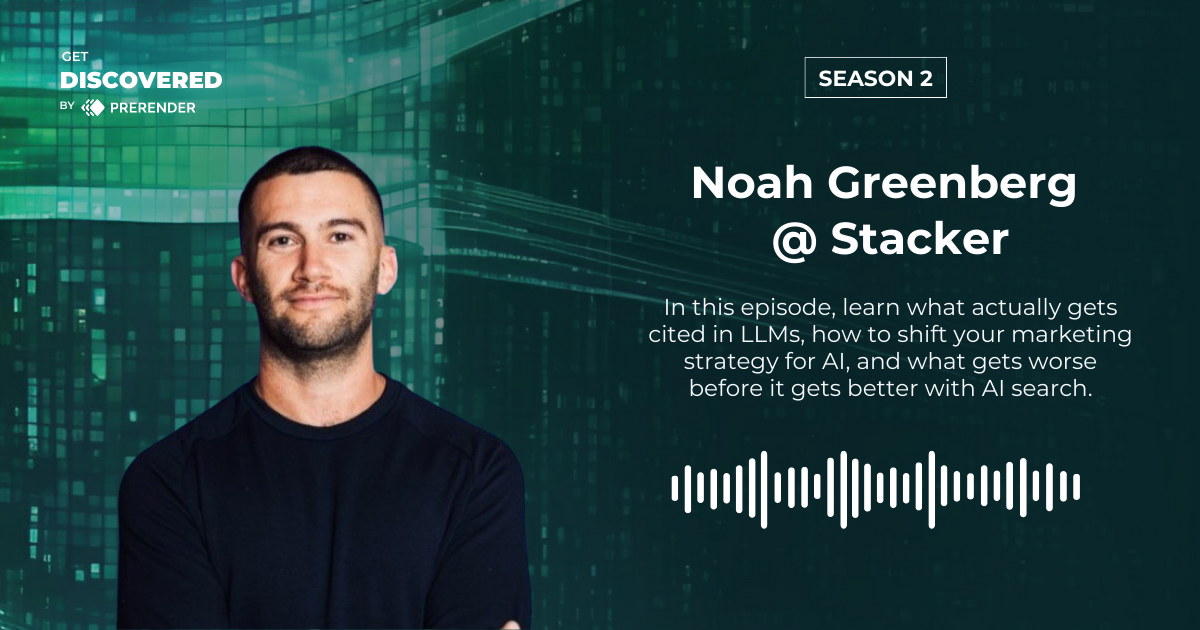
In this episode of Get Discovered, we sat down with Noah Greenberg, founder and CEO of Stacker. Noah brings a fresh, unique perspective on how AI is impacting the content marketing space, and shares his thoughts on what brands need to do to stay visible.
Watch Noah’s full conversation with us here, or read on for the Sparknotes.
Why No One Can Track Attribution Anymore
We start each Season 2 episode by asking guests to share one thing they learned this week in AI news. Noah kicked off our conversation by highlighting Kevin Indig’s piece “The Great Decoupling,” a data-driven analysis that exposes a paradox rattling marketing teams everywhere: clicks are declining, but leads are increasing at statistically significant rates.
This isn’t a minor shift. It’s the collapse of the attribution model that’s defined digital marketing for a decade.
“We’ve lived in this world with Google where the number of clicks you get equals the amount of business you get,” Noah explained. “But we’re entering this new world where maybe someone searches on ChatGPT and sees a brand mentioned, but they don’t click through to you. Maybe they go to Google and click there, so Google gets the attribution. Or maybe they go directly to your website, and we all know how accurate direct traffic can be in analytics.”
This attribution crisis is a recurring theme throughout Season 2. “I genuinely don’t know how to measure attribution anymore,” host and Prerender.io CEO Joe Walsh admitted in our episode with Klaus Schremser from Otterly AI. It’s not just a technical problem: it’s an existential one for teams trying to prove ROI and make strategic decisions.
When we asked Noah how widespread this understanding is across the industry, he didn’t sugarcoat it: “If we were in a baseball game where the ninth inning is when everyone realizes there’s more than just trackable clicks, I would say we’re in the third inning at best.”
Translation: most marketing teams are still optimizing for a world that no longer exists.
How Your Content Strategy Should Change Because of AI
For now, one of the biggest mistakes Noah sees brands making is being stuck in a mindset that worked for the past decade: creating content meant to convert. “A lot of brands are still building content where when you read that article, you’ll say, ‘I think I’d like to buy this product,'” Noah said. “What we’ll call content marketing or demand gen content.”
But in his opinion, LLMs have made this type of content largely ineffective. When someone searches for “types of shoes I need for running a marathon,” they’re no longer finding brand content. They’re getting an answer synthesized from archived internet content.
The brands winning today are taking a different approach: becoming the media companies their potential customers turn to. They’re telling stories about training regimens of marathon winners or documenting someone’s journey from casual runner to marathon runner. It’s about establishing authority and trust, not driving immediate conversions.
“While a dozen companies have been doing this for 10 years and have nailed it,” Noah noted, “the volume of marketers realizing this is a strong play has snowballed in the past 24 months.”
What Type of Content Actually Gets Cited in LLMs
When it comes to showing up in AI-powered search results, Noah emphasized two consistent patterns over the past six to nine months:
- Uniqueness matters. If there are thousands of pieces of content saying the same thing, LLMs will just give the answer without sourcing anyone. But if you produce a brand new perspective—through subject matter experts, survey data, or proprietary first-party data—that’s what gets cited.
- Data is the cheat code. Whether it’s Redfin publishing home price data or Apollo sharing research on the best time to email a CEO, content with statistics consistently gets cited with proper attribution.
But Noah was careful to add an important caveat: “It changes so frequently right now that I don’t feel comfortable making any blanket statements.” His advice? Do your own primary research. Go into these LLMs, ask queries in your space, and see who’s actually being cited.
From Noah’s perspective, these changes may have some positive benefits. In his mind, AI search might actually level the playing field for newer brands.
“On Google, if you were a startup without good domain authority, it was going to be seven months until you hoped to rank,” Noah explained. “Whereas with these LLMs, you can put out a piece of content, and if it’s great and well-structured and unique, 24 hours later, you can start getting cited. It removes the moat that legacy brands had with SEO.”
Writers Won’t Be Replaced by AI
Despite early scares about AI replacing writers and editors, Noah doesn’t see this happening in brand journalism anytime soon. The economics are just different.
“If you’re a publisher, your business model is ad-supported. You need to make at least a penny more for every piece of content,” he said. “That’s not the case when you’re Salesforce thinking about making five or six great stories that make a potential customer more likely to buy when they’re thinking about a CRM.”
The goal for brands investing in content is to tell unique stories with much lower volume but much higher impact. And that requires human creativity, judgment, and storytelling ability.
The Biggest Misconception About AI Visibility
When we asked about the biggest misconception around AI visibility today, Noah brought it back to attribution—again.
“The amount of money being spent on these products isn’t going down,” he said. “There’s still the same pie, if not bigger. Someone might be suggested your product on ChatGPT, then walk into your store and buy, and you’re never going to know they found you on an LLM. But if you agree that five years from now the amount of searches on these platforms will be way bigger, and billions of decisions will be influenced, then you have to find a way to get behind this strategy. Even if you can’t track the clicks today.”
Looking ahead 12 to 18 months, Noah predicts that the rapid pace of change will actually become more challenging, not less.
“Over the past year, it was generally accepted that no one knew what they were doing with AEO and GEO—these acronyms didn’t even exist a year ago,” he said. “But you’re going to start having people who build credibility and set strategies in stone without acknowledging that the rules will be very different a year from now.”
His advice? If you’re setting an AI search strategy, build in the intention to come back to the table every three months and reassess what’s changed. This isn’t SEO, where the fundamentals remained relatively stable for 20 years.
Further reading: How to Optimize Your Website for AI Search – A Technical AI Optimization Guide
Key Takeaway: What Works Today May Not Tomorrow
Noah left us with one key takeaway: “You have to do your own primary research and recognize that what works today may or may not work six months from now.”
Unlike the early days of Google, where Matt Cutts publicly shared what you should and shouldn’t do to win on Google, OpenAI and Anthropic don’t provide that guidance. There are brilliant people doing primary research and sharing their findings, but every brand needs to test, learn, and adapt continuously.
The game has changed. The question is whether you’re willing to change with it.
To learn more about Stacker, connect with Noah on LinkedIn, or head over to Stacker’s website.
If you’re curious about unpacking the AI visibility crisis we’re all facing, follow the Get Discovered podcast on Spotify, Apple, or on our podcast page to tune into the conversation. We speak with business leaders, marketing experts, SEOs, and CEOs, just like Noah.
And if you’re looking for a solution to help ensure your content shows up on Google, ChatGPT, or Perplexity, Prerender.io is your go-to.