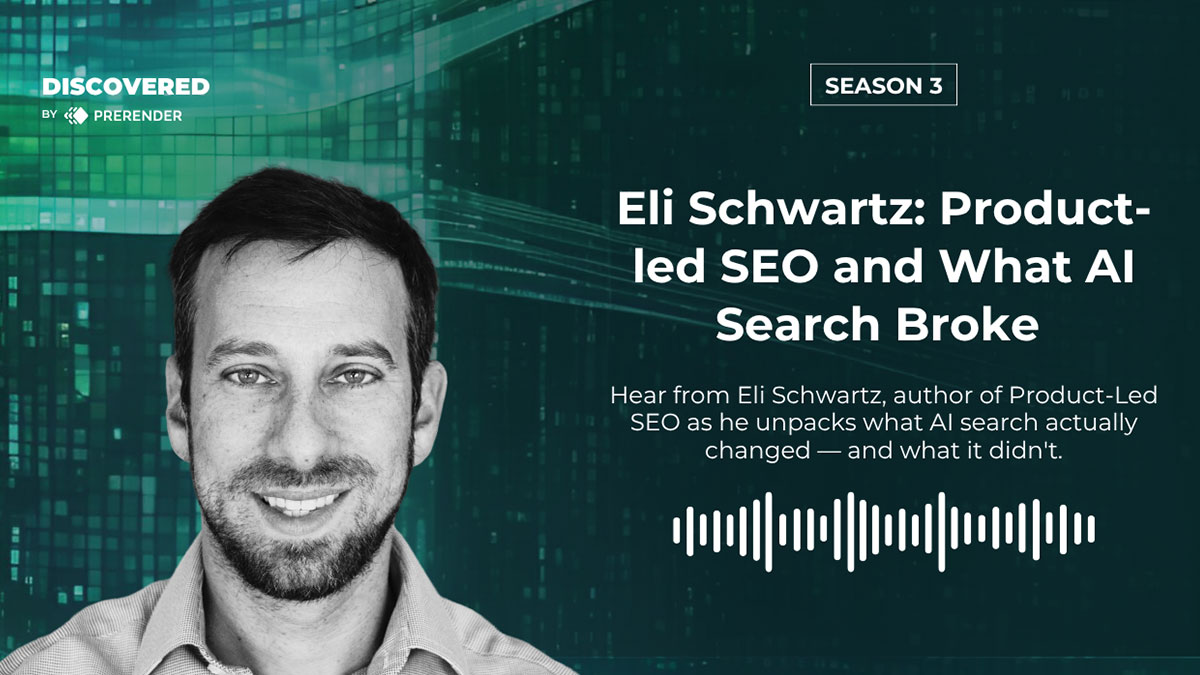
For years, SEO’s job was simple: rank, get the click, own the journey from there. Eli Schwartz, author of Product-Led SEO and strategist who took SurveyMonkey’s organic search from near-zero to a $200M-a-year growth engine, says that doesn’t exist anymore.
Opening season 3 of Get Discovered Podcast, he argued this isn’t a crisis. It’s SEO doing what it always has, adapting to a new interface
Product-led SEO was never about writing more
Five years after his book, Schwartz’s core idea is sharper than ever. Stop building content for the algorithm and start building a product for the searcher.
Most companies still treat SEO as “create for the machine and hope.” Rank, trap the visitor, and figure out monetization later. Product-led SEO starts instead with why someone opens a search bar. What’s their trigger, the job to be done, and the experience that answers it?
That matters more now. Commodity content, the kind re-explained across a thousand sites, is exactly what AI Overviews and AI Mode are built to absorb. An LLM will say it faster and never send anyone to you. The content that survives does something a summary can’t.
SEO, AEO, GEO: Why the label matters less than the system behind it
Schwartz would rather the acronyms didn’t exist. Hiring separate SEO and AEO specialists is, in his view, as mistaken as splitting out “mobile SEO.” But with this much organizational attention flowing toward the terms, they’re probably here to stay.
Where he and host Joe Walsh agreed: the real shift sits one layer down, in discovery and crawling, the systems most teams ignore while staring at rankings. Rankings without a click mean nothing, and being cited by an LLM doesn’t guarantee one either. AI hasn’t stolen SEO; it’s disrupted the top of the funnel SEO used to own.
The head-term/long-tail split is dissolving
Search “hotel prices” and Google folds in your past searches, location, and intent signals until a two-word query behaves like a hyper-specific one. Personalization has erased the line between generic head content and pure long-tail. Anyone still designing a single “average” customer journey should take note, he advises.
The attribution crisis is real
Impressions and rankings, Schwartz argued, were vanity metrics that hid mediocre work for years. Now that AI answers have stripped that cover away, dashboards are flashing red for teams that didn’t get worse. They just lost the metric flattering them.
His fix isn’t a new dashboard. It’s tying everything to revenue and accepting the attribution fog brand marketing has always lived with. Paid media never had to, because Google and Meta had every incentive to prove their own case. Car companies, by contrast, have always trusted that the billboard worked. SEO teams now need to build that same trust, often without the authority to change how they’re measured.
Demand hasn’t changed; people need products and services as much as ever. The pathway has. Teams that can’t tell that story convincingly are the ones getting cut.
Better for users, brutal for marketers
Schwartz believes AI search favours users: shorter journeys and more exposure for niche, quality brands Google once buried as too risky. The tradeoff is less browsing and less serendipitous discovery.
For marketers, the shortcuts are dying. AI can cross-reference a page’s claims against review sentiment, complaint volume, and reputation signals, so buying links and gaming rankings stop working. What survives is real quality and a real audience, which is terrifying or liberating depending on what your growth was built on.
The takeaway
SEO isn’t over. The shortcuts, the vanity metrics, and the assumption that ranking equals revenue are. What’s left is the older, harder work Schwartz has always championed: know exactly who you’re building for, build something worth finding, and defend your results in a language that no longer starts with “impressions.”
Tune in to the full conversation
Listen to the full episode of the Get Discovered podcast wherever you get your podcasts. Subscribe so you don’t miss any conversation on the fundamentals of online discovery and machine experience.
Eli Schwartz is the author of Product-Led SEO and is currently writing Customer Intelligence*, a follow-up focused on how few companies actually understand their customers beyond a persona board. Find him on LinkedIn or at productledseo.com.