Your buyers are building their shortlists inside AI assistants. Ask one for a supplier in your category, and you get an answer, not a list of links. A few suppliers are named, but the rest don’t exist for that buyer
If your products aren’t in that answer, you aren’t in the running. And you may never see the traffic you lost.
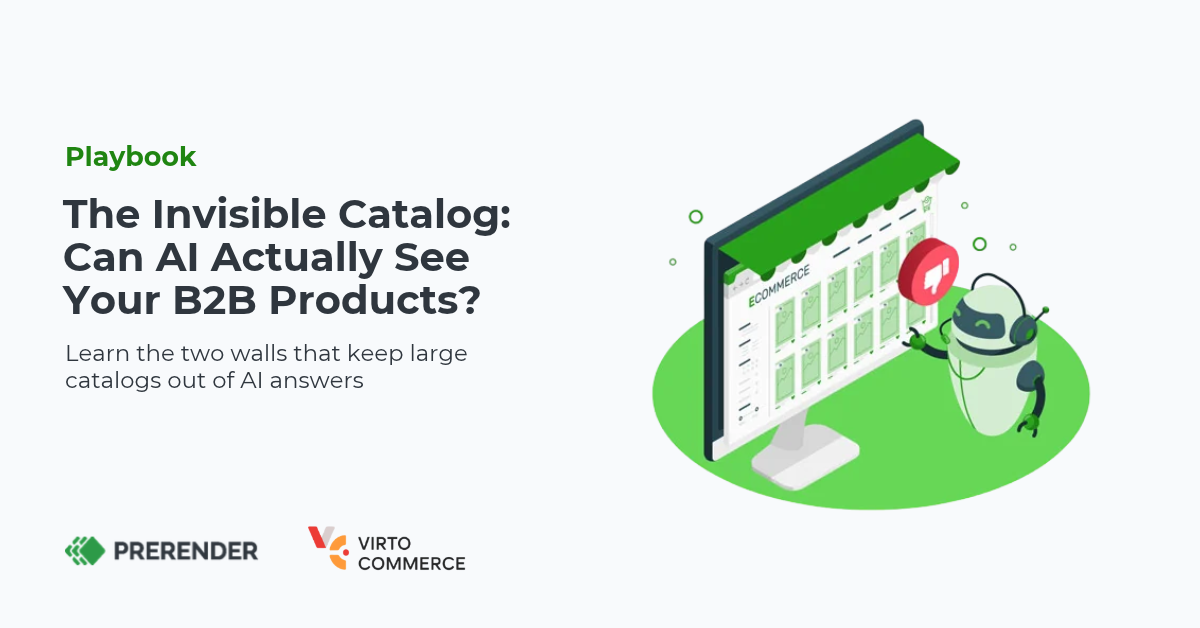
For most large B2B catalogs, the cause isn’t weak content or bad SEO. It’s two barriers between the catalog and the machines doing the reading, and most teams aren’t watching either. We mapped both with our partner Virto Commerce in a new field guide. Here’s the short version.
Discovery moved. Your catalog didn’t.
For 20 years, the job was to rank. Now buyers ask an AI assistant, and it names a few suppliers. The shelf is no longer a results page. It’s the context an AI model can pull together about you when someone asks.
Virto Commerce founder Evgeny Grigul calls where this leads the “dark digital catalog”: catalogs that exist to be read by machines more than browsed by people.
Two walls between your catalog and AI
Machines only recommend what they can read and reach. For most large B2B catalogs, they can do neither.
Wall 1: AI crawlers can’t read it
Modern catalogs run on JavaScript, built for people. GPTBot, PerplexityBot, and most other machine crawlers don’t run it. They read the HTML your server sends and stop there. On a JavaScript-heavy catalog, that’s a near-empty shell with no visible products, no prices, no specs.
Speed makes it worse. Across 18 enterprise retail catalogs and about 3 million pages, 93% took longer than 5 seconds to fully load. Crawlers that do render work on a limited budget, so pages this heavy risk being indexed incomplete, or not at all.
Wall 2: AI crawlers can’t reach it
Even a perfectly rendered page is missing what matters most in B2B. Prices, availability, assortments, and contract terms sit behind a login. Lavazza by Bluespresso kept thousands of customer price lists by hand, one per client. No crawler or agent was ever going to see them.
The answer isn’t to publish everything. In B2B, a product doesn’t fully exist until it sits inside a buyer, a contract, and a region.
“The question is never just ‘can AI see my catalog.’ It’s ‘which version of my catalog should AI see, and where does that stop.’ Oleg Zhuk, CTO, Virto Commerce
Get the full field guide
The Invisible Catalog, written with Virto Commerce, covers:
- A 10-minute AI visibility baseline, plus rendering and entity checks to find the cause
- How to make your catalog readable to AI crawlers without a rebuild, and which pages to prioritize
- How to define a public layer AI can see, keep pricing and contract terms behind the login, and why that isn’t cloaking
- Case snapshots from KW Parts, Lavazza by Bluespresso, HEINEKEN, and Haarshop
- A six-step framework and readiness checklist your team can start this week
Your buyers are already asking. Find out what the machines can see.