You shipped a vibe-coded website over a weekend using Bolt.new, Lovable, or your AI coding tool of choice. Then, you type your site or product name into ChatGPT, and nothing appears, or worse, a competitor shows up in your place. This AI visibility gap has nothing to do with your content quality. It’s how AI-generated websites are built and how LLM crawlers discover, render, and interpret them.
Many AI-built sites rely heavily on JavaScript, creating indexability and rendering issues that affect both traditional search engines and AI search platforms. If AI crawlers can’t access your vibe-caded content, they can’t understand it, or recommend it in AI-generated answers.
Our team has cracked the code on why your vibe-coded website isn’t showing up in AI search and LLMs, and walks you through the specific fixes to improve the SEO for vibe-coded apps: metadata that AI crawlers actually parse, structured data formats that feed language models, and the signal patterns that get products cited in AI-generated answers. Most take under an hour to implement.
TL;DR of How to Make Vibe-Coded Websites Discoverable on AI Search
- AI-website generated tools, like Bolt.new and Lovable, produce React SPAs/websites with client-side rendering by default. When AI bots request a page, it returns an empty HTML shell to crawlers — no content, no headings, no meta tags.
- LLM crawlers (GPTBot, ClaudeBot, PerplexityBot) fetch raw HTML only. They do not execute JavaScript.
- Prerender.io generates static HTML snapshots of your pages and serves them to crawlers on request. No changes to your vibe-coded website codebase required.
- Three additional steps (structured data, descriptive meta tags, clean URLs) reinforce LLM visibility across all major AI search platforms.
AI Search Is Where Search and Transactions Happen
When an LLM cites your product in an answer, the recommendation carries different weight than a sponsored ad or a search result. The model is endorsing you. In early 2025, post-purchase surveys run by Fairing showed a 10x increase in customers citing LLMs as where they discovered a product in six months, not over the years.
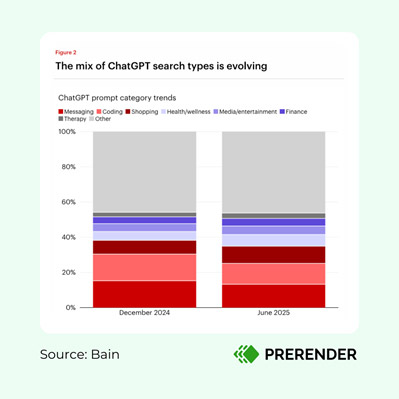
For product discovery specifically, 31% of consumers now prefer AI over traditional search, according to an October 2025 survey of over 1,000 US consumers. Bain even found that shopping activity on ChatGPT doubled in six months, and Shopify reported AI-referred orders grew 11x between January 2025 and early 2026.
And when looking at the AI search conversion rates, ChatGPT referrals converted at 15.9% against Google organic at 1.76% (source). Across a broader sample of sites, Semrush put the average conversion advantage at 4.4x, and a different study showed LLM visitors also spend 68% more time on the site than organic visitors.
The window to establish AI discoverability is open right now, and most of your competitors haven’t thought about it yet. The catch is that if your site was built with Bolt.new, Lovable, Replit, or any similar AI website builder, there’s a structural reason you may not be showing up on search, and it has nothing to do with your content quality.
AI Search vs. Google Search Optimization: How Search Bots Work On JS Content
To understand why vibe-coded apps are invisible to AI search, you need to know how JavaScript rendering for LLMs works and how it differs from Google.
Googlebot loads your page in a headless Chrome browser, executes your JavaScript, waits for content to render, and indexes the result. The process is slow, but Googlebot eventually sees what your users see.
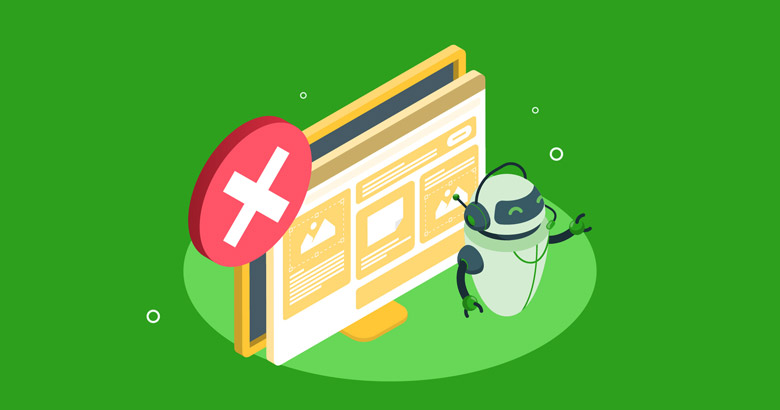
LLM crawlers work completely differently. GPTBot (OpenAI), ClaudeBot (Anthropic), and PerplexityBot send a single HTTP request and read whatever raw HTML comes back. They do not run your JavaScript, wait for your React components on your Lovable site to mount, or follow deferred load sequences. If the content does not exist in the initial HTML response, those crawlers never see it.
Vercel and MERJ confirmed this in a December 2024 study analyzing billions of requests across Vercel’s network. GPTBot fetched JavaScript files 11.5% of the time but showed zero evidence of executing them. ClaudeBot fetched JS files nearly 24% of the time — also without executing a single one. PerplexityBot showed the same pattern.
Google’s own developer documentation puts it plainly: “Not all bots can run JavaScript.” GPTBot, ClaudeBot, and PerplexityBot are all in that category. What they can read is static HTML.
Why AI Crawlers Can’t Read Your Vibe-Coded Website
So, what does this mean for your vibe-coded site’s visibility in AI search? Tools like Cursor, Bolt, and v0 default to React or Next.js with client-side rendering because those web frameworks produce fast, interactive UIs with minimal configuration.
The AI SEO trade-off is that your page’s actual content (product descriptions, features, pricing pages) often lives in JavaScript bundles that only execute in a real browser. Crawl that same page with a raw HTTP request and you typically get a shell: a <div id="root"> and a pile of script tags with nothing inside them.
If you want to go deeper on how AI crawlers differ from traditional search bots, our breakdown of traditional vs. AI crawlers is a useful reference.
What The AI Website Built Tool Shipped vs. What Search Crawlers See
Bolt.new and Lovable both generate React and Vite single-page applications (SPAs) with client-side rendering by default. This default is a platform-level constraint. Lovable’s own FAQ confirms the platform generates React + Vite + TypeScript by default, not Next.js, which means no built-in server-side rendering.
Note: as of May 13, 2026, Lovable offers native server-side rendering (SSR) for websites built on their platform after April 20, 2026. Any websites that were deployed before that are still unsupported. The Lovable SSR isn’t perfect yet, as mentioned by several users on Reddit (Source: this Reddit thread).

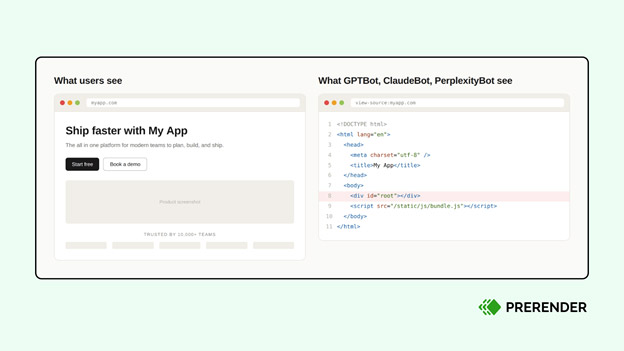
When a user visits your homepage, they see the full experience: hero headline, product features, social proof, pricing, and CTAs rendered cleanly across the page.
Here is what GPTBot, ClaudeBot, and PerplexityBot get when they request the exact same URL:
<!DOCTYPE html>
<html lang="en">
  <head>
    <meta charset="utf-8" />
    <title>My App</title>
  </head>
  <body>
    <div id="root"></div>
    <script src="/static/js/bundle.js"></script>
  </body>
</html>
Your headline, product features, pricing, testimonials, and every piece of visible text on the page live inside that empty <div> after JavaScript populates it. Crawlers see none of it. This is the core reason LLMs are not citing your website even when the content is excellent.
The same indexability issues of vibe-coded websites extend to meta descriptions, structured data, and internal links. In React apps using react-helmet or similar libraries, JavaScript injects these tags after page load. Crawlers see only the fallback, usually empty or generic. Hash-based routing makes things worse: URLs like yoursite.com/#/pricing strip the fragment before reaching the server, so each page cannot be individually requested or indexed.
| What a user sees: A fully rendered landing page with headings, copy, and calls to action. What GPTBot, ClaudeBot, and PerplexityBot see: An empty div and a script tag. |
Like one Lovable builder described: “For humans, this works perfectly. Your browser executes the JavaScript, the page appears, and you never notice the difference.
For search engine bots, it’s a disaster. Most crawlers do a simple HTTP request and read the HTML they get back. They don’t reliably execute JavaScript.
The gap is invisible in Google Search Console because Googlebot eventually renders the JavaScript and indexes the content. There’s no equivalent warning for AI crawlers. Your Google rankings can look healthy while ChatGPT and Perplexity have nothing to cite.
To check what crawlers currently find on your site, run this in your terminal:
curl -s https://yoursite.com | grep -i "title\|meta\|h1\|<p"Or right-click the page and choose “View Page Source”. If the output is mostly empty, or shows only <div id="root"></div> with little readable text, your AI-generated website has the same problem most do.
How Prerender.io Closes the SEO Gap for AI-Built Websites
Migrating to Next.js for server-side rendering to improve your vibe-coded apps’ SEO is a full rebuild. It means leaving the AI builder tools you used, starting a new codebase, and spending weeks on infrastructure instead of product. For most indie builders, that trade is not worth it.
Prerendering your Lovable websites with Prerender.io solves the same problem without requiring a rebuild of your AI-built apps. Prerender sits between your vibe-coded website and incoming crawler requests. When GPTBot or ClaudeBot visits a URL, Prerender.io checks its cache for a pre-rendered static HTML snapshot of that page and serves it. Human visitors continue to get the normal interactive SPA. Crawlers get a complete, readable HTML document with all your content, headings, meta tags, and structured data fully visible.
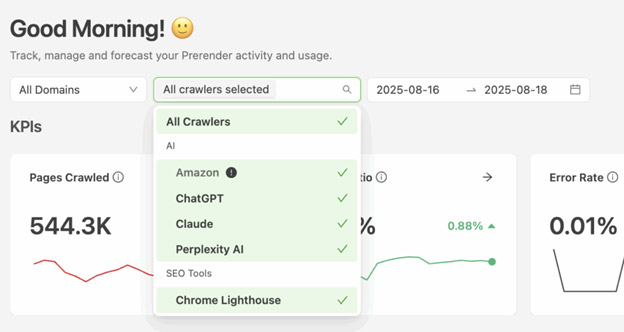
Additionally, Prerender.io supports cache and recache, allowing your Lovable website to deliver fully rendered pages to crawlers in 0.03 to 0.05 seconds. Cache refresh frequency is also configurable depending on your site’s refresh needs. These two functions set Prerender.io apart from HadoSEO.
For Lovable and Bolt.new deployments, Prerender.io runs through a Cloudflare Worker and takes 30 to 45 minutes to set up, without rebuilding the app or adding dependencies. The result is real SEO for vibe-coded apps without touching your codebase.
Prerender.io supports every major crawler powering today’s AI search engines: GPTBot, OAI-SearchBot, ClaudeBot, Claude-SearchBot, and PerplexityBot. For deeper walkthroughs, Prerender has a guide on how to optimize your website for AI crawlers.
3 Tips To Improve SEO for Lovable and Bolt.new Websites Used by SEO Specialists
Prerendering solves the architectural SEO problem of vibe-coded websites. These three steps (used by many SEO specialists) reinforce the SEO and AI SEO signal once crawlers can actually read your content.
1. Write Descriptive Meta Tags for Every Page
AI crawlers use your <title> and <meta name="description"> to understand what a page is about before deciding whether to index it. A title like “Home” gives them nothing. Describe the specific content of each page in plain language. Most AI builders will update these if you prompt them directly and specifically.
2. Add Basic Structured Data
JSON-LD schema markup helps AI systems parse your content accurately. A Princeton study found that GPT-4’s accuracy on content improved from 16% to 54% when structured data was present. For a SaaS site, the Organization schema on the homepage and FAQPage or Product schema on relevant pages is a reasonable starting point. Schema is one of the cleanest signals an LLM can parse, which makes it a strong lever for ChatGPT search optimization and Perplexity SEO rewards the same discipline.
3. Fix Hash-Based Routing if Your App Uses It
Hash-based URLs like yoursite.com/#/pricing doesn’t work with AI crawlers. The fragment is never sent to the server, which means each page can’t be individually requested or indexed. Each page on your site needs its own distinct, descriptive URL. If your Bolt.new or Lovable app uses hash routing, this is worth addressing through the builder before you do anything else.
Get Your Vibe-Coded Website Found in AI Search with Prerender.io
Bolt.new and Lovable are excellent at shipping real products fast. Client-side rendering is a sensible default for interactive apps. Crawlability simply was not part of the design equation when these defaults were set.
If you have shipped on Lovable, Bolt.new, or a similar AI builder and your website is not showing up in LLMs when users search for what you do, the rendering setup is almost certainly why. Run the curl check above to confirm, then try Prerender for free and see what AI crawlers currently find on your vibe-coded app.