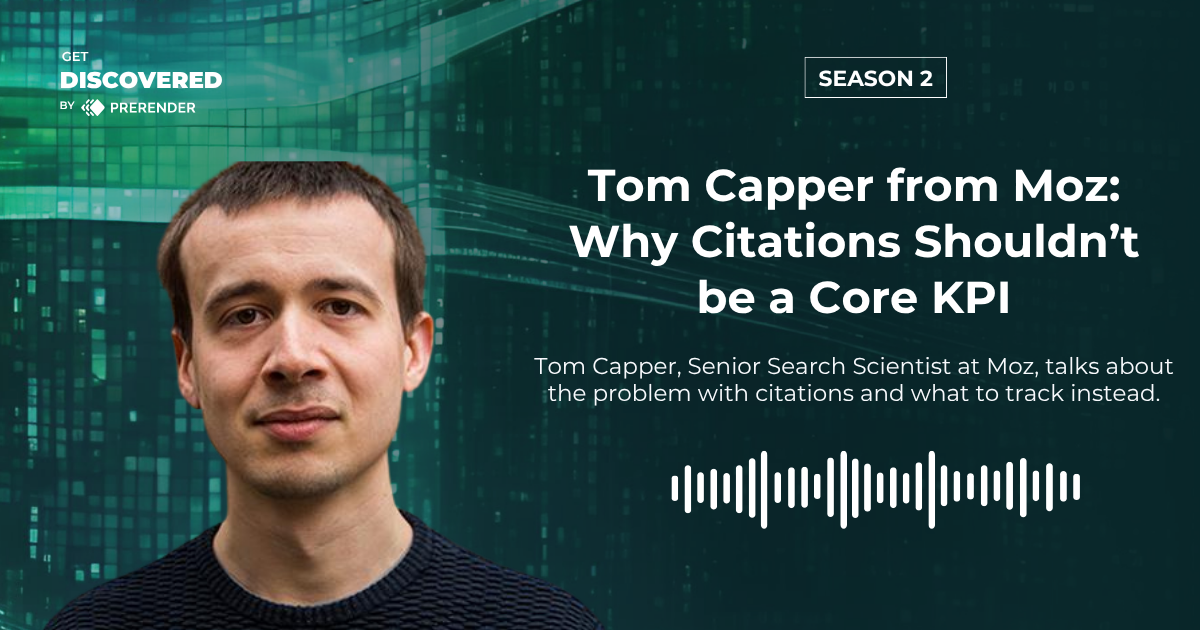
In this episode of Get Discovered, host Joe Walsh sits down with Tom Capper, Senior Search Scientist at Moz. As one of the most trusted voices in the SEO space for quantitative data, Tom digs into what the data is actually telling us about AI’s impact on search visibility, what’s changing (and what’s still the same), and what marketing teams should do about it.
Tom has spent five years building original research into how search works, and he’s one of the few voices in the industry whose predictions tend to hold up over time.
Watch the full conversation below, or read on for key takeaways.
Why Ranking #1 on Google No Longer Guarantees AI Visibility
One of the most striking findings Tom shared from his original research is that, in a study of nearly 40,000 queries, 88% of the links cited in Google’s AI Mode responses don’t appear in the equivalent organic top 10 for the same keyword.
This means that a brand could sit at the top of a traditional SERP, but still be completely absent from the AI response its potential customers are actually reading. It’s important to note that this isn’t always the case, and rankings do still matter. AI systems often pull from the top five search results. Tom is simply saying that rankings don’t guarantee AI visibility.
That’s because AI Mode isn’t just answering a single query. Instead, it’s running what he describes as roughly 20 different sub-searches simultaneously, pulling from a much broader range of sources than any single organic result page. So the content that ranks well for a given keyword may have nothing to do with what AI Mode pulls when it constructs its answer to the underlying question a user is actually asking.
The practical implication for marketing teams: tracking your organic rankings and assuming that tells you something about your AI visibility is becoming increasingly unreliable. Rankings are still important, but these two problems may require different measurement approaches.
Related reading: What 100M+ Pages Reveal About How AI Systems Retrieve and Cite Your Content
How to Rethink SEO as a Brand Channel (Not Just a Performance Channel)
For most of its history, SEO has been measured like a direct response channel. Focus on rankings to drive clicks, which drive conversions, and at the end of the day, everyone reports on traffic. That model is under pressure right now, yet Tom argues that it was always a little misleading.
“There’s a big chunk of SEO that ought to have been thinking about itself as a brand channel probably quite a long time ago,” he told Joe. “What we are doing now is getting exposure.”
With AI Overviews and zero-click search handling more informational queries, the click-through that SEO teams used to count on is happening less often. But that doesn’t mean the value of appearing in those results has disappeared. It just means the value has shifted from the click to the impression.
Tom and Joe discuss a strong analogy here. “If your company invests in billboards, no one asks how many people clicked the billboard. The brand recognition counts.” A significant share of organic search has always worked that way, but marketers just weren’t measuring it in those terms before.
In the context of AI search, this becomes more pronounced. When an AI model recommends your product by name (even without linking to your site), that’s your brand being surfaced in the highest-trust context possible. The person who finds you that way and then visits your website directly is a fundamentally different visitor than someone who clicked the third link in a SERP.
What this means for how you should measure: branded search volume, share of voice in AI responses, direct traffic trends, and third-party coverage are all more meaningful signals in this environment than raw organic click volume alone.
Why Digital PR Has Become One of the Most Valuable Levers for AI Search Visibility
If brand visibility in AI responses is the goal, the question is what actually moves the needle. Tom’s answer was clear. Digital PR, which he described as probably the biggest lever available to most companies right now, is one that most haven’t fully committed to yet.
The logic behind this makes sense once you understand how AI models decide what to surface. These systems are trained on large bodies of text from across the web, and they tend to favor brands that are mentioned frequently and positively across authoritative third-party sources like news coverage, industry publications, research citations, and expert roundups. You can’t optimize your way into an AI recommendation purely through on-site improvements to your own pages. Instead, the signal has to come from the broader web talking about you.
“Digital PR is probably the biggest lever if you want to improve your standing in these kinds of results,” Tom said. “And that has not been true in SEO for more than a decade.”
For years, digital PR was often reduced to link building to secure the placement, earn the backlink, and track the increase in your domain authority. That framing made sense when links were the primary trust signal Google was evaluating. But as Tom noted, the relationship between links and rankings has been loosening for a while, and AI search has accelerated this shift.
Now, a placement in a respected industry publication that mentions your brand—even without a link itself—is contributing to the rise of third-party text that AI models draw from. The link has become secondary to the mention.
Related reading: How to Get “Indexed” in AI Search
How to start building your digital PR presence:
- Map out which publications, journalists, and independent review sites cover your category. These are the sources that AI models are likely pulling from when they answer questions in your space.
- Identify which of your competitors are being mentioned regularly in those outlets, and understand what kinds of stories or data are generating that coverage.
- Shift the brief for your PR team. Getting placements without links is not a failure. In the current environment, the mention itself is the asset.
- Reallocate funds, and consider investing more in PR than you might have previously.
The AI Attribution Problem (Again): Don’t Focus on Citations as a Core KPI
Tom was candid about the fact that none of this is easy to measure right now—as we’ve heard in nearly every episode this season. (Noah Greenberg from Stacker, Elizabeth Thorn from Toggl, and Ryan Law from Ahrefs all talked about this.) Brand impressions in AI responses don’t appear in Google Search Console. This means that a customer who reads an AI recommendation for your product and searches your brand directly will show up in your analytics as a branded search or direct traffic, but without a trace of the original touchpoint.
“Attribution and analytics in general are not in an amazing spot right now,” Tom acknowledged, while also pushing back on the idea that this is entirely new. Traditional SEO attribution had its own issues. The click-through data that made organic search feel so measurable was always capturing something directional rather than definitive.
His more important point: over-focusing on citations as a KPI is a mistake. He gave the example of an AI model recommending a specific car model. If you’re the automaker, the win is being recommended, not whether your own website was one of the sources cited in the footnote. A third-party automotive magazine being cited is arguably better for credibility.
This is a meaningful mindset shift for SEO teams used to optimizing toward measurable outcomes. The measurement infrastructure for AI visibility is still being built. In the meantime, the right move is to expand what you track, and to treat brand-building activities as legitimate contributors to discovery performance—not as something separate from SEO.
Why Google Winning the AI Race Might Actually Be Good News for Marketers
One of the more counterintuitive moments in the conversation came when Tom pushed back on the assumption that Google’s dominance in AI search is something marketers should fear. From his perspective, Google winning the top-of-funnel AI battle against ChatGPT is probably the better outcome for most marketing teams, even if it doesn’t feel that way.
“Google is the devil we know,” he says. “It has years of experience dealing with web spam, SEOs, and the messy realities of the open web. It has tried things, failed, and course-corrected.” A world where search consolidates around Google—even a more AI-driven version of it—looks a lot more like a world marketers already know how to operate in than one where a handful of new, unpredictable platforms are each rewriting the rules simultaneously.
As Tom put it, a Google-dominant future is “a slightly less intimidating future and one that might look a little bit more like what we know how to play in.”
Key Takeaways for Marketing Teams
So what can marketers take away from this conversation? Tom’s research, unique takes, and this conversation itself have a few standout points:
- Don’t over-index on citations as a KPI
Being recommended by name inside an AI response is the win, not whether your own website shows up as a cited source. A third-party publication being cited alongside your brand recommendation is often more credible than your own site being cited. Track mentions and recommendations separately from source citations.
- Invest in digital PR with a new brief
The ask isn’t “get us a backlink.” It’s “get us mentioned in the places our customers and AI models trust.” That means identifying authoritative outlets in your category and building genuine relationships with the journalists and editors who cover it. Links are a secondary benefit, not the goal.
- Start treating brand as an SEO input
Tom noted that brand authority is now a stronger predictor of ranking performance than domain authority, and that this relationship becomes even more critical in AI-driven results. Anything that puts your brand in front of your audience in a memorable way—sponsorships, events, TV, or community building—is contributing to branded search signals that influence discovery downstream.
- Use citations as a strategic intelligence tool
Rather than using citations as a core KPI, re-evaluate your relationship with them. Instead, you can look at which third-party sources AI models cite when recommending brands in your category to build your digital PR plan. If a specific publication or review site keeps appearing, that’s your outreach list.
- Build measurement flexibility into your strategy now
The tools for tracking AI visibility are improving quickly, but the attribution landscape won’t settle down anytime soon. Build reporting that surfaces leading indicators—branded search volume, third-party mentions, and direct traffic trends—alongside traditional organic metrics, and revisit what you’re measuring regularly as the tooling catches up.
- Original research is one of the highest-leverage content investments you can make
If your brand is the only source for a specific data point or finding, AI models have no choice but to cite you when that information is relevant. You don’t need a dedicated research team to start. Focusing on the internal data you already have, framed around a story worth telling, is enough.
Listen to the full episode:
About Tom Capper
Tom Capper is a Senior Search Scientist at Moz, where he builds original research into how search actually works. He’s a regular speaker at MozCon and SMX, and publishes the Moz Top 10 newsletter biweekly. Connect with him on LinkedIn or follow his work over at Moz directly.
About Prerender.io
Prerender.io is a leading SEO solution that helps modern websites ensure their JavaScript-heavy pages are fully visible to search engines and AI tools. Trusted by companies like Microsoft, Salesforce, and Walmart, Prerender is the go-to partner for businesses navigating the future of SEO and AI-driven discoverability. Start for free today.