In season two of Get Discovered, we’re documenting what we’re calling the discovery crisis: how AI is changing where online discovery happens, what actually gets surfaced, and why so many marketing teams are realizing they don’t have the visibility or control they thought they did.
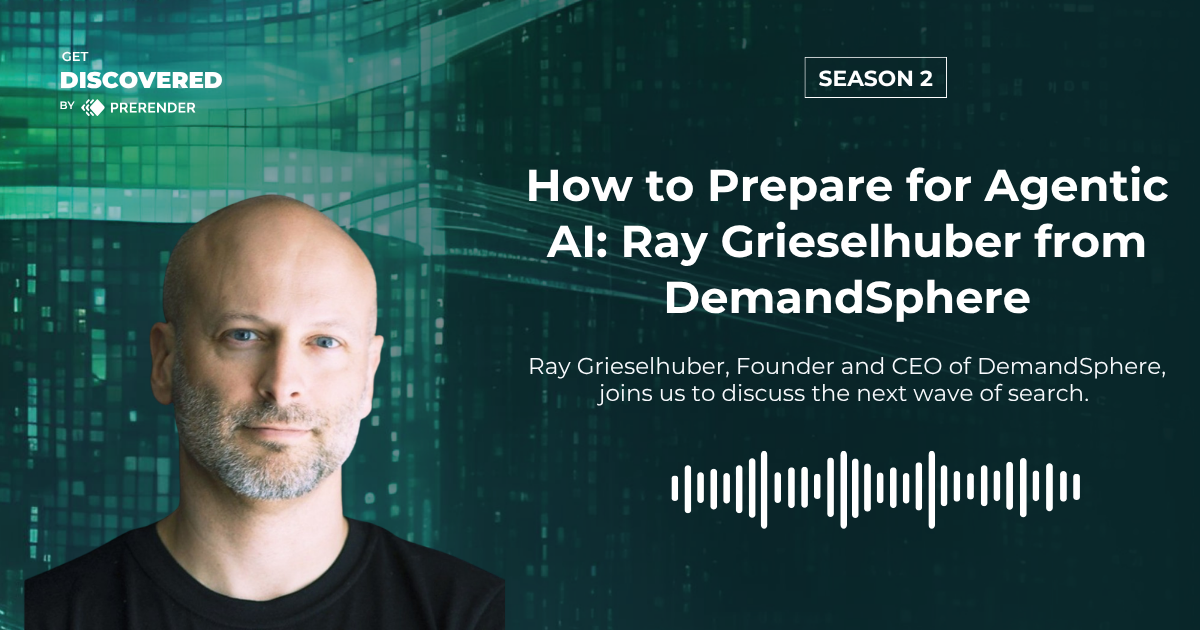
In this episode, host Joe Walsh sits down with Ray Grieselhuber, founder and CEO of DemandSphere, a platform that gives marketing teams a unified view of their brand across traditional search, Large Language Models, and agentic search experiences.
The conversation covers everything from indexing to attribution to how to prepare for agentic AI. Whether you’re a growth leader or SEO expert, you’ll definitely find this one valuable.
Listen to the full episode below, or read on for a written summary.
The Measurement Contract Is Broken
Ray opens with a framing that shapes the rest of the conversation: the measurement contract between SEO effort and business outcomes has fundamentally broken down.
It used to be relatively straightforward, even if it was difficult to clearly attribute revenue from SEO. You’d identify search volume for a topic, create content targeting those keywords, and expect a reasonably predictable number of clicks based on ranking position and clickthrough rates. It was never perfectly deterministic, but it was workable.
That model no longer holds for most sites.
“The big thing is that the measurement from a business perspective, the measurement contract has really gotten broken in many ways… You have to bring this mindset that you’re triangulating directional data from a lot of different sources in order to build a picture.”
What Ray describes is less like a dashboard and more like reckoning. Using multiple imprecise signals together to form a directional picture, then treating the whole thing as a feedback loop rather than a formula. That skillset, he argues, is what will help people survive this wave. Those who’ve been doing SEO for years already know how to work this way. For those who are new to it, he admits that this shift can feel disorienting.
The Great Decoupling of Clicks and Impressions
One of the most concrete phenomena Ray points to is what’s widely being called “the great decoupling,” a term coined by the well-known SEO expert, Kevin Indig. It refers to the breakdown of the historically tight correlation between impressions (a proxy for search demand), rankings, and traffic. (We also discuss this in our conversations with Noah Greenberg, CEO of Stacker, and Klaus-M. Schremser, CEO of OtterlyAI.)
For a long time, if your content ranked well for high-volume terms, you could count on traffic following. That relationship has weakened significantly. Impressions are up on many sites, but clicks aren’t following at the same rate because AI Overviews, featured snippets, and other zero-click features are absorbing more of the interaction.
This creates a new kind of challenge, says Ray. You can no longer look at search volume data and confidently project the engagement you’ll get from capturing that demand. The signal still matters, but it’s less predictive than it once was.
However, not every site is experiencing this equally. Ray notes that some of DemandSphere’s customers still show tight correlations. But for most, it’s a genuine source of anxiety and a real planning problem.
Yes, Traditional SEO Still Matters
One of the more grounded parts of this conversation is Ray’s insistence that foundational SEO principles haven’t gone away, a theme we’ve heard from nearly every podcast guest this season. They’ve just shifted where they apply.
A common misconception in the industry is that SEO is either completely dead (the panicked take) or completely unchanged (the defensive SEO-community take). Ray argues that both of these miss the point.
From Ray’s perspective, the reason traditional SEO still matters is largely about the index. Google’s web index remains the most comprehensive map of the internet that exists, and most Large Language Model applications—whether they’re running on Bing’s API or scraping search results more directly—are still drawing on that index for live retrieval.
“I always talk about the index being the prize, and nobody has a better index of the internet than Google. So that makes them incredibly valuable as a platform company. It also means that a lot of the things that still matter for SEO still matter very much within the realm of what most people would call AI search visibility.”
The implication for practitioners: the work you’re doing to help search engines find, crawl, and understand your content is also the work that helps LLM applications surface it.
Further reading: How to Get Indexed on AI Platforms
The Training Layer vs. Retrieval Layer
Ray draws a distinction that’s genuinely useful for thinking about LLM visibility: the difference between what a model knows from its training data and what it retrieves in real time.
Training data has a cutoff date. The moment a model launches, its knowledge is already aging. This is why tools like ChatGPT and Perplexity have increasingly added live web retrieval—often called retrieval-augmented generation, or RAG—to supplement what the model was trained on. When you ask an LLM a question about a current topic, the system often goes to a search index to pull fresh information before generating a response.
This means you’re always dealing with a hybrid system. Some of what shapes your visibility in an LLM response is baked in from training, while some of it is determined in the moment by live retrieval from search indexes.
For SEO and content strategy, this has real implications. Ranking well and being crawlable still matter for the retrieval layer. But what about training?
Ray’s view is that training data visibility is harder to engineer, but it’s also shaped by the same underlying forces that drive search indexing. The internet that training datasets pull from has already been shaped heavily by Google’s index and by the signals that determine what gets crawled and surfaced. Sites like Common Crawl, which are widely used in training datasets, tend to favor established, well-linked, well-indexed domains.
“If you’re one of the top brands in the world, then you’re going to probably do pretty well on that. If you’re a smaller brand, your visibility within Common Crawl itself is going to be limited.”
Ray’s practical advice: don’t treat training visibility and live retrieval as separate problems. Both reward the same fundamentals of being indexed, authoritative, and well-structured.
Further Reading: A Technical Guide to Optimize Your Website for AI Search
Why You Should Think of Your Website as a Knowledge Repository
One of the more conceptually useful ideas in this conversation is Ray’s suggestion to stop thinking about your website as a marketing function and start thinking about it as an interlinked knowledge repository.
The mental model he offers is something like an internal Wikipedia or a well-maintained personal knowledge base (think Obsidian, or Zettelkasten-style note systems). The idea is that your content should be structured for knowledge retrieval with clear topic relationships, well-organized internal linking, and content that answers specific questions—rather than optimized purely for marketing purposes.
This isn’t a completely new idea in SEO, but the framing becomes more urgent in an LLM context. Models doing retrieval are, in a sense, trying to pull the most relevant and well-organized information on a topic. Sites that are structured to make that easy are better positioned compared to sites that aren’t.
Ray connects this to a longer-standing belief at DemandSphere: “Good SEO is good product management and also good corporate strategy.” You can often tell how well-run a company is by how coherent and discoverable its search surface is.
How to Think About Agentic AI
One of the more forward-looking threads in this conversation involves how to think about “agents as users of your website.”
Joe raises the idea, as it’s something the Prerender.io team has been thinking about internally. He notes that the user class for websites is expanding, and it’s not just humans anymore. Agents are browsing, querying, and making decisions on behalf of users. And as agentic tools become more accessible to non-technical users, the share of traffic and interaction driven by agents is likely to grow.
Ray pushes back slightly on the more radical version of this thesis: he’s skeptical that human-facing websites will become irrelevant in a three-to-five-year timeframe. But he’s fully on board with the underlying point: “Yes, you should be thinking about agents as a distinct user class now.”
“You should definitely be thinking in terms of new protocols to expose your website’s behavior to agents, because it will be an influencing factor in many ways in that first part of the funnel.”
The framing he finds useful is a hybrid model. Agents may handle the early stages of discovery and shortlisting to help users narrow down options before they engage directly. But the closer you get to a real decision (especially one involving money), the more likely a human is to want to be in the loop. The website isn’t going away, of course, but it’s becoming a new layer in a more complex decision stack.
Further Reading: How to Build Agent-Friendly Websites
The Biggest Misconceptions in AI Search Today
Ray identifies two misconceptions that he sees as a kind of pair.
The first is the familiar one: “SEO is dead.” This is the panicked response to AI disruption, and Ray (like most thoughtful practitioners) thinks it’s wrong. The fundamentals of how information is organized and retrieved online haven’t changed as much as the discourse suggests.
The second is the defensive mirror image: “it’s all just SEO.” This is the response from the SEO community that’s tempting to make, but equally incomplete. When you say “it’s all just SEO,” you’re focusing on the mechanics of indexes and content at the expense of the more important question: what are users actually doing, and how is that behavior shifting?
“If any conversation we’re having about this, if you’re not bringing it back to what users are doing, how is user behavior shifting, then you’re missing the boat.”
For Ray, human attention is the prize. The tools for capturing it change faster than the underlying human behaviors do.
What Gets Better in the Next 12–18 Months
On the optimistic side of the ledger, Ray points to something he and Joe both feel: the ability to build things faster is genuinely transformative right now.
DemandSphere has fully embraced AI-based engineering, and the distinction Ray makes is worth noting. Vibe coding is fine for what it is. But AI-based engineering goes further: it means having a real deployment pipeline and operational infrastructure behind what you build. With that foundation in place, you can now build and ship things at a speed that wasn’t previously possible for a team of any size.
He also reframes the “SaaS apocalypse” narrative in a useful way. Yes, some software companies are going to struggle or disappear, and especially those that are little more than a UI wrapper around a database. But the silver lining is that this clears away a layer of subscription overhead that was never delivering enough value to justify its cost. The companies that survive and thrive will be the ones that have found a way to function less like a product you log into and more like a service that’s genuinely part of your team’s workflow. We’re curious to see where this takes us.
Tune Into the Full Conversation
Listen to the full episode of the Get Discovered podcast on Spotify, Apple Podcasts, YouTube, or wherever you get your podcasts. To connect with Ray, visit DemandSphere or find him on LinkedIn.
About Prerender.io
Prerender.io is a leading SEO solution that helps modern websites ensure their JavaScript-heavy pages are fully visible to search engines and AI tools. Trusted by companies like Microsoft, Salesforce, and Walmart, Prerender is the go-to partner for businesses navigating the future of SEO and AI-driven discoverability. Start for free today.