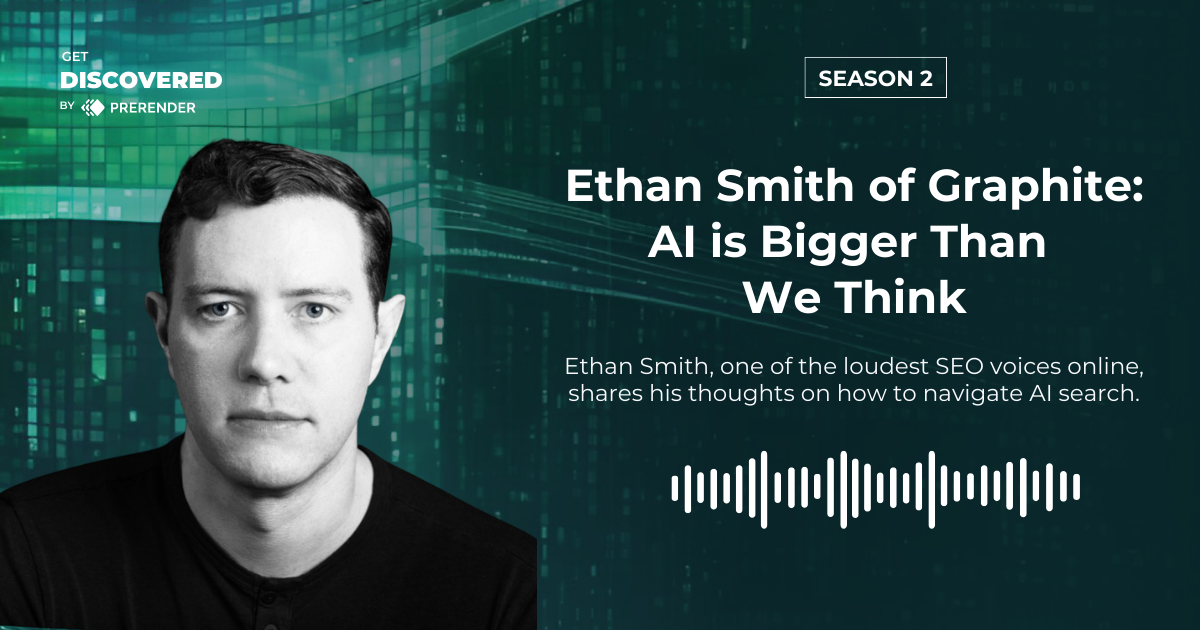
Ethan Smith, CEO of Graphite, works with some of the world’s largest tech organizations: Adobe, Webflow, Notion, and more. He’s also an adjunct professor, teaching AEO and SEO to other leaders globally. He knows his stuff, and he openly shares his wisdom online with Graphite’s extensive database of research. He’s one of the biggest voices in SEO on LinkedIn, and we were lucky enough to have him on the Get Discovered podcast.
In the podcast, he draws on his research with a wake-up call: AI search is much bigger than we think. This, along with other key takeaways explored below, is a core tenet of our conversation. He explains what’s happening with SEO and AI today, where our conventional wisdom has gone wrong, what’s working and what’s not, and what teams should be doing right now.
Watch the full episode on YouTube below, or read on for a summary.
Why AI Search is a Bigger Channel Than You Think
One thing Ethan wants to clear up is that yes, AI search is real, and yes, it’s big. But most of the numbers you’ve seen dramatically understate the size.
Virtually every report measuring AI search traffic has looked at web traffic only. The problem? Around 75–86% of AI tool usage occurs within mobile apps, not in web browsers, according to Ethan and his data team at Graphite. When you add that in, the picture changes.
By Ethan’s analysis, AI search is now over half the size of traditional web search globally, and roughly a third the size in the US. This suggests that it’s a larger channel than most of us realize.
But there’s a caveat that most people are misunderstanding: this channel size doesn’t mean you have to throw everything out the window and start anew.
AEO vs. SEO: Is There Actually a Difference?
One of the most refreshing things Ethan said in the conversation is something most SEOs already know, even if LinkedIn posts tell us otherwise: AEO and SEO are largely the same.
The different acronyms are everywhere: GEO, AIO, AI SEO, or AEO. And with that comes the assumption that everything has changed, too. But for most SEO experts, and Ethan included, AEO and SEO are essentially the same.
His conclusion is that optimizing for LLMs like ChatGPT isn’t fundamentally different from the old era of optimizing for Google. The underlying principles of quality content, authoritative sources, and strong technical foundations all still apply. (Some aspects of technical SEO are even more important than before.)
However, he does identify two fundamental differences between AEO and SEO that you should be paying attention to:
- The long tail keyword is longer. AI queries are much more conversational and specific than traditional keyword searches. “Best running shoes” becomes “I have a knee issue and need stability in a neutral shoe for road running. What do you recommend?” The implication for marketers: you need to be thinking about a much wider surface area of prompts.
- Off-site signals matter more. Links have always mattered, but where your brand appears across the web (review sites, forums, help content, comparison pages, and third-party mentions) now feeds directly into whether AI systems surface you as a trusted citation.
Everything else? For now, mostly the same.
The Three Personas Spreading Bad AEO Advice
So why is there so much hype around the naming conventions? And why are teams feeling the pressure to throw their old strategies out the window?
Ethan simplifies this into three profiles that are spreading misinformation:
- The VC-funded startup founder. They need to pitch a massive TAM and maximum disruption. Language like “SEO is dead, Google is going away, and AEO is completely different” is used as a fundraising strategy. It doesn’t necessarily benefit brands like yours.
- The new entrant consultant. No SEO background means no baseline credibility, unless you decide to reframe the game entirely. If everything is different, then your lived-in experience doesn’t matter. This is a convenient positioning move on LinkedIn, and it’s frequently wrong.
- The misled SEO practitioner. This one’s not malicious, but they’re just repeating things they’ve read many times until it feels true. This aspect of human psychology, known as the illusory truth effect, Ethan explains, comes down to this: if we hear something often enough, the brain treats it as an established fact. Sometimes, people can’t help it. This can sometimes even be subconscious.
Ethan suggests being skeptical of it all, including his own work. Over on Graphite’s Five Percent blog, Ethan and his team publish raw data, link to the sources, and actively invite people to poke holes in their analysis. In his words, it’s a modern-day version of peer-reviewed analysis as found in academia (Ethan is an adjunct professor). He encourages you to partake in this due diligence process, too.
AEO Misconceptions That Are Actually Costing You
Ethan walked through the specific false beliefs he hears most often in conversations with marketing leaders:
- “Search traffic is declining.” He actually published a study showing this isn’t true. The reality is that search isn’t going down, but it is reshuffling. The main challenge here is that it’s harder to attribute. Instead, he suggests thinking of AI as an additive channel, not a replacement one.
- “I just need to figure out Reddit.” This comes from a commonly cited discussion that Reddit dominates AI citations. But, according to Ethan, that stat comes from looking at the top 10 cited domains and making a pie chart. When you look at all citations, he says, Reddit represents around 2.5% of cited domains. It’s still the single most-cited domain, so yes, you should be thinking about it. (We saw this in our own research, too.) But 95% of citations come from domains outside that top 10, so the real opportunity is much broader.
- “AI can’t read HTML, so you need to convert everything to Markdown.” Ethan is direct on this one: there’s no evidence for it. No one from any LLM provider has ever said this, he says, and AI can parse HTML perfectly fine. In fact, it’s recommended by many SEO experts like Carolyn Shelby, Principal SEO at Yoast, to actually convert your content to HTML. (Need help with that? That’s what we do here at Prerender.io.)
- “AEO and SEO are fundamentally different disciplines.” They’re not. As mentioned above, the overlap is significant. While there are nuances with AEO you should consider and prioritize more, such as offsite, longtail, and technical foundations, the two run on the same principles.
Graphite’s 5% Framework and What Actually Drives Results
One of Ethan’s most useful contributions to the conversation is what he calls his 5% framework, a variation on the 80/20 rule. He created this rule after auditing hundreds of companies.
The key findings of this: your top 5% of landing pages drive roughly 87% of your organic traffic. So in his eyes, most SEO work (ex. Screaming Frog exports, the alt tag audits, or elaborate agency slide decks) doesn’t actually have an impact. The companies that grow are the ones that identify the small number of plays that actually matter and go deep on those.
For AI discovery specifically, here are Ethan’s suggestions:
1. Start with prompts, not keywords. Pull customer questions from your sales team, your support inbox, and your paid search data. These are the prompts your customers are actually typing into ChatGPT. Track them and see which domains get cited for those prompts, and then you can focus your attention.
2. Invest in product-focused content, especially for long tail keywords. Evaluate your help center content, integration pages, feature documentation, and use case pages. This isn’t just for your top integrations, but for your 35th most popular integration too. This is where the AI prompts live. The questions people ask aren’t always “what is [product]?”, but more like: “how does [product] work with [specific tool] for [specific use case]?”
3. Off-site presence beyond Reddit. Consider investing in videos, affiliates, third-party blogs, and forums that are relevant to your industry. However, this obviously depends on your team size and budget. The right off-site mix depends entirely on which prompts you’re trying to win and the resources you have available to you.
How to Measure ROI on AI Discovery
One of the most practical parts of the conversation was around measurement, and specifically how to make the business case to a CMO or CRO who’s skeptical of a channel with fuzzy attribution. This is a common theme we’re hearing throughout this podcast, like with Noah Greenberg from Stacker or Elizabeth Thorn from Toggl.
From Ethan’s perspective, here’s how you can measure it:
- Ask “how did you hear about us?” at conversion. It’s self-reported and imperfect, but it captures a signal that click-tracking never will. (Ryan Law, Director of Content Marketing at Ahrefs, prioritizes this type of measurement.) Post-conversion surveys can surface AI as a touchpoint in ways that traditional attribution models miss entirely.
- Track visibility and rank for your priority prompts. Use a prompt tracking tool for general trend monitoring. For actual experiments, Ethan is quite clear: “You need to manually run the same prompts multiple times while logged in to get the real distribution of responses,” he says. Most tracking tools run queries logged out. This is directionally useful, but it isn’t what your customers are actually seeing.
- Size up the channel. Show leadership how large the channel actually is. Look at high intent, longer prompts, and conversational queries: traffic from AI referrals tends to be primed. This alone is a meaningful commercial argument.
Lastly, Ethan explores split testing with the classic Pinterest SEO experimentation model. Start by dividing your target prompts into control and test groups, then establish a baseline, intervene on the test group, and measure the delta. In his opinion, you don’t need a data science team. Someone willing to copy and paste prompts into ChatGPT every week will do.
How Brands Can Win on Reddit (Without Being Banned)
In the latter part of the conversation, we asked Ethan how brands can authentically engage on Reddit, but without being banned or perceived as a corporate shill. This is a topical one: every marketer is hearing about the importance of Reddit for citations, and most brands want to be part of this conversation.
In Ethan’s opinion, spammy fake accounts and astroturfing can work on a small scale, but this approach is harmful, unsustainable, and a terrible look for anyone working with companies of real size.
Here’s what he says actually works for a strong, authentic Reddit presence:
- Engage in threads where commenters are already talking about your brand. Note: he doesn’t mean you should chime in defensively or to reframe the narrative, but to add your perspective honestly. For example, he commented on a thread questioning whether he was overhyped, and he did so authentically without shaming commenters. “The comments were appreciated,” he notes.
- Create content that addresses the concerns customers are raising. For example, he shared how Lululemon responded to Reddit threads about how their pants started pilling by sharing washing guides and care instructions. The Reddit conversation naturally shifted, and people perceived Lululemon more favorably as a result.
- Consider Reddit ads on threads where the sentiment is already positive for you. If a thread organically favors your brand, amplify it with ads.
What Gets Worse Before It Gets Better
Each episode, we ask guests for their 12–18-month outlook. Ethan’s perspective was candid: spam content will get worse before it gets better (which, interestingly enough, is what Ryan Law from Ahrefs said in his podcast episode, too).
As Ethan explains, Google has spent two decades building spam-detection algorithms. Today, this is essentially a cat-and-mouse game where each new spam tactic pretty quickly gets countered. But AI search tools like ChatGPT, Perplexity, and Gemini are years behind that curve, for now, and their spam filters don’t exist yet. (This is why you’ll occasionally see strange, low-quality domains appearing as AI citations.) The spam that stopped working on Google a decade ago is suddenly working again on LLMs.
So, for the next year, Ethan predicts, marketers can expect more listicle abuse, fake affiliate content, and coordinated Reddit manipulation. Who knows what will come after that.
But, on the optimistic side, Ethan is genuinely excited about AI’s ability to eliminate the parts of marketing and analysis work that are essentially glorified data entry. The kind of research that once took months, such as pulling traffic data across tens of thousands of sites or identifying patterns, now takes hours. “More time on strategy, less on mechanics,” he says.
Summing Up the Conversation
At the end of every episode, we ask guests a single sentence to sum up: if listeners take away one thing from this conversation, what would that be?
Ethan’s answer: most of what you’ve read about AEO is wrong. Or at least, not validated. He clarifies that this information isn’t maliciously wrong, per se. However, most of it is still wrong because the field is so young and the incentives to overstate disruption are real.
Instead, he suggests doing your own research, looking at raw data, asking for source links, running small experiments yourself, and checking whether the prompts your customers use actually produce citations or not.
About Ethan Smith
Ethan Smith is the CEO and Founder of Graphite.io, a growth agency working with companies like Webflow, Notion, and Upwork. He is one of the more rigorous voices in the AEO space, known for publishing primary research with source data and actively inviting peer critique of his findings. Follow him on LinkedIn or explore his research on Graphite’s blog.
About Prerender.io
Prerender.io is a leading SEO solution that helps modern websites ensure their JavaScript-heavy pages are fully visible to search engines and AI tools. Trusted by companies like Microsoft, Salesforce, and Walmart, Prerender is the go-to partner for businesses navigating the future of SEO and AI-driven discoverability. Start for free today.