A successful domain migration doesn’t mean AI models understand your brand correctly. Global sportswear brand On found that out the hard way.
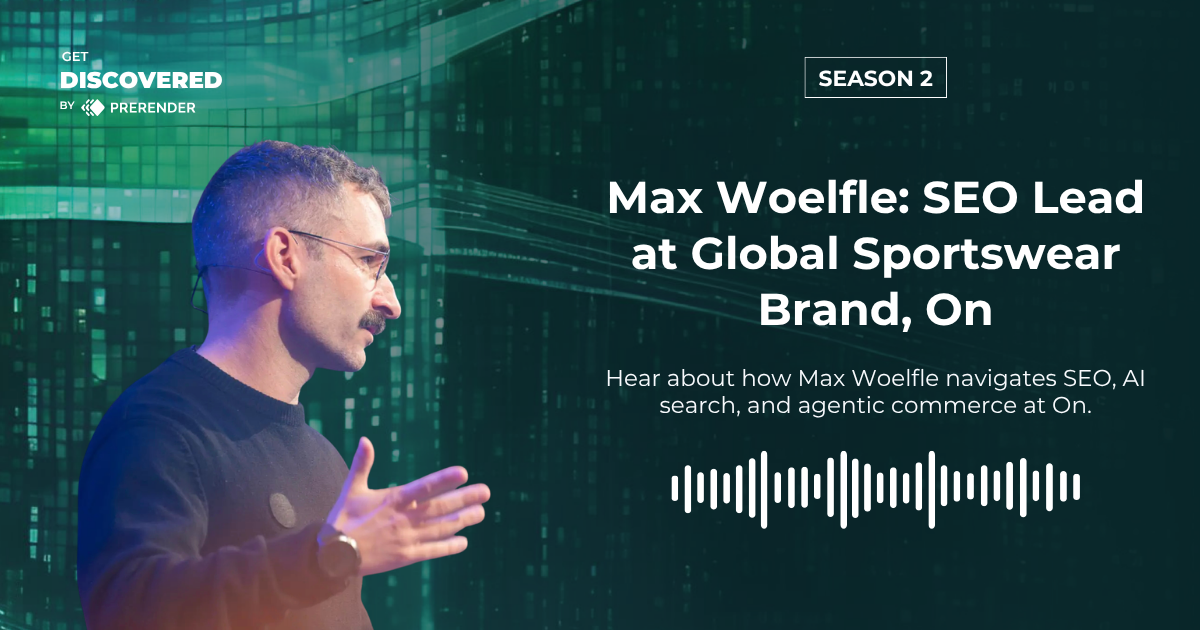
In this episode of the Get Discovered podcast, we sit down with Max Woelfle, SEO Team Lead at On, one of the fastest-growing athletic brands in the world and a Prerender.io client since 2023.

Together, we talk about what the brand’s move from on-running.com to on.com revealed about AI training data, entity confusion, and why the technical foundations brands lay today will determine their visibility in an agentic world.
Watch the full episode below or read on for key takeaways.
A “Successful” Domain Migration With a Hidden Catch
In early 2024, On made a significant brand move by migrating from on-running.com to on.com. The two-letter domain reflected the brand’s ambition to grow beyond running into a global sports brand, and from a pure SEO standpoint, it worked. Traffic dipped for a few weeks and then bounced back to its pre-migration growth trajectory, which at the time felt like a clean win.
About eighteen months later, though, Max’s team started noticing something strange. When they examined how AI models talked about On in isolation, looking at the base model without live retrieval, “on-running.com” still loomed large. Years of training data from Reddit threads, product reviews, and news coverage were pointing to a different domain than the one that On now calls home.
“I didn’t, at the time, think about the training models or the training that was happening for the models,” Max explains. “And we see now how sometimes signals are blurry.”
The underlying issue comes down to a distinction that matters far more now than it did three years ago: the difference between the training phase and the retrieval phase. When you ask ChatGPT a question today, you’re getting an answer shaped by two very different inputs. The first is the base model, which represents years of web data baked in during training that forms the model’s foundational understanding of the world. The second is live retrieval (RAG), which pulls in current information to supplement or correct what the model already “knows.”
From a user’s perspective, these two sources are completely invisible because you get one unified answer. But underneath that answer, the base model might be pulling On toward “on-running.com” while live retrieval corrects it to “on.com.” That kind of collision creates subtle inconsistencies that brands rarely catch, and especially in 2024 when Max and his team made the switch.
“If you just look at it from a user perspective, everything looks fine,” Max says. “It doesn’t necessarily work for the entire ecosystem that is AI nowadays.”
Three Entities, One Brand
The domain migration also brought a deeper issue into focus. Over the years, On had accumulated not one but three distinct entities in the training data that models were trying to reconcile: On Cloud, a popular shoe model that over time became a shorthand for the brand itself; On Running, the original brand identity; and On, where the brand is headed today.
Reddit, product reviews, and press coverage had spent years interchangeably using all three, and models trained on that data have to make sense of it somehow. At the live interface level, they often manage it. But at the base model level, the picture gets messy.
“If I ask ChatGPT right now, it would be ‘On,’ in parentheses, formerly known as On Running,” Max explains. “But if I really only look at the base models, very often you get this mixed up. It’s OnCloud, and that’s the company name.”
The practical consequence goes well beyond a branding annoyance. When AI models are working with confused or conflicting entity information, errors multiply across the answers they generate: incorrect headquarters locations, missing product attributions, and wrong contact information. That last one is where the problem becomes a real consumer issue.
Why Incorrect AI Answers Are a Real Consumer Problem
Consider the scenario Max raised: a customer wants to file a warranty claim and asks ChatGPT for On’s warranty contact number. If the underlying data is wrong, or if the most accurate version of that information lives on a JavaScript-heavy page that AI crawlers couldn’t process, that customer gets the wrong number and has nowhere obvious to turn.
“There’s a consumer at the other side that wants to return a shoe,” Max says. “They will just take the ChatGPT answer for face value, and it’s our job to fix that.”
This is where JavaScript rendering—and a solution like Prerender.io—enters the picture, says Max. Many brands store their most current, accurate information, covering things like headquarters, contact details, product specs, and return policies, on pages that are heavily client-side rendered. Google has spent years building a crawler sophisticated enough to handle most JavaScript, but AI crawlers haven’t yet matched that pace. It’s why Max and his team at On have been using Prerender.io since 2023.
The result is that a brand’s most recent and most accurate information may be completely invisible to the models that millions of people are now asking for recommendations and answers, while the static, older version of that information, from before a rebrand, a move, or a policy change, gets baked into the training data instead.
This gap is particularly wide for smaller or faster-growing companies. Brands the size of Nike are referenced by so many third-party sources that any single source of confusion tends to get corrected naturally. A brand that has been growing fast for the last five years, with most of its accurate information living on a modern JavaScript stack, is far more exposed to this problem.
Further reading: How On Saves Millions Per Year with Prerender.io
Measuring Organic Growth When the Click Disappears
Alongside the AI visibility challenge, Max is grappling with a measurement problem that every organic growth team is now facing (and one we’ve explored at length on this podcast): how do you demonstrate the value of search when AI conversations don’t generate clicks?
The old model had a comfortable, if imperfect, logic to it. You could trace a reasonably clear line from impressions in Search Console through click-through rates to sessions on the website and eventually to revenue. That model is now fragmenting because the discovery phase, the moment when someone decides which brand to actually consider, has increasingly moved into AI conversations that leave no footprint in your analytics.
“We know that people are prompting and having conversations with AI, and we know roughly how many users ChatGPT has,” Max explains. “But we have no reliable way of measuring that because the only people who have that data are the likes of ChatGPT and Claude.”
On has started running display ads on ChatGPT, which at least generates impression data tied loosely to conversation topics. Max also uses a simple proxy to make the scale legible internally: if roughly 1% of AI conversations result in a click-out based on available signals, then 1,000 sessions from AI on your site implies around 100,000 conversations where your brand came up. That’s not a precise measurement, but it’s a useful order-of-magnitude reality check for stakeholders who are used to thinking in clicks.
The harder internal challenge is making the case for investment when the raw traffic numbers from AI channels are smaller than what Bing drives. It takes real work to argue that a channel with modest visible traffic deserves serious attention. Studies show that AI search contributes to pipeline 15x-30x more than you think.
“You have to at one point say that we don’t know exact numbers,” Max says. “But I do think it’s a fair assumption to say: if we don’t show up in any of the prompts around this topic, we won’t be showing up in any of the conversations around this topic.”
Further reading: 5 Common Mistakes on JavaScript Ecommerce Sites
Who Owns AI Discovery Inside a Brand?
One of the more practically useful threads in this conversation is about organizational structure. AI discovery cuts across SEO, product, engineering, PR, and analytics, and in most companies, nobody has formally claimed ownership of it.
At On, Max explains how the company has overhauled this entirely in a year-long test. Now, his team is known as the Organic Growth team internally, rather than simply SEO. He explains that they’re the coordinating layer that brings stakeholders together without trying to own everything. In the same way that his team once managed shopping feeds by connecting developers, product managers, and data owners, they are now doing the same for GEO and AI visibility, acting as the connective tissue rather than the sole executor.
“The idea is that all of this will turn into business as usual,” Max says. “Discovery should be addressed by the whole company anyway.”
In practice at On, this means PR teams are becoming more digitally minded on how brand activity translates into AI-accessible signals, analytics teams are taking on prompt monitoring as a standard function, and developers increasingly understand why server-side rendering matters for AI crawlers. The Organic Growth team is not large enough to do all of it, but it can set the standards and make sure the right people are connected to each other.
Agentic Commerce: Build the Foundation Now, Even If Volume Is Low
To conclude, the conversation turned to something that is still more future than present, though perhaps not by as much as people assume.
Agentic commerce is the idea that AI agents will eventually shop on behalf of consumers, researching, comparing, and purchasing without the human ever visiting a brand’s website. Max is clear that mass-market adoption is not coming tomorrow—something that Marius Meiners, CEO of Peec AI, also echoed on the Get Discovered podcast—but he is equally clear that waiting for it to arrive before preparing is the wrong approach.
His analogy is a useful one. When did you first buy something on your phone? For most people, it was well after the iPhone made it technically possible, because the technology was ready years before consumers trusted it enough to act on it. Agentic commerce is in a similar early phase, technically feasible for a small group of early adopters but nowhere near mainstream.
“I don’t think it comes as fast as the companies that are thinking about going public wanted us to believe,” Max says. “But we need to make sure the technical possibilities are there. The same way that you have to have your website crawlable, the same way you should have your products shoppable in an agentic world.”
For On, that means treating agentic commerce the way good engineering teams treat infrastructure: build it correctly even when the usage numbers are modest, so there is a foundation to iterate on. Ten agentic conversions this year still give you a year-over-year baseline for next year, which is more than you have if you wait.
In Max’s perspective, the brands that will win in an agentic world are not the ones that react when the volume arrives. They’re the ones that made themselves technically visible, entity-clear, and crawlable long before.
Tune Into the Full Conversation
Listen to the full episode of the Get Discovered podcast wherever you get your podcasts. Subscribe so you don’t miss future episodes with marketing and SEO leaders navigating the AI discovery challenge in real time.
To connect with Max, you can find him on LinkedIn. Learn more about On at on.com.
About Prerender.io
Prerender.io is a leading SEO solution that helps modern websites ensure their JavaScript-heavy pages are fully visible to search engines and AI tools. Trusted by companies like Microsoft, Salesforce, and Walmart, Prerender is the go-to partner for businesses navigating the future of SEO and AI-driven discoverability. Start for free today or talk to sales for an Enterprise solution.