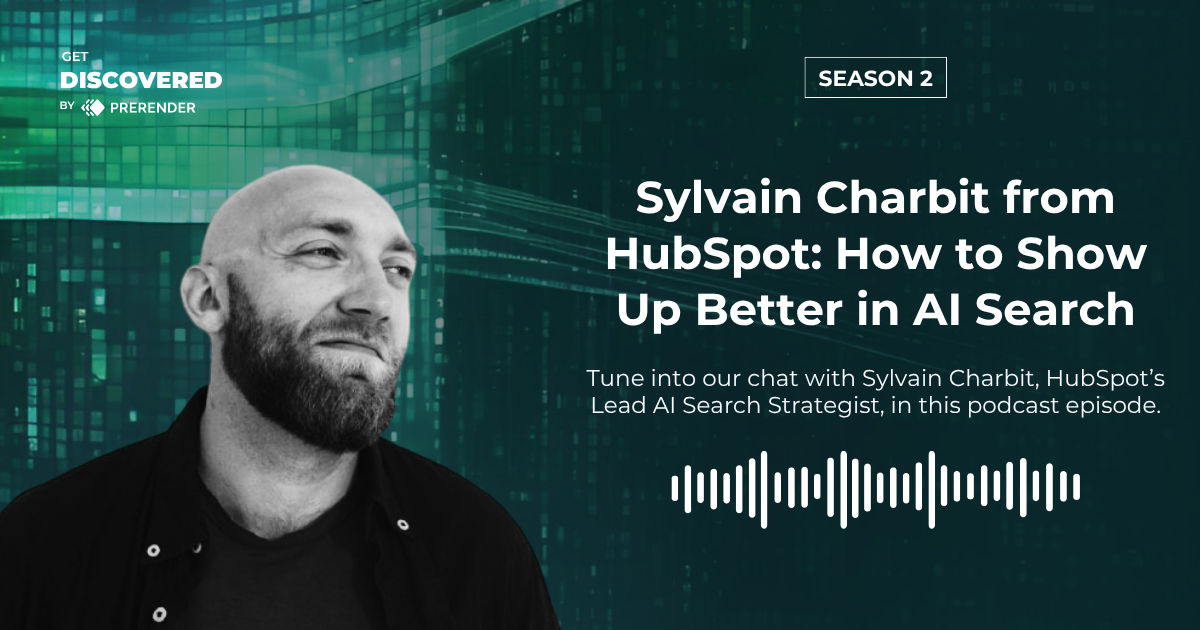
HubSpot is one of the most recognizable brands in SaaS. It powers nearly 300,000 businesses across 135 countries, its blog is one of the most visited marketing destinations on the internet, and it’s one of the most consistently cited B2B brands in AI search.
In this Get Discovered podcast conversation, Sylvain Charbit, HubSpot’s Lead AI Search Technical Strategist and a Prerender.io client, pulls back the curtain on how HubSpot is navigating the shift from traditional SEO to AI search.
With actionable tips for brands of all sizes—not just enterprise giants like HubSpot—he shares what his team is testing, what’s working, what failed, and where most marketers are still going wrong with AI.
Watch the full conversation below, or read on for key takeaways.
The Gap Is Widening Between Traditional SEO and AEO
Most conversations during our podcast this season have been centered on a key theme: AEO (or GEO or AIO, whichever search term you prefer) is essentially the same as traditional SEO. And especially the technical foundations. While Sylvain thinks this still rings true, he has a unique take on this. In his opinion: yes, it is. But that’s not the full story.
For example, when asked about HubSpot’s success in AI search and whether its strong traditional SEO was central to that, this is his response:
“I would say that would be a lie to say that our past traditional SEO successes didn’t play a key role in our AI search visibility today. Yes, we are definitely benefiting from that. But this is not the only thing.”
HubSpot capitalized on that foundation, but they pushed past it. They ran experiments, moved fast, and tried new things specifically for AI discovery. The strong traditional SEO foundation made those efforts more efficient, but it’s not the only reason why they continue to perform well. It’s because they’re constantly evolving with where AI is going, and they know that traditional SEO and AEO have unique differences.
SEO and AEO Aren’t the Same Anymore
While the SEO fundamentals haven’t changed, it’s more complicated than that. Unlike with the previous days of traditional SEO, AI search strategies like thin content, AI-generated filler content, and topic clusters won’t work. All of these approaches now cost more than they return. Instead, build genuine authority and focus on pages that actually answer your customers’ specific questions, with data, and reflect a real point of view.
And here’s where Charbit pushes back on the popular narrative that SEO and AI search optimization are the same. He overtly disagrees.
His take is, honestly, refreshing. Anyone who works in search knows that AEO has a unique set of challenges that differentiate it from traditional SEO. While three years ago, he says, SEO and AEO were about 95% overlapping. Today, he estimates that overlap is closer to 80-85%. But in twelve months, it’ll narrow even further.
“The gap between traditional SEO and AI will keep on widening. I know Google said this is the same thing. I don’t believe it is, even if it’s very close. But in twelve months, you will see that widening.”
Who knows how this will play out in the next 3-5 years with agentic search, but it seems to accurately capture the state of search as it is now. And much better than what the SEO evangelists—or even the GEO evangelists—are repeating on LinkedIn these days, something that anyone working in search can resonate with.
AI Search Is Not a Traffic Channel (Yet)
Segueing into the next part of the conversation, we explored myths and misconceptions about AI visibility. The clearest misconception that Sylvain hears from marketing leaders is the assumption that AI search should behave like a traffic acquisition channel, measurable through clicks and UTMs. It mostly doesn’t, and at least not yet.
“AI search is mostly about awareness and influence in general. The user will appear in AI results and then go somewhere else: go to your website, or to a place where you can buy your product or consume your information. This is not something that’s easy to explain or even to understand.”
For now, the mental model needs to shift. When someone asks ChatGPT which CRM to consider, and your brand gets mentioned alongside two competitors, that doesn’t count as a click. It’s a mention—something entirely different than a citation—and it influences the buyer’s consideration set before they ever visit any website.
Measuring success in AI search requires a different set of metrics, such as direct traffic, referral traffic, citation rate tracking, prompt monitoring, share of voice across AI platforms, and more. Not just sessions and conversions. For now, the companies optimizing for clicks from AI search are measuring the wrong thing.
SEO Mistakes That Can Actually Hurt You in AI Search
Sylvain spent time on something that isn’t often discussed: the SEO strategies that negatively impact your AI visibility, even if your site is well-optimized otherwise.
The Cloudflare Problem
Many marketers assume that if they’re visible in Google, they’re visible to AI search tools. But this isn’t quite true. Cloudflare’s default settings, and similar CDN configurations, can actually block AI bots from crawling your site entirely, without you ever knowing. You have to turn that off manually. There’s also a robots.txt setting within Cloudflare’s interface that, if left at default, can block your site from appearing in multiple LLMs at once.
“Cloudflare is a very good example. You just set it up, and you’re like, ‘Okay, well, I’m visible in Google, but ChatGPT doesn’t know me at all.’ It’s just because you have to turn off that button that is being activated by default.”
Too Many Schema Tags
Last year, a widely circulated recommendation suggested that schema tags should be packed with as many attributes as possible to give AI systems more granular context. But Sylvain’s team tested this extensively. His team’s findings? Zero impact.
“As many schema attributes as possible didn’t work at all. It didn’t move the needle at all, and it hurts in the sense that this is wasted resources.”
Adding clean and well-structured schema, even if it’s just two or three attributes, will have more impact than the over-engineered version.
Broad Topic Clusters
Topic clusters were a renowned content strategy a few years ago, and HubSpot was one of the brands leading the charge in this domain. They pioneered wide, low-intent content created to capture broad search volume on every topic (for example, an automotive repair shop writing blogs about what sports cars are). But now, that’s not working anymore. And in fact, it’s being penalized, both by Google and AI systems.
Instead, it’s best to have detailed product pages filled with unique insights, experience, and expertise—a development of the EEAT model. Otherwise, you’ll see low traffic, poor conversions, and content efforts that cost significantly more than they return.
Tips for Brands to Show Up in AI Search, According to HubSpot
Most of this conversation happened in the context of HubSpot, a brand with enormous authority built over more than a decade. So the natural question: what do you do if you don’t have that?
Sylvain has a few suggestions for brands of all sizes:
- Start with fewer pages, not more. Make every one of them genuinely useful with authored content, real perspectives, and actual data points.
- Get crawlable. Check your robots.txt, fix your Cloudflare settings, minimize JavaScript roadblocks (you can use a solution like Prerender.io for this), and submit proper sitemaps. Make sure Google knows you exist because right now, Google’s index is still the backbone of how most AI systems find content.
- Monitor signals that AI users are finding you. For example, unusual long-tail queries in Google Search Console that make no sense for a standard search, but perfectly match the conversational prompt someone might type into an AI tool. Build more content around what you find.
“When you see something that is working—meaning you’re starting to notice different sorts of traffic coming in, or very long-tail keywords in Google Search Console that would make zero sense in a regular search—maybe that’s something that interests AI users. This is maybe something you should create content for.”
Where Will AI Search Go in the Next 12 Months?
Sylvain shares two developments that he thinks will get the most attention in the next year or so.
- Agentic search. If Google I/O is any signal (the word “agentic” appeared every two minutes), the next phase of AI search goes beyond answering questions. It’s completing tasks like booking a restaurant, filling out a form, or handling a support ticket. For brands, this means visibility won’t just be about getting cited in answers. It’ll be about being accessible enough for an agent to act on your behalf.
- The LLM power shift. The Q1 2026 State of AI Search report from Datos and SparkToro showed Claude’s user share jumping from around 3.5% to nearly 8.7% in the US, and close to 10% in Europe. ChatGPT’s dominance is eroding while Gemini is growing. This matters for AEO because different AI platforms use different search indices, and multi-platform discovery continues to be important.
Key Takeaways
Ultimately, HubSpot isn’t winning at AI search by following what they did with traditional SEO. And they’re not abandoning their SEO fundamentals, either. This conversation highlights that the secret to success for any new channel is to constantly experiment. Test and refine what’s working, what’s not, and pivot accordingly.
It also suggests that we’re going back to first principles. Maintain your authority, be unique, and use original insights—not just AI-generated summaries—to ensure you stay relevant. There’s no shortcut to genuine authority.
Lastly, while there’s no shortcut to authority, there are a lot of ways to accidentally block the authority you’ve already built from being seen. Fix the technical barriers first, and build real content second. Measure what you can, acknowledge what you can’t, and keep on experimenting.
Tune Into the Full Conversation
Listen to the full episode of the Get Discovered podcast wherever you get your podcasts. Subscribe so you don’t miss future episodes with marketing and SEO leaders navigating the AI discovery challenge in real time.
To connect with Sylvain, find him on LinkedIn, Twitter, his website, or check out his work at HubSpot.
About Prerender.io
Prerender.io is a leading SEO solution that helps modern websites ensure their JavaScript-heavy pages are fully visible to search engines and AI tools. Trusted by companies like Microsoft, Salesforce, and Walmart, Prerender.io is the go-to partner for businesses navigating the future of SEO and AI-driven discoverability. Start for free today or talk to sales for an enterprise solution.