AI agents for ecommerce are already completing B2B procurement workflows autonomously: filtering catalogs, comparing specifications, and initiating purchase orders without a human in the loop. If your enterprise site can’t return usable HTML on first request, those AI agents leave and convert on a competitor’s site instead.
Bain estimates U.S. agentic commerce could reach $300 billion to $500 billion by 2030. The procurement workflows driving that figure are already active. So for large enterprise sites built on JavaScript frameworks, this is a serious revenue problem.
This article maps the SEO hurdles that prevent enterprise agentic AI from completing workflows on your site and their commercial consequences at each stage.
TL;DR: The 5-Step Enterprise Agentic AI Website Preparation Sequence
Enterprise sites lose agentic transactions at five points, in this order:
- The AI agent is blocked before it arrives: robots.txt rules built for training crawlers are now blocking transactional agents.
- The AI agent hits a blank page: JavaScript-heavy pages return empty HTML to agents that can’t execute scripts.
- The AI agent can’t navigate: poor semantic structure leaves agents without a path through large catalogs.
- The AI agent can’t interpret the content: HTML parsing overhead causes spec errors, price misreads, and availability failures.
- The AI agent can’t complete the transaction: multi-step procurement flows built for browsers have no interface for agents.
Each failure point relies on the previous one. No fixes later in the process are effective until the rendering layer functions properly. This is also the order we follow in this article.
Agentic AI vs. Generative AI: Why Enterprise Sites Face a Different Problem
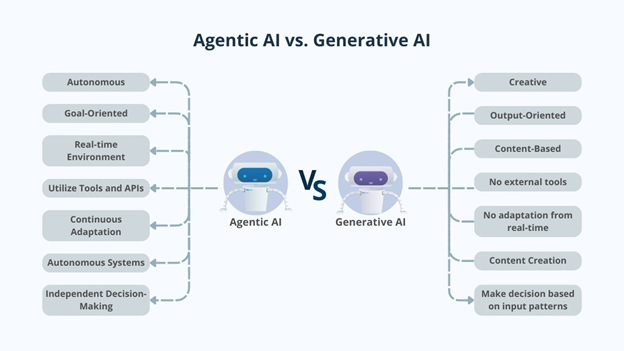
The distinction between agentic AI vs. generative AI determines what category of problem you actually have.
Generative AI systems, such as the crawlers behind ChatGPT, Perplexity, and Google AI Overviews, primarily visit your site to extract information. When they miss a page or misread a product description, the cost is reduced presence in AI-generated answers. This is a citation and visibility problem.
Agentic AI systems, on the other hand, visit your site to execute tasks. An AI agent acting on behalf of a procurement manager might filter a product catalog, compare vendor specifications, check pricing, and initiate a purchase order, all without a human in the loop.
When that process fails, the consequence is transactional. The agent moves to the next vendor it can work with and completes the purchase there. At this point, enterprise sites face the highest exposure because the gap between what agents need and what they deliver is widest at scale.
The same factors that create excellent user experiences are also the conditions that block AI agents at each stage of the buying journey. This includes:
- JavaScript-heavy architectures.
- Dynamic content.
- Personalized catalog pages.
- Complex checkout flows.
Read more: Guide to AI-friendly vs. AI-agent-friendly websites.
The Failure Points: Where Enterprise Sites Lose Transactions
Each failure point below maps an agent’s journey through your site from entry to exit. They follow a sequence, so fixing downstream problems without addressing upstream ones accomplishes nothing, because the agent never reaches the downstream stages.
1. The AI Agent is Blocked Before it Arrives
Most enterprises configured robots.txt rules during the generative AI crawling wave to control how their content was used in training and summaries. That made sense at the time, when the goal was limiting visibility and protecting content from being scraped.
However, agentic AI changes the implications of those decisions. An agent blocked by robots.txt cannot reach your content, navigate your catalog, or initiate a purchase. What was once a content governance measure is now a direct barrier to revenue.
As a result, enterprises need to reassess their access controls. Robots.txt rules should distinguish between training crawlers and transactional agents, rather than treating them the same. At the same time, emerging standards like llms.txt point toward a more granular approach to managing how AI systems access and interact with site content.
Where robots.txt was designed for a world of human browsers and search engine crawlers, llms.txt allows site owners to specify which content is available for AI summarisation versus transactional access: a distinction robots.txt was never designed to make.
2. The AI Agent Hits a Blank Page
This is the most common failure in enterprise agentic AI, making every other optimization irrelevant if left unaddressed.
Many modern enterprise sites are built on JavaScript rendering frameworks. The initial HTML payload these frameworks return contains little meaningful content. Product descriptions, pricing, availability, and filters all load dynamically after JavaScript executes. For a human browser, the process is invisible, but for AI agents making an HTTP request without a headless browser, the page arrives empty.
This is the AI agents and JavaScript rendering compatibility problem at the center of agentic commerce: the transaction collapses before it starts.
At enterprise scale, this rendering gap is significant, affecting catalog, product detail, pricing, and checkout pages, which are all typically rendered client-side and effectively invisible to agents that can’t execute JavaScript.
This can be solved at the infrastructure level without architectural changes or framework migrations, using prerendering—more on that in the next section.
3. The AI Agent Can’t Navigate to the Right Page
Rendered content solves the reading problem, but agents also need to navigate enterprise sites with hundreds of thousands of URLs. This navigation depends on semantic HTML.
Semantic HTML for AI is how agents understand page hierarchy and relationships. Tags like <nav><main><article><section>
On small sites, poor semantic structure is a minor friction. On enterprise catalogs, it is a transaction routing failure. Agents that can’t navigate websites efficiently stall at category landing pages, fail to reach the correct product variant, or exit the session before reaching a transactable page.
An agent shopping for a specific SKU that lands on a category page with no structural path forward doesn’t try harder; it tries your competitor. Each of those outcomes is a sale that goes to a competitor with a cleaner site structure.
4. The AI Agent Can’t Interpret What it’s Reading
An agent that can read and navigate to a page still needs to understand what it is looking at. Enterprise product pages are designed for human comprehension, but agents don’t perceive any of that. They process the underlying content, and when that content arrives as raw HTML, the parsing overhead is substantial.
A product page with three paragraphs of description also contains navigation markup, tracking scripts, class attributes, and layers of wrapper elements with no semantic value. The agent processes all of it to extract the relevant content.
This is where Markdown for AI agents has emerged as the practical content delivery approach. Markdown strips presentational noise and leaves clean, structured content that agents can parse with significantly less overhead. Cloudflare’s research documents that agents extract information more reliably from Markdown-formatted content than from HTML loaded with class names, nested div structures, and inline styles.
The commercial implication is direct. An agent reading a clean Markdown version of a product page reaches the pricing, specifications, and availability faster, with fewer tokens consumed and less room for misinterpretation. At scale, that parsing overhead produces real errors: specs misread, prices misquoted, availability misreported. Across thousands of agent sessions, that compounds directly into transaction failures.
5. The AI Agent Can’t Execute the Task
An agent that can reach, read, navigate, and accurately interpret your content still needs a mechanism to complete the workflow. On most enterprise sites, that mechanism doesn’t exist for agents.
Multi-step procurement processes assume a user is managing each interaction. From form submissions to authentication handoffs and dynamic pricing confirmations, all depend on browser behavior that agents don’t replicate. So when an agent reaches the execution stage on a site built exclusively for human interaction, it encounters a structural incompatibility difficult to navigate past.
The commercial consequence of this is that an agent that completes every prior stage and then fails at execution is a completed sales process that generates no revenue. The agent invested the full workflow on your site and converted on a competitor site.
At enterprise scale, across B2B procurement workflows where purchase order values are significant, that failure repeats silently across every agent-driven session your site can’t complete.
This is where a Model Context Protocol (MCP) becomes commercially relevant. MCP AI protocols give agents a standardized interface to interact with external services and systems. In practice, MCP gives an agent the ability to authenticate, submit forms, trigger API calls, and confirm transactions: the programmatic equivalent of a checkout flow built for machines, not browsers. Search Engine Land and Wix’s AI Search Lab confirm that MCP is rapidly becoming the baseline expectation for transactional agentic interactions.
Why Enterprise Agentic AI Optimization Starts with Prerendering
ChatGPT Operator, SAP Joule, and agents built on Salesforce Agentforce and Coupa are already executing workflows that include vendor evaluation and purchase initiation. Site accessibility now directly influences whether a vendor is considered at all.
Prerendering for AI agents is how JS-dependent enterprise sites re-enter these workflows—and Prerender.io is where that starts.
Prerender.io operates as a middleware layer between incoming agent requests and your website. When an agent requests a page, it intercepts the request, executes your JavaScript, and returns a fully rendered HTML snapshot without architectural changes or framework migrations. It integrates with any existing JavaScript stack and supports large-scale environments through cache control, crawl budget management, and selective rendering rules.
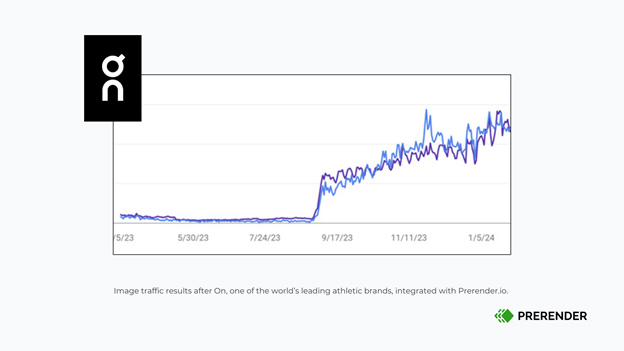
On, a global premium sportswear brand operating across more than 60 countries, ran into this exact problem during a major front-end update in 2023.
JavaScript rendering failures cascaded across every revenue channel simultaneously, Google Shopping Ads disapprovals, indexing failures across global markets, and broken social previews. Server-side rendering would have taken months of engineering work and pulled the development team off the product roadmap. Prerender.io was implemented instead. These are the results over three years:
- +67% increase in Google organic traffic.
- +98% increase in Bing traffic.
- Up to $1M in annual Google Ad revenue protected.
- Millions of dollars saved annually versus the SSR alternative.
“Prerender.io offers the strongest combination of stability, speed, and value.” — Marilena Pixner, Senior Organic Growth and SEO Specialist, On
Final Thoughts on Agentic AI Optimization for Enterprise Websites
Agentic commerce is already operational. The five failure points above are the full sequence: fix them in order, starting with rendering, and enterprise sites re-enter procurement workflows they’re currently excluded from. Skip the sequence or start in the middle, and optimization is happening on a path no agent travels.
Let Prerender.io be where your preparation starts. It won’t solve every failure point above, but without it, none of the others are reachable.
Get started with Prerender.io today and secure your website’s accessibility to agent-driven workflows.
Enterprise Agentic AI: Frequently Asked Questions
1. Why Can’t AI Agents Render JavaScript?
AI agents make a basic HTTP request and process whatever the server returns immediately: no browser, no script execution, no waiting. On enterprise JavaScript-heavy sites, that first response is near-empty HTML. Pricing, availability, and product content that loads dynamically never arrive. The agent reads a blank page and exits.
2. How Does Agentic Search Differ From Traditional AI Search?
Traditional AI search—ChatGPT, Perplexity, Google AI Overviews—retrieves and summarises information. The output is an answer. Agentic search evaluates options and completes a task on the user’s behalf. The output is an action, usually a transaction. A visibility failure in traditional search costs you a citation. A failure in agentic search costs you the sale.
3. How Can Enterprise Websites Prepare for AI Agents?
In sequence: unblock agent access via robots.txt and llms.txt, solve the rendering layer so JS-heavy pages return complete HTML, add semantic structure so agents can navigate your catalog, clean up your content layer for machine readability, then expose procurement workflows through APIs or MCP. Each step depends on the one before it: the rendering layer has to come first.
4. What is Prerendering for AI Agents?
It means generating fully rendered HTML versions of JavaScript-dependent pages so agents receive complete content on first request (product descriptions, pricing, availability) rather than an empty shell. See how Prerender.io handles this technically.
5. What is the Commercial Risk of Ignoring Enterprise Agentic AI Optimization?
Silent, ongoing transaction loss that doesn’t appear in standard analytics. Agents that can’t interact with your site don’t bounce visibly; they exit and convert with a competitor. At enterprise scale, across B2B procurement workflows with significant order values, that failure repeats across every agent-driven session your site can’t complete. Estimate what inaccessible pages are costing you with the ROI calculator.