International SEO fails most often on sites where the configuration looks completely healthy. Your hreflang annotations validate, your URL structure follows documented standards, and every regional market has its own Search Console property with geotargeting enabled. Yet regional variants stall, and pages in secondary markets take months to index—or never appear in search results at all.
That failure happens beneath the surface configuration layer, in the underlying infrastructure that determines whether search bots can actually fetch and execute your signals. The nine technical issues below operate in that delivery pipeline. Each issue includes a diagnostic check you can run against your site today, followed by a risk-based prioritization framework at the end to help you protect revenue.
TL;DR: Why SEO for International Websites Fails
- Configuration is the floor of international SEO: hreflang, URL structure, geotargeting, and localized content can all be validated on a site whose secondary markets still fail to index.
- Infrastructure decides whether crawlers receive your signals at all: rendering, crawl allocation, deployment cadence, and bot handling sit below the configuration layer and never surface in a standard audit.
- Crawl allocation is the bottleneck, not render speed: Vercel and MERJ measured a 10-second median render delay, but query-string URLs hit 31 minutes at the 75th percentile against 22 seconds for clean URLs, and deep locale pages stall before a render is ever triggered.
- AI crawlers don’t execute JavaScript: GPTBot, ClaudeBot, and PerplexityBot render nothing and make 963 million monthly fetches against Googlebot’s 4.5 billion, so anything your front end injects client-side is invisible to them.
- IP-based redirects block Googlebot and every AI crawler at once: all of them crawl from US IPs, so a country-keyed redirect sends every one of them to your US pages.
- Four of the nine issues share one root cause: hreflang, JavaScript rendering, AI crawler exclusion, and schema localization are delivery failures that prerendering resolves.
- Fix hreflang, JavaScript rendering, and IP redirects first: each block’s indexation outright, so nothing else you do reaches search until they clear.
Why International SEO Breaks Even When Everything Looks Correct
A routine SEO health check across your international sites usually starts with validation: checking Search Console, running an audit crawl, and confirming your regional setups look green. Yet even when every tool reports a healthy international SEO implementation, regional traffic stalls and secondary markets fail to index.
That disconnect happens because standard audits only test code syntax in ideal conditions, executing JavaScript instantly with no resource limits. Googlebot operates under strict crawl budgets and rendering queues that tighten as your total page count multiplies. When deep catalog pages sit in a multi-week rendering backlog, even perfectly written hreflang tags and localized canonicals never reach the index.
Multi-market setups break within this delivery pipeline, typically hitting three infrastructure bottlenecks:
- Delayed regional revenue: Search engines take longer to process JavaScript-rendered pages, leaving new market launches or product updates stuck in a queue for weeks while competitors capture the traffic.
- Wasted crawl budget on dead ends: Duplicate pages and complex search filters drain search engine visits before bots ever reach your high-value regional product pages, killing their visibility.
- Lost market share in AI search: Emerging AI search engines and bots ignore JavaScript completely, serving your potential international customers blank pages, raw HTML, or competitors’ localized content instead.
Fixing these revenue bottlenecks requires looking beneath the surface—specifically at rendering behavior, crawl allocation across markets, signal delivery, structured data, and geographic routing. That is precisely where standard audits stop looking, and where international setups quietly break at scale.
Note: The analysis below assumes your hreflang tags, URL architecture, and Search Console properties are already implemented per market.
9 Technical Issues That Break International SEO at Scale
Each issue below ends with a check you can run against your own site today.
1. Hreflang Implementation Errors Break the Entire Hreflang Cluster
Hreflang tags tell search engines which regional version of a page to show to users in different countries. When these tags break at scale, search engines get confused and default to your primary market, or drop regional pages from search results entirely.
Because tags on large catalogs are generated dynamically by your CMS, a single template bug instantly breaks every language version at once. The failure mode isn’t just a few broken URLs; it’s a collapsed cluster where no market passes signals to another.
Business impact:
Your international storefronts (like German or Japanese locales) suffer sudden, simultaneous traffic and ranking drops in the same week, even though no one edited the content on those pages. This causes immediate revenue loss and wastes localized marketing efforts.
Run this check: hreflang parity across locales
- Fetch the raw server response for a URL using curl:
curl -sL [https://example.com/en-us/product-page/](https://example.com/en-us/product-page/) | grep -i “hreflang” - Compare the raw HTML annotation count against the rendered DOM in your browser’s Developer Tools.
- Diagnostic: Fewer tags in the raw HTML response means your annotations rely on client-side JavaScript execution (see Issue #2). Varying tag counts between locale templates indicate a broken template render, which breaks cluster reciprocity.
Need more help? This Hreflang guide can help you to fix common hreflang problems.
2. How JavaScript Rendering Multiplies Crawl Cost
Loading pages with JavaScript forces search engines to spend extra computing power to render your content before they can index it. While Google handles client-side scripts easily on smaller sites, massive multi-market catalogs overwhelm that system.
On a 500,000-page catalog spread across multiple countries, Googlebot simply runs out of crawl budget. Your deep regional product pages aren’t stuck because the code itself is slow; they are stuck waiting in a massive queue just to be fetched and rendered in the first place. Parameterized URLs and site filters make this backlog exponentially worse, delaying hreflang discovery and keeping secondary markets unindexed for weeks.
Business impact
New product launches, campaign landing pages, and inventory updates in secondary markets take weeks or months to appear in local search results. This creates a severe lag in time-to-market revenue, giving agile local competitors a free pass to capture search traffic and sales first.
Run this check: render overhead in your crawl allocation
- Open Crawl Stats in Search Console and compare request rates between parameterized locale URLs and clean category URLs.
- Run URL Inspection on a filtered category page in a secondary market and inspect its last crawl date.
- Diagnostic: Filtered pages recrawling monthly, while clean category pages recrawl weekly, confirms that JavaScript rendering overhead is eating your crawl budget.
For more ways to fix these client-side issues, explore our breakdown of 8 JavaScript SEO Problems and How to Solve Them.
3. Why AI Crawlers Miss International SEO Signals
Most international SEO advice focuses exclusively on Googlebot, but AI search engines like ChatGPT, Claude, and Perplexity crawl your site differently. Major AI crawlers—including GPTBot, ClaudeBot, and PerplexityBot—do not execute JavaScript at all. They fetch your site’s raw HTML response, ignore client-side scripts, and move on.
If your localized copy, structured data (schema), alternate tags, or translated metadata are injected via JavaScript, they are completely invisible to these engines. When an AI crawler requests a localized page on a client-side rendered site, it receives a blank template or unlocalized default content, causing AI search engines to overlook your regional presence entirely.
Business impact
When prospective international customers ask AI tools for regional product recommendations or pricing, these platforms pull answers from local competitors who serve static, fully rendered HTML. This creates an invisible leak in high-intent global traffic and brand visibility as search behavior shifts toward AI tools.
Run this check: what AI crawlers receive from your locales
- Fetch a localized URL using an AI crawler user agent:
curl -A “GPTBot/1.0” [https://example.com/de/kategorie/](https://example.com/de/kategorie/) | grep -c “application/ld+json” - Check the output count for your localized schema or translated text blocks.
- Diagnostic: A result of zero confirms that AI crawlers receive none of your localized schema or content on that regional page, leaving your brand invisible in AI-generated answers.
To ensure your dynamic site stays visible across all artificial intelligence engines, learn how to optimize your website for AI crawlers.
4. Crawl Budget Management Across Markets
Search engine crawl budget is finite per host, and multi-market sites burn through it fast. Near-duplicate regional pages across similar locales (like en-us, en-gb, and en-au) consume separate crawl visits for nearly identical content. Thin localized variants and complex faceted navigation filters compound this waste, forcing search bots to spend resources on low-value URLs instead of indexing core regional catalog items.
A structural fix requires locale-segmented XML sitemaps. Build one sitemap per market under a parent sitemap index, include every regional hreflang alternate URL inside its respective locale sitemap, and submit each to its corresponding Google Search Console property. Pair this with isolated path rules in your robots.txt file to block unnecessary parameter crawls.
Business impact
Key product launches and seasonal inventory in secondary markets take weeks to index while primary market SKUs surface in days. This delay wastes crawl budget on non-converting URLs and stalls international revenue growth on high-margin inventory.
Run this check: Crawl waste per locale
- Segment your server logs by regional path (e.g., /de/, /fr/, /jp/).
- Calculate Googlebot request volume per 1,000 indexable URLs for each market, then measure what percentage hits non-canonical or parameterized filter URLs.
- Diagnostic: A secondary locale burning a significantly higher share of crawl requests on parameters than your primary market confirms severe crawl waste.
Read our crawl budget best practices for large sites to learn more.
5. Template Drift Causing Cross-Market Hreflang Errors
Most teams treat international SEO as a one-time validation setup, but live multi-market sites suffer from template drift. Because parent CMS templates push updates into every regional child site simultaneously, a routine front-end code release can silently strip self-referencing tags or invert canonical URLs across eight markets at once.
Because these template updates rarely trigger SEO alerts, the code regression goes unnoticed. The diagnostic failure lands weeks later when search engines recrawl the affected pages and silently drop regional rankings. Monitoring must align with your front-end deployment cadence rather than relying on static monthly audits.
Business impact
A single unflagged front-end update can break international signals overnight, wiping out months of organic search growth across global storefronts without anyone realizing code was broken.
Run this check: Post-deploy head diff
- Capture the code of a benchmark sample URL from each locale before your next code release.
- Diff the post-deployment HTML against your pre-deployment baseline.
- Diagnostic: Any unapproved changes to hreflang tags, canonical URLs, or structured data confirm template drift, allowing you to catch regressions before search engines recrawl.
6. Schema Localization Gaps on JS-Rendered Sites
Structured data must reflect the specific local market it sits in. Translating on-page text while leaving JSON-LD fields like priceCurrency, availability, region, or inLanguage set to primary-market defaults tells search engines your page has contradictory signals. This metadata conflict suppresses rich snippet eligibility across every language version.
JavaScript-rendered sites carry a second failure mode: schema injected after initial page load stays missing from the raw HTML response. It waits in a delayed rendering queue for Googlebot and remains completely invisible to non-rendering AI search engines.
Business impact
Conflicting or missing localized schema strips your search listings of eye-catching rich snippets (like localized pricing, star ratings, and stock status). This lowers click-through rates and degrades search conversion across all regional markets.
Run this check: locale-specific schema values
Diagnostic: Identical currency or language values across different locales mean your schema was machine-translated without being localized, suppressing rich snippets globally.
Extract the raw application/ld+json schema block from an equivalent page in each locale:
curl -sL [https://example.com/de/produkt/](https://example.com/de/produkt/) | grep -i “application/ld+json”
Verify that priceCurrency, inLanguage, and localized offer availability reflect the target market.
7. Core Web Vitals Vary by Region, So Measure and Fix Per Market
Core Web Vitals rely on field data collected from real user sessions, meaning performance scores reflect the actual physical geography of visitors loading your pages. Distance to server origin shows up first in Time to First Byte (TTFB). Official web.dev guidance on TTFB classifies performance as good at 0.8 seconds or below, and poor above 1.8 seconds. Because TTFB precedes both First Contentful Paint (FCP) and Largest Contentful Paint (LCP), every millisecond of server latency directly degrades your primary rendering metrics.
A centralized site served from a North American origin server can clear LCP standards in the US while failing performance thresholds in Southeast Asia or South America on identical code. Evaluating global performance averages masks regional failures, as Chrome User Experience Report (CrUX) judges each market on its own local 75th-percentile distribution. CDN edge nodes reduce latency for static assets, but dynamic origin calls (like local currency or inventory checks) bypass edge caching.
Business impact
Slow regional load times hurt organic rankings in local search results and drive up bounce rates among international shoppers, directly reducing cross-border ecommerce conversion rates.
Run this check: CrUX field data by market
- Open the CrUX Dashboard in BigQuery or query the CrUX API segmented by country dimension for your top international markets.
- Compare 75th-percentile TTFB and LCP metrics side-by-side across regions.
- Diagnostic: A secondary market sitting above 1.8 seconds on TTFB while your primary market clears 0.8 seconds confirms an infrastructure latency bottleneck that front-end code optimizations cannot fix.
To better understand how content delivery networks handle dynamic rendering overhead, learn about the difference between CDNs vs. Prerender.io for enterprise SEO.
8. URL Structure Trade-Offs for Crawl and Authority at Scale
Choosing between country-code top-level domains (ccTLDs), subdirectories, and subdomains is often treated as an architectural decision made once during a site launch. However, the long-term crawl budget and domain authority costs compound over time.
Google names ccTLDs as the strongest country-targeting signal available, but force Googlebot to allocate separate crawl budgets and build domain authority independently across every market. Managing eight ccTLDs means managing eight isolated, under-resourced crawl pools that cannot pass link equity to one another. Subdirectories consolidate crawl budget and domain authority under a single root domain, allowing equity earned in your primary market to benefit international pages. Subdomains sit awkwardly in the middle, incurring authority fragmentation without the strong geotargeting benefits of ccTLDs.
Business impact
Fragmented domain architecture keeps secondary markets weak, forcing you to spend extra budget building local domain authority from scratch for every new international launch.
Run this check: Crawl allocation per host, tracked quarterly
Diagnostic: A declining crawl ratio on secondary hosts proves that host fragmentation is suppressing search engine discovery across your international portfolio.
Log Search Console crawl request totals per 1,000 indexable URLs per host property on a quarterly basis.
Compare the crawl frequency of your weakest international domain against your primary host.
9. IP-Based Redirects Block Googlebot From International Pages
Forcing automated IP-based redirects is one of the most common ways multi-market sites accidentally destroy their international search presence. Googlebot originates almost all of its crawls from US IP addresses and rarely sends location-specific header variations. A country-keyed IP redirect intercepts Googlebot on regional URLs and forces it back to your US default store.
This issue is even worse for AI crawlers. Major AI bots (including OpenAI and Anthropic crawlers) run strictly out of US data centers. An automated IP redirect routes every AI bot directly to your default US pages, rendering international variants completely unreachable to conversational search engines. The correct technical solution is to serve requested URLs directly, suggest a location banner with an opt-in switcher, and maintain stable URLs.
Business impact
Automated IP redirects block Googlebot and AI crawlers from ever visiting your international pages, rendering your entire global site architecture invisible in local search results.
Run this check: What a crawler resolves to on a non-US locale
- Inspect a localized non-US URL using the live test tool in Google Search Console, or test via the command line:
curl -sI -A “Googlebot” [https://example.com/fr/produits/](https://example.com/fr/produits/) | head -n 3 - Check the initial HTTP status code and response URL.
- Diagnostic: Receiving a 301 or 302 redirect to a US URL confirms that automated IP routing is actively blocking search engines from indexing your international pages.
If you suspect your rendering pipeline is creating similar indexing blocks, review these 10 signs that you have JavaScript rendering problems.
How Prerender.io Resolves the Rendering Layer of International SEO
International indexing failures frequently stem from a single delivery bottleneck: search engine bots and AI crawlers receive raw, unrendered HTML that lacks your localized signals. Prerender.io fixes this pipeline by serving fully pre-rendered static HTML directly to bots on the first request.
Where Prerender.io Solves the Problem International SEO for Enterprise
- Hreflang delivery and JavaScript rendering: Googlebot receives complete, fully executed hreflang annotations instantly, eliminating the two-wave rendering queue and protecting your crawl budget.
- AI search visibility: Non-rendering bots (like GPTBot, ClaudeBot, and PerplexityBot) receive localized copy, translated metadata, and complete HTML rather than blank JavaScript templates.
- Schema localization: Regional structured data (including local currencies, stock availability, and language tags) arrives in the initial server payload, securing rich snippet eligibility across all markets.
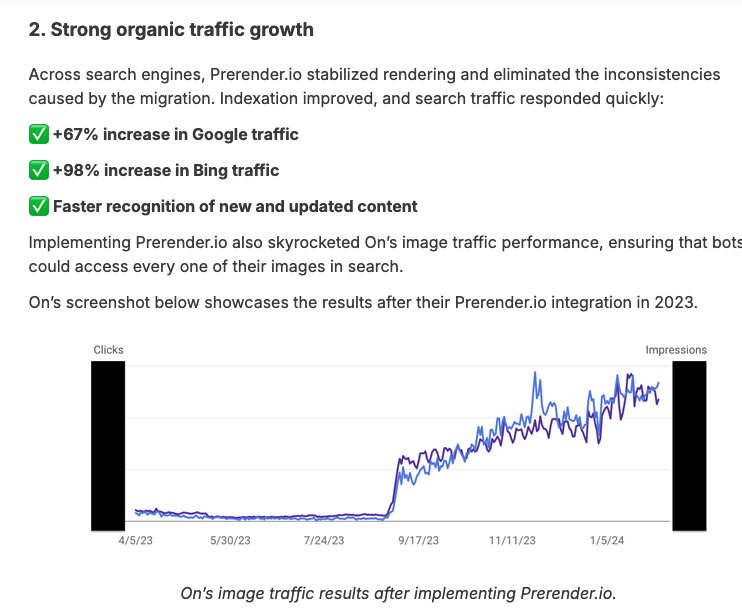
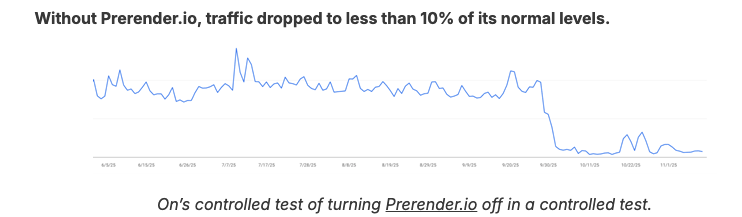
On Running, a sportswear brand operating across more than 60 countries, demonstrated the impact of this mechanism. When they temporarily disabled Prerender.io in a single low-traffic international market for one month, organic traffic in that region plummeted below 10% of its baseline. Traffic recovered immediately once prerendering was restored. Read On’s success story with Prerender.io.
On Running traffic after Prerender.io adoption:
On Running traffic when it paused Prerender.io:
Where Prerender.io Assists (Sitemaps & Monitoring Still Required)
- Crawl budget management: Serving lightweight static HTML significantly lowers CPU load per fetch, helping search engines crawl deeper into large dynamic catalogs. However, organizing locale-segmented sitemaps and setting up per-market Search Console properties remains your responsibility.
- Template drift: Pre-rendered cache refreshes ensure that updated tags surface cleanly after deployments. However, automated post-release diff monitoring is still needed to catch CMS template regressions before deployment.
What Prerender.io Does Not Touch
Prerender.io operates specifically at the rendering layer. It does not resolve Core Web Vitals latency (a CDN and origin hosting challenge), URL architecture trade-offs (a domain strategy decision), or IP-based redirects (a geographic routing misconfiguration). Those infrastructure bottlenecks require edge-caching rules, site migration planning, and opt-in location banners.
How to Prioritize International SEO Fixes
No team fixes nine things at once, and most international SEO best practices arrive as a flat checklist that offers no help in choosing. These four tiers rank the nine issues by how much revenue each one puts at risk against how fast the fix shows up in search.
Tier 1: Blocks indexation, critical
- Hreflang errors (#1): one faulty template variable collapses the cluster, and several markets lose rankings in the same week.
- JavaScript rendering overhead (#2): deep locale pages never get allocated the crawl that would index them.
- IP-based redirects (#9): every non-US locale is unreachable to Googlebot and to every AI crawler at once.
Tier 2: Compounds on large catalogs
- AI crawler exclusion (#3): localized copy, schema, and metadata are absent from AI answers, no matter how correctly they are configured.
- Crawl budget waste (#4): new products surface in secondary markets monthly instead of daily, and the gap widens above roughly 100k pages.
Tier 3: Erodes authority without an obvious drop
- Template drift (#5): validated hreflang breaks on a front-end deploy, nobody flagged as SEO-relevant.
- Schema localization (#6): rich results get suppressed across every language version, including the ones nobody edited.
Tier 4: Plan rather than react
- Core Web Vitals by market (#7): slow markets are judged on their own field data and never on your global average, so this rewards ongoing attention.
- URL structure (#8): crawl budget and authority stay fragmented across markets that cannot lift each other, though migration risk means this belongs in your next replatform conversation
Final Thoughts on Technical International SEO Strategy
An international SEO strategy depends on infrastructure that most audits miss. Your hreflang, URL structure, and geotargeting can all be validated even when crawlers receive HTML that contains none of them, and no amount of configuration work fixes a delivery problem.
Start where indexation is actively blocked, verify what crawlers receive rather than what your CMS believes it publishes, and treat every front-end deploy as a possible regression across all markets at once.
Then test the rendering layer on your own locales before committing to anything. Prerender.io’s free 30-day trial includes 25,000 renders, enough to cover a meaningful slice of a multi-locale catalog and build enough Search Console history to see whether coverage in your weakest market moves.
Start a free Prerender.io trial and see exactly what crawlers receive from your international pages today.
FAQs About International SEO
Is international SEO the same as multilingual SEO?
No. Multilingual SEO covers serving content in more than one language, while international SEO covers targeting more than one country, which brings currency, shipping, legal, and search engine differences on top of language. A single-language brand selling into Canada, Australia, and the UK is doing international SEO with no translation involved.
Does hreflang still work if JavaScript injects it?
Google can read hreflang injected by JavaScript, though only once it renders the page, and that rendering competes for the same crawl budget as everything else on a large site. AI crawlers execute no JavaScript at all, so client-side hreflang is invisible to them, regardless of how correctly it is written. Serving annotations in the initial HTML response removes both constraints.
How long should a new locale take to index?
Google aims to check and index pages in a reasonably timely manner, which for most sites means three days or more, and deep pages on large catalogs take considerably longer than that. A locale showing almost no indexed pages after several weeks usually points to a blocking issue rather than a normal waiting period.
Do I need a separate Search Console property for each market?
You need one per market to get usable data. A single property covering the whole site blends every locale into one coverage number, which hides the market that is actually failing. Separate properties also let you submit the matching locale sitemap and read crawl stats for that market alone, and ccTLDs require separate properties by definition.
Is prerendering the same as cloaking?
No, provided the prerendered HTML matches what users see. Cloaking means serving crawlers materially different content from users, while prerendering serves the same content in a form crawlers can read without executing JavaScript. Google’s guidance treats dynamic rendering as a workaround rather than a permanent recommendation, so the practical test is content parity between what bots and users receive.
Can AI crawlers read hreflang and structured data?
AI crawlers can read both when the markup arrives in the initial HTML response. None of the large AI crawlers execute JavaScript, so anything injected client-side remains invisible to them, no matter how well configured.