Your search for the best Screaming Frog alternative begins by pinpointing the specific limitations you’re trying to overcome. As a classic SEO spider, Screaming Frog is highly effective at surfacing technical issues. However, its desktop-only setup and spider crawl constraints often fall short for massive, high-speed site audits. Today’s SEO teams aren’t looking for a 1:1 replacement, but are evaluating different Screaming Frog alternatives to find the right balance of cloud scalability and SEO crawling depth for their specific workflows.
After researching several Screaming Frog competitors and talking to SEO managers and agency teams about their day-to-day workflows, our team came up with 12 best Screaming Frog alternatives, both free and paid, with the pros and cons of each and the use case it fits best. Our Screaming Frog alternatives include Prerender.io, Sitebulb, Ahrefs, and Semrush.
How We Evaluated These Screaming Frog Alternatives
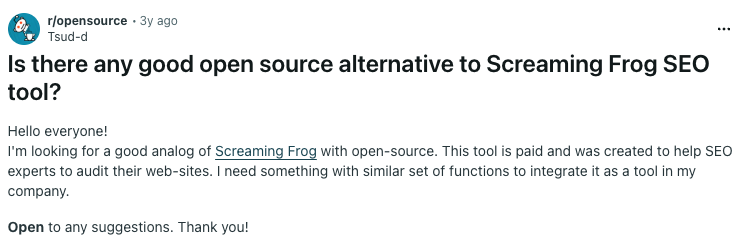
We didn’t list these tools on spec sheets alone. Our team reviewed reports, compared each tool against the core jobs that Screaming Frog excels at (its SEO spider crawling function), and spoke with several SEO managers and agency contacts about which SEO crawling tools they actually keep in their stacks. We also dug into where SEOs raise the question themselves, like this Reddit thread on open source alternatives to Screaming Frog, to ground the shortlist in what practitioners actually reach for.
We scored each tool against the criteria that matter most when you’re replacing or supplementing Screaming Frog and its SEO spider online feature:
- Pricing model: whether the tool offers a genuine free tier, a free trial, or paid-only access. This includes free vs. paid crawl limits.
- Deployment: cloud-based vs. desktop crawling, since this drives speed, collaboration, and how much it taxes your machine.
- Audit scale: how many URLs a single crawl handles, from 500-URL caps to enterprise crawls in the millions.
- JavaScript rendering: whether the crawler can render JS-heavy pages built on React, Vue, or Angular.
- Reporting and prioritization: how clearly the tool surfaces issues and ranks them by severity.
- Integrations: connections to Google Search Console, GA4, and other SEO platforms.
One limitation worth stating up front: we focused on tools that many SEO experts recommend or that many SEO teams use at scale. We didn’t test every niche or abandoned crawler on the market, so this list favors popular, actively maintained options over obscure ones.
Screaming Frog‘s Limitations: Why You Might Need an SEO Spider Alternative
Despite its power, Screaming Frog isn’t always the most scalable or beginner-friendly solution. While Screaming Frog SEO Spider is widely regarded as the industry-standard web crawler, its functional limitations mean it isn’t universally favored among SEO professionals.
- Desktop-only crawling: its desktop-based operation can slow down a computer during site crawls, and its site crawl efficiency can be hampered by low computer specifications.
- Not suitable for extremely large websites: some users claim that Screaming Frog’s SEO spider isn’t powerful enough to crawl websites with thousands of URLs. They often run into errors, interrupting the SEO site review process.
- Too technical for beginners: inexperienced SEOs may find the tool overwhelming. Additionally, the free plan’s 500-URL crawl limit is also quickly reached. Once you cross that threshold, you have to switch to a paid plan to continue, which can strain those with a small budget.
Want to get more out of your existing setup? Explore 13 Screaming Frog Features and Tricks You Didn’t Know to enhance your audits before you switch tools.
Best Free Screaming Frog Alternatives (Free SEO Crawlers)
If you’re just starting out or have a smaller site, these free Screaming Frog alternatives offer excellent value without heavy setup or subscription costs.
1. Prerender.io: Best for Site Crawling, Indexing, and JavaScript Rendering
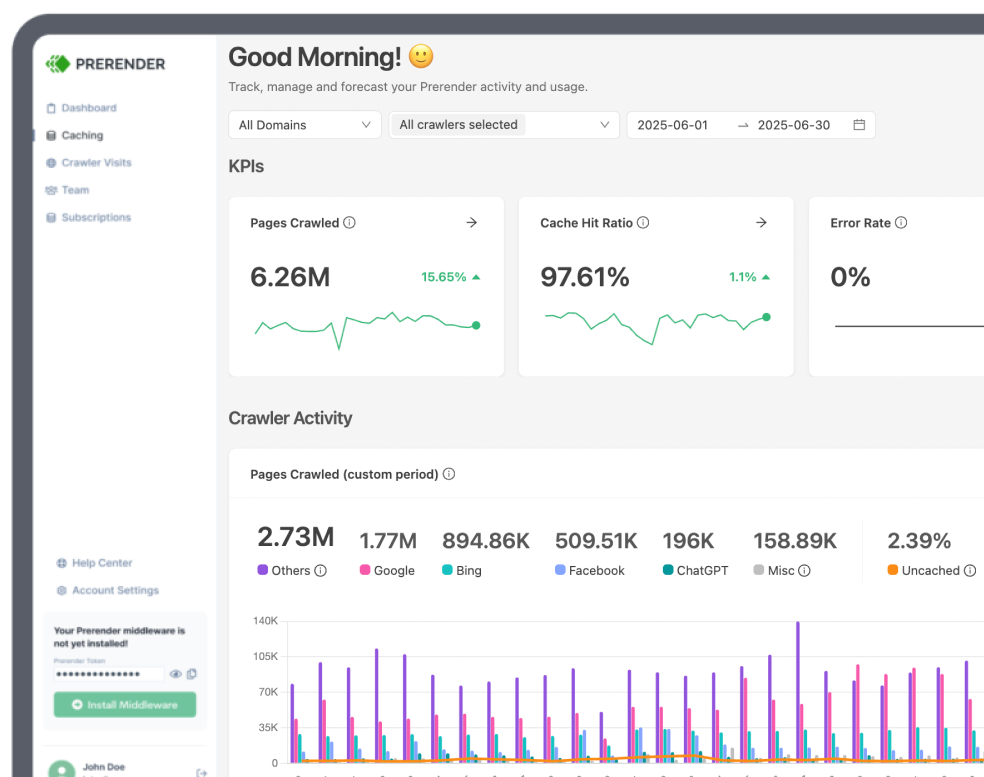
Prerender.io isn’t a dedicated web crawler like Screaming Frog, and we want to be upfront about that. We include it here because, in our testing, it solves the problem most crawlers only diagnose: JavaScript content that bots can’t read. Instead of just flagging crawl issues, Prerender.io fixes them at the source by rendering your JavaScript for search engines and AI crawlers.
That means that Screaming Frog SEO spider identifies SEO issues, and Prerender.io resolves the JavaScript rendering problems. Prerender.io turns JS-powered pages into static HTML snapshots that search crawlers can read instantly, so they can be discovered and retrieved by Google and AI search systems.
Prerender.io also lets you configure rendering rules per bot—defining what each crawler receives rather than serving the same snapshot to everyone. For enterprise JS sites managing visibility across both Google and AI search platforms, this distinction matters: Googlebot, GPTBot, and other search bots each have different crawl behaviors. Prerender ensures Google sees fully rendered product and category pages while AI crawlers receive the structured content they need for retrieval and citation. Screaming Frog can identify that a bot couldn’t read your page; Prerender determines what each bot reads.
We recommend running Screaming Frog SEO spider or another crawler to surface issues, then use Prerender.io to fix the rendering problems it exposes. Learn more about how Prerender.io site auditing works compared to Screaming Frog.
Pros of Prerender.io
- Effective for large-scale JavaScript-based websites
- Crawl and render analytics, for traditional search crawlers (like Google) and AI search crawlers (ChatGPT, Perplexity, Gemini, and more)
- Offer log file analysis
Cons of Prerender.io
- Focuses on rendering and indexing, so it complements a crawler rather than replacing one
Try Prerender.io today for free and upgrade as you grow.
2. Xenu’s Link Sleuth
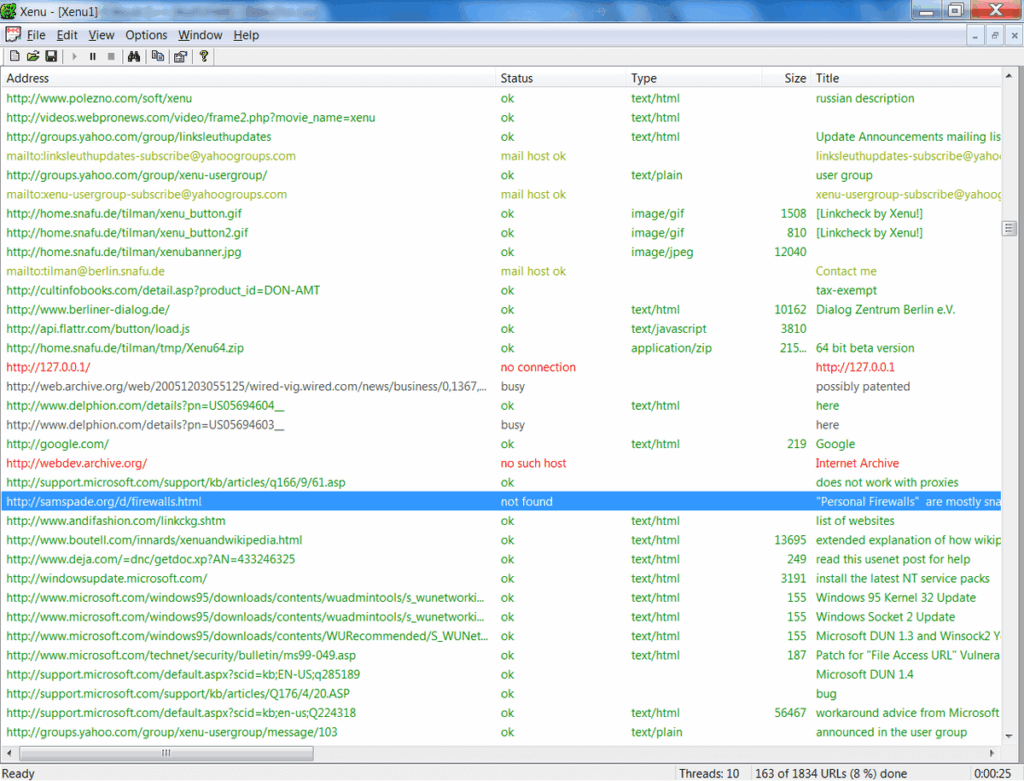
For a no-cost, stripped-down alternative to feature-rich crawlers, Xenu’s Link Sleuth is one of the most accessible options we tested. It skips dashboards and advanced features to focus on fast, efficient link scanning.
Give it a domain, and it starts crawling immediately. The output is an organized list of every link it finds, with status codes, link types, page sizes, and meta titles. It supports SSL pages, gets updated regularly, and reliably detects redirects.
Those capabilities stop at the basics, though, so it won’t carry a full technical SEO audit. If you mainly need to catch broken links and check fundamental site connectivity on a small site, Xenu’s Link Sleuth handles that well. For deeper insight, you’ll want one of the heavier tools below.
Pros of Xenu’s Link Sleuth
- Easy to use
- Reports key fields like status codes and meta titles
- Reliable redirect detection
Cons of Xenu’s Link Sleuth
- Limited features
- Best suited to small sites and quick link checks
3. Scrutiny
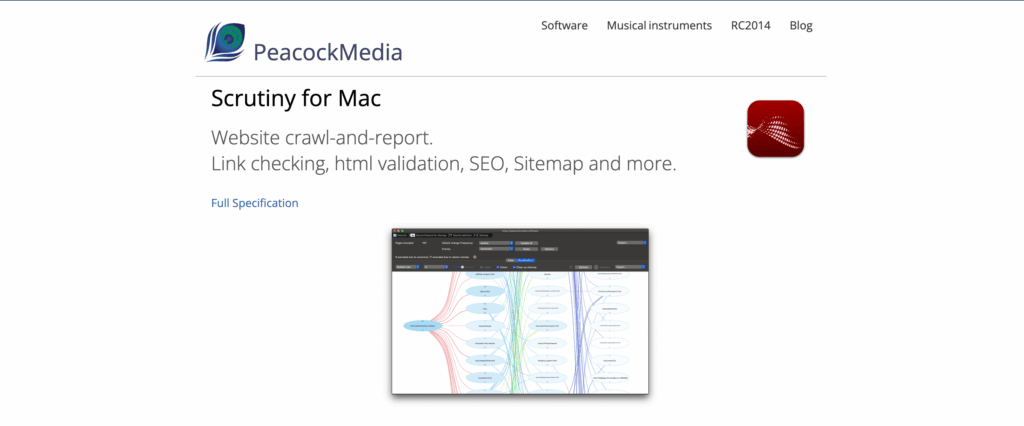
Scrutiny is a Mac application and a strong Screaming Frog alternative for anyone in that ecosystem. It works much like Xenu or Screaming Frog but is built natively for macOS.
It’s more capable than a basic link checker. You can log into members’ areas, scan links inside PDFs, and render scripts before crawling. On the SEO side, it scans meta titles and descriptions, checks content for thin or duplicate pages and keyword stuffing, exports XML sitemaps, and runs a spelling and grammar check across your content. Learn how to solve XML sitemap roadblocks in this guide.
Its one real constraint is the 30-day free trial. After that, you pay to keep using it. For the feature set, that’s reasonable, and it makes Scrutiny a genuine Screaming Frog alternative for Mac users.
Pros of Scrutiny
- Meta title and description scanning
- XML sitemap export
- Advanced crawling and link inspection
Cons of Scrutiny
- Available for Mac only
4. Spotibo
Spotibo is a free, web-based Screaming Frog alternative for basic SEO crawling. Because it runs in the browser rather than as a download, you can use it on Windows, Mac, or any other platform.
The free version caps crawling at 500 pages per month. We like that this is a monthly reset rather than a lifetime limit, which makes it practical for smaller sites you audit regularly. It crawls pages and links, reports status codes from redirects to 404s, and flags content issues, URL structure problems, and meta title and description errors. It also scans images for titles, URLs, and alt text.
A useful extra: you can segment and analyze the data inside the dashboard without exporting it first.
Pros of Spotibo
- URL structure scans
- Meta description and title analysis
- In-dashboard data segmentation
Cons of Spotibo
- Basic crawling capabilities
- 500-page monthly limit on the free plan
5. Visual SEO Studio
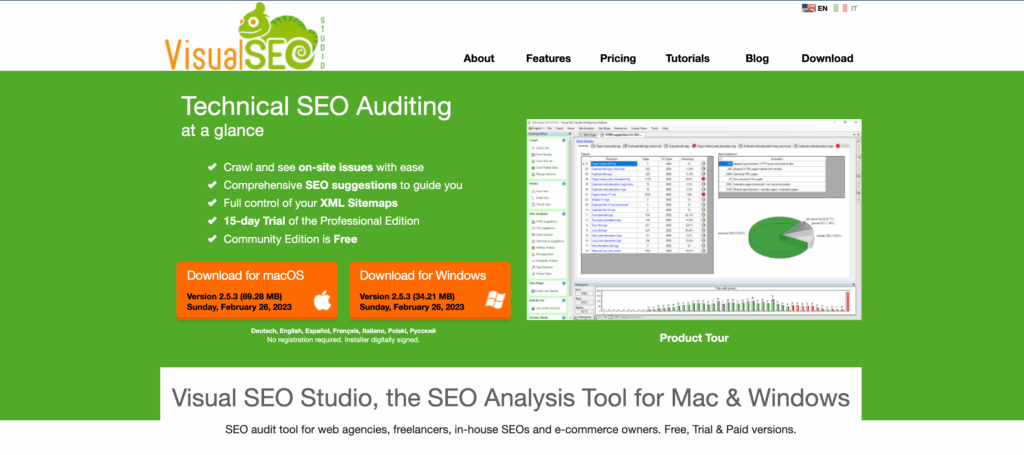
Visual SEO Studio (VSS) offers free and paid versions. The free tier is a capable Screaming Frog alternative with two main limits: it crawls up to 500 pages and uses only two concurrent connections, so larger crawls take longer.
Within those limits, it covers the essentials well. It identifies crawl errors, inspects page titles and metadata, flags HTTP/HTTPS issues, finds broken links, checks robots.txt, and generates XML sitemaps. It also recommends fixes for the issues it surfaces.
The paid version unlocks URL-list crawls, analytics health checks, readability analysis, performance suggestions, link inspectors, and custom filters, and it raises the crawl ceiling to roughly 150,000 pages. For beginners and smaller sites that don’t need high-speed crawls, the free version is an excellent starting point.
Pros of Visual SEO Studio
- Robots.txt inspection
- XML sitemap generation
- Fix recommendations for surfaced issues
Cons of Visual SEO Studio
- Limited concurrent connections on the free plan
Best Paid Screaming Frog Alternatives (for In-Depth SEO Audit and Crawling)
If you need more depth, scale, or collaboration than the free tools offer, these paid Screaming Frog alternatives deliver features that match or extend what Screaming Frog does.
6. Sitebulb
Of every tool we tested, Sitebulb is the closest direct alternative to Screaming Frog, and the one SEOs most often run alongside it. It does the same core job, crawling your site and auditing technical and on-page SEO, but it approaches the workflow differently.
The biggest difference is how it handles findings. Screaming Frog hands you a large list of URLs and leaves you to interpret it. Sitebulb categorizes, prioritizes, and explains issues as the crawl runs, so you get an immediate read on what to fix first without digging through raw data. That prioritization and the built-in hint explanations are what agency users told us save them the most time on client work. It also generates crawl maps and site visualizations that make the site structure easier to present to stakeholders.
The other key difference is deployment. Screaming Frog is desktop only. Sitebulb offers both a desktop app and a cloud version, which makes it a better fit for larger crawls and team collaboration. Sitebulb Cloud starts around £95 per month, and you can compare Sitebulb and Screaming Frog directly on their own breakdown. You can test it for free for 14 days before committing.
Pros of Sitebulb
- Prioritized and explained issues instead of a raw URL list
- Desktop and cloud versions
- Crawl maps and visual reporting for stakeholders
- Free JavaScript crawling with evergreen Chromium rendering
Cons of Sitebulb
- Free access is a 14-day trial rather than a permanent free tier
7. Lumar
Lumar, formerly DeepCrawl, is a cloud-based website optimization platform built for enterprise teams. Where most tools on this list audit a single site, Lumar crawls millions of URLs at high speed and brings technical SEO, site speed, accessibility, and GEO/AI search analytics into one platform.
Brands like Adobe, eBay, and Microsoft use it to monitor large, fast-changing sites across multiple teams. It crawls at up to 450 URLs per second, prioritizes issues by impact, and supports custom crawl segmentation and pre-production testing. That depth is its strength and its tradeoff: users report a learning curve, and the feature set can feel like a lot when you only need a quick crawl.
Pricing isn’t published and runs at the enterprise level, so Lumar fits large organizations rather than solo SEOs or small teams. If you’re weighing platforms at this tier, see our breakdowns of Lumar alternatives and Botify vs. Lumar.
Pros of Lumar
- Crawls millions of URLs at enterprise scale
- Combines technical SEO, site speed, accessibility, and AI search analytics
- Customizable crawl segmentation and pre-production test suites
Cons of Lumar
- Enterprise pricing, not published, out of reach for smaller teams
- Steeper learning curve given the breadth of features
8. Ahrefs Site Audit
Unlike many tools, a key differentiator of Ahrefs is data freshness. Results are updated regularly.
This tool can also be used for functions like backlink audits, strategic content promotion, and competitor analysis. Since it is a cloud-based crawler, your website’s URL will be scanned when you feed it into the tool, and it can help identify common SEO errors on your website.
Users will be able to navigate this tool easily. It has a simple interface, and all the reports are displayed in visuals that are easy to review and understand.
A significant benefit of using Ahrefs is that the crawling will be completed within hours. That means you won’t have to wait for days for crawl results, saving you time and energy.
You can use their features to perform a technical audit of your website.
Pros of Ahrefs Site Audit
Some highlights from Ahref’s site crawler feature are:
- Identification and suggestions to fix indexation issues
- Identify pages with thin or duplicate content
- Find broken links and redirects
- Check for the canonical issues, and if the website has more than one version
- Ensure proper on-page SEO practices
- Conduct a full content audit and identify gaps
- Check structured data errors
- Verify backlink profiles and linked domains
Cons of Ahrefs Site Audit
- The technical SEO analysis isn’t as deep as Screaming Frog
7. Semrush Site Audit
Semrush Site Audit is one of the most popular SEO platforms, and it works for both seasoned webmasters and beginners.
Alongside SEO audits, it covers PPC analysis, keyword research, backlink analysis, rank tracking, and content optimization. You can track your own site or a competitor’s. Its priority optimization feature ranks issues so you fix the most damaging ones first. It checks HTTPS implementation and security certificates, flags broken images, duplicate content, error pages, missing alt text, and redirect problems, then lets you monitor how your fixes affect rankings over time.
Related: Discover the 7 best practices for maximizing the power of alt-text in your SEO strategy.
Pros of Semrush Site Audit
- Comprehensive indexability and crawlability checks, including HTTP status and crawl depth
- Tracks fixed errors and catches new ones
- Checks more than 120 ranking factors
- Flags HTTPS and site-architecture issues
- Identifies page-code problems and missing values
Cons of Semrush Site Audit
- No free version, and the audit tools aren’t sold separately
10. Netpeak Spider
Netpeak Spider is a desktop crawler that mirrors how search engine bots move through a site. It’s well suited to pinpointing technical SEO problems, measuring site performance, and surfacing the factors that influence ranking.
It runs on Windows only, not macOS or Linux. Once it crawls, it presents results in a single dashboard, and its detailed reports export cleanly. We found it strong for fast, thorough technical reviews, especially when you need to filter and segment large result sets. As desktop software, it can use significant storage, and it lacks direct Google Search Console integration.
Netpeak Spider offers a free version so you can test the crawler before subscribing.
Pros of Netpeak Spider
- Catches technical errors like duplicate content and on-page issues
- Customizable crawl rules for full-site or section-specific crawls
- Analyzes more than 50 on-page SEO factors per crawl
- Examines internal and external links
- Helps avoid robots.txt and canonicalization errors
Cons of Netpeak Spider
- No direct Google Search Console integration
11. Moz
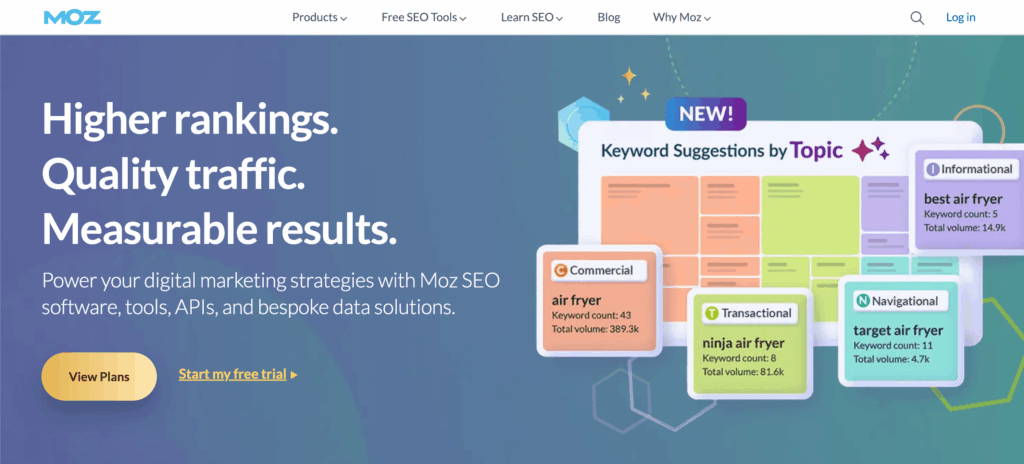
Moz is one of the most established SEO platforms, with a broad set of solutions for common SEO problems.
It audits your site, identifies errors affecting site health, and helps you resolve them, which indirectly supports better rankings. The interactive dashboard shows pages crawled, new issues, and issue severity using clear color-coded charts, so you can spot critical and high-priority errors fast. You can flag issues, prioritize fixes, and request an instant recrawl to confirm a fix worked.
Pros of Moz
- Auto-crawl with notifications when new issues appear
- Color-coded reports that make site health easy to scan
- Instant recrawl to verify fixes
- Issue flagging and prioritization
- Detects both typical and complex errors site-wide
Cons of Moz
- Limited technical depth compared with dedicated crawlers
12. Serpstat
Serpstat is a versatile SEO platform, and its site audit is the relevant piece here. The audit delivers an in-depth analysis of site efficiency and improvement areas, and you can compare results over time to confirm your optimization work is paying off. You can also schedule recurring crawls and prioritize what to review.
Its standout feature is SDO Score Dynamics, which tracks changes across your audit history and surfaces recurring vulnerabilities that drag on performance. The interface is intuitive, results segment by parameter, and crawls run quickly. Like several tools here, it has no free version and concentrates on on-page SEO issues.
Pros of Serpstat
- Compare current and historical audit results
- Inspects simple and complex on-page issues
- Visual reporting for monitoring site elements
- Score Dynamics for tracking audit changes over time
- Analyzes readability, browser caching, and page-load factors
- Checks canonical tags and SSL
Cons of Serpstat
- Primarily focused on on-page SEO issues
Comparison of Top Screaming Frog’s SEO Spider Alternatives
Here’s how each tool compares on best use case, key features, and free-plan availability.
|
Screaming Frog Alternative |
Best for |
Key Features |
Free Plan |
|
Prerender.io |
Site crawling and JavaScript rendering for better indexing |
JavaScript content rendering, technical SEO scoring, 404 error checker |
Yes |
|
Xenu’s Link Sleuth |
Basic link audits on small sites |
Easy to use, organized URL list, key field review |
Yes |
|
Scrutiny |
SEO managers on Mac |
Meta title and description scanning, XML sitemap export, advanced link inspection |
Yes (30-day trial) |
|
Spotibo |
Web-based crawler with basic audit features |
URL structure audit, meta analysis, data segmentation |
Yes |
|
Visual SEO Studio |
Sites with moderate crawl needs |
Robots.txt inspection, XML sitemap generation, fix recommendations |
Yes |
|
Sitebulb |
Desktop and cloud site crawl |
Prioritized issue explanations, desktop and cloud, crawl maps |
Yes (14-day trial) |
|
Lumar |
Enterprise-scale crawling |
Millions of URLs, site speed and accessibility analytics, crawl segmentation |
No |
|
Ahrefs |
All-in-one SEO tools |
Broken link discovery, on-page SEO analysis, structured data checks |
No |
|
Semrush |
Competitive analysis integrations |
HTTPS analysis, missing-value identification, 120+ factor checks |
No |
|
Netpeak Spider |
Data segmentation and filtering |
Customizable crawl rules, 50+ on-page factors, link analysis |
Yes |
|
Moz |
Content optimization guidance |
Auto-crawl, instant recrawl, issue flagging |
No |
|
Serpstat |
Integration with other SEO tools |
Data visualization, current vs. historical audit comparison |
No |
Key Features to Look for in a Screaming Frog Alternative
When you evaluate alternatives, prioritize the features that keep your audits efficient, scalable, and compatible with modern frameworks like React, Vue, and Angular. The right tool replicates what Screaming Frog does well and addresses its limits.
- Cloud crawling: run crawls from the cloud instead of your desktop.
- Crawl scheduling: automate recurring audits so issues surface proactively.
- API integrations: connect to Google Search Console, GA4, and Ahrefs to centralize your SEO data and streamline reporting.
- JavaScript rendering: render JS-heavy pages so you can audit and index content traditional crawlers miss.
- Error reporting and prioritization: flag broken links, metadata errors, and indexation problems, then rank them by severity.
- Customizable crawl rules: adjust depth, frequency, and exclusions to focus on key sections without wasting crawl budget.
- AI crawler visibility (ChatGPT, Perplexity, GPTBot): track how your site appears to generative AI crawlers and ensure your content is accessible for AI-driven discovery.
These features keep your Screaming Frog alternative auditing efficiently while keeping your site visible, indexable, and optimized for both traditional and AI-driven search.
What Makes Screaming Frog So Popular? (SEO Spider and Audit Capabilities Explained)
Before choosing an alternative, it helps to understand why Screaming Frog became the go-to tool for technical SEO audits.
Screaming Frog excels as a technical auditor, using its crawlers to detect technical and on-page SEO issues. It analyzes missing metadata, broken links, duplicate or thin content that can trigger soft 404s, and weak URL structure. Each finding includes the URL’s HTTP status code, so you can identify and fix errors precisely.
On price, Screaming Frog offers a forever-free plan covering up to 500 crawled URLs and a paid plan at £199 per year. The paid tier unlocks advanced crawling and detection, including a crawl scheduler, JavaScript rendering, and near-duplicate content detection.
That combination of powerful crawlers, deep analysis, and an accessible free tier is why so many SEO professionals and agencies still reach for it.
Screaming Frog for SEO Audit, Prerender.io for SEO Improvement
The Screaming Frog SEO Spider is great at identifying SEO issues, but it doesn’t fix them at the root, especially poor crawling and indexing on JavaScript sites. That’s why many SEO teams pair their crawler with Prerender.io to handle the heavy lifting of prerendering.
Adding the ChatGPT user agent to Prerender.io’s crawl settings produced a clear win for one of our customers, who saw a large jump in referral traffic from ChatGPT to their site.
While your crawler finds the issues, Prerender.io resolves the rendering ones, improving indexing speed by up to 260% and boosting AI crawler visibility.
Try Prerender.io today and optimize your site for traditional and AI search engines.
Related Resources:
- Screaming Frog’s Auditing Blind Spot for JavaScript Rendering
- When to Use Screaming Frog vs. Prerender.io for JavaScript SEO Auditing
- 13 Screaming Frog Features and Tricks You Didn’t Know
FAQs: Alternative Screaming Frog SEO Spider Tools
What is the best free alternative to Screaming Frog?
For a no-cost crawler covering basic audits, Xenu’s Link Sleuth and Spotibo are solid starting points. If you want the closest match to Screaming Frog itself, Sitebulb offers a 14-day free trial of a full technical auditor. For JavaScript-heavy sites, Prerender.io’s free audit tool goes beyond traditional crawling to confirm your content is visible to both Googlebot and AI crawlers.
Which Screaming Frog alternative is best for JavaScript SEO?
Prerender.io is the top choice for JavaScript-heavy sites. Unlike typical crawlers, it renders your pages before bots arrive, which fixes the core problem most crawlers, including Screaming Frog, only flag. For the details, see our article on Screaming Frog’s auditing blind spot for JavaScript rendering.
Is there a good open source alternative to Screaming Frog?
This comes up often, including in this Reddit thread on open source SEO crawlers. The honest answer is that fully open source options are limited and tend to require technical setup. Most SEOs land on a free tier or trial from a maintained tool like Spotibo, Visual SEO Studio, or Sitebulb instead, since they get active updates and support.
Do I need a Screaming Frog alternative if I’m already using Ahrefs or Semrush?
Often, yes. Ahrefs and Semrush focus on backlinks and keyword insights rather than deep technical rendering or crawl health. Pairing one of them with a rendering tool like Prerender.io gives you a full-stack setup that covers both discoverability and indexability.
Can I use Screaming Frog and Prerender.io together?
Yes, and that’s the ideal setup. Screaming Frog identifies technical SEO issues, and Prerender.io makes sure your JavaScript pages are visible to crawlers and AI search engines. For guidance, see When to Use Screaming Frog vs. Prerender.io for JavaScript SEO Auditing.