Enterprise SEO visibility has moved beyond the traditional single-channel SERP. It now encompasses AI Overviews, LLM citations, and regional volatility, rendering most legacy SEO tools insufficient. A page ranking well in one market may be invisible in another; content performing in organic listings may never surface in AI-generated answers. Technical decisions, specifically regarding JavaScript rendering and accessibility, are now the primary gatekeepers of discoverability.
So, what is enterprise SEO at this scale? It is no longer defined by simple rankings or crawl budget. It is the practice of ensuring content is consistently accessible, interpretable, and competitive across every system that surfaces it.
To find the right infrastructure, we evaluated 10 enterprise SEO tools based on their ability to address rendering bottlenecks, global governance, and AI-driven visibility. Rather than a basic feature roundup, we assessed whether each tool could move a site from identified issue to real-time resolution. Below are our expert insights on the software required to build a future-proof enterprise SEO tech stack.
Why Enterprise SEO Requires a Dedicated Enterprise-Level Tool Stack
General-purpose SEO tools aren’t designed for the operational reality of enterprise websites. When you’re managing hundreds of thousands (or millions) of URLs across multiple markets, working with JavaScript-heavy architectures, and tracking visibility across both traditional and AI-driven search surfaces, no single platform covers the full problem space.
SEO tooling for global brands today requires a layered stack, combining systems for crawlability, technical validation, performance monitoring, and emerging AI visibility. Each solves a different part of the visibility equation.
Our guide to optimizing SEO on large-scale sites can help you navigate enterprise SEO challenges more effectively.
Enterprise SEO Tech Stack at a Glance
Choosing the right enterprise SEO tool depends on your team’s specific objectives — whether you need to resolve technical rendering bottlenecks, manage global content workflows, or track emerging AI visibility. The table below summarizes the core functions and primary differentiators for each platform.
| Tool Name | Primary Use Case | Key Enterprise Differentiator |
|---|---|---|
| Prerender.io | JavaScript prerendering | Serving 100%-indexed-ready and AI-friendly content to search crawlers |
| Conductor | Content Governance | Unified SEO/marketing attribution for teams |
| Semrush | Global Market Intelligence | All-in-one data command center for global brands |
| Ahrefs | Authority Research | Link flow and AI brand citation tracking |
| Seobility | Technical Auditing | API-first audits for peripheral sites |
| Screaming Frog | Granular Technical Diagnostics | Desktop-based template-level debugging |
| Otterly | AI Search Monitoring | Tracking visibility in LLMs and AI Overviews |
| BrightEdge | Edge-based Deployment | On-page/schema updates without dev tickets |
| Oncrawl | SEO Data Modeling | Unifying log/crawl data with BI business KPIs |
| seoClarity | Global Platform Management | Configurable modular access for distributed teams |
10 Best Enterprise SEO Tools in 2026
Here are ten tools that reflect what enterprise SEO actually looks like in 2026.
1. Prerender.io
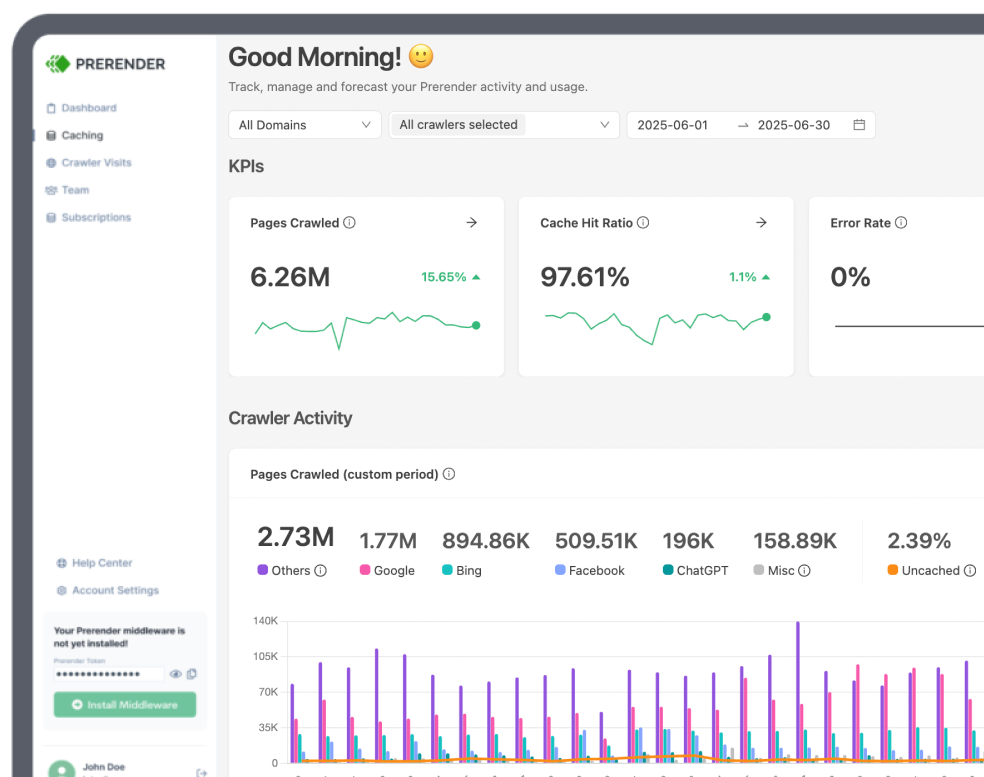
Run a crawl on most large JavaScript-heavy websites, and you’ll find a familiar pattern: incomplete content in bot responses, delayed indexing, and inconsistent visibility. Often, the root cause is two-wave indexing and the render lag between the initial HTML crawl and the eventual JS render—a delay that most coverage reports fail to quantify.
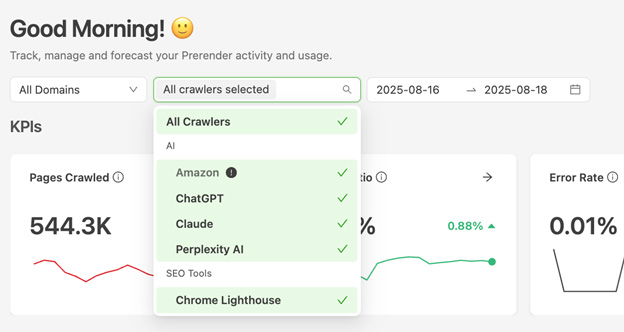
Prerender.io addresses this at the infrastructure layer by intercepting bot requests and serving fully rendered HTML, ensuring 100% index-ready content for both traditional search engines and AI platforms. For enterprise platforms with large page inventories, it deploys in hours with a one-time integration that requires no changes to your existing framework.
It also helps optimize your crawl budget by reducing the rendering overhead that creates indexing backlogs. As a result, an enterprise rendering infrastructure layer like Prerender.io is the necessary starting point for a functional visibility stack in 2026. All that’s needed is installing Prerender middleware.
Who is Prerender.io for?
Prerender.io is built for enterprise SEO teams managing large-scale, JavaScript-heavy sites. It is the essential infrastructure for organizations that:
- Manage large page inventories: You need to scale React, Angular, or Vue sites without the technical setup bottleneck.
- Need AI-visibility: You must ensure content is discoverable by AI crawlers (like GPTBot or PerplexityBot) that often lack deep JS execution capabilities.
- Prioritize speed-to-index: You cannot afford the indexation latency of second-wave rendering or the regression risks associated with full-scale SSR re-platforming.
Why Choose Prerender.io? (Unique Features)
Prerender.io bridges the critical gap between diagnostic and resolution layers.
- JS rendering fix, not just detection: Tools like Lumar and Screaming Frog may be strong in JS-rendering diagnostics. Prerender.io is the resolution layer — actively executing and serving rendered HTML in real-time to close those gaps.
- AI-native infrastructure: Unlike standard SEO suites reliant on Google Search Console (GSC) for traditional baseline metrics, Prerender.io optimizes specifically for AEO by ensuring AI crawlers receive fully rendered HTML on their first visit.
- Enterprise-ready: Built with the security, API-first architecture, and SSO/RBAC compliance required to pass enterprise procurement standards.
When to Use Prerender.io
- Significant content indexing lag: Technical audits confirm a quantifiable delay between your first-wave HTML crawl and your second-wave JS render.
- AI discoverability issues: Your AI visibility monitoring tool shows your site is cited less frequently in AI Overviews compared to competitors, despite having high-quality content.
- Engineering bottlenecks: You need to fix indexation speed and quality but are stalled in an engineering queue. Prerender acts as a cached-HTML layer in front of your stack, bypassing the need for immediate, high-risk SSR migrations.
Learn more about how to optimize your enterprise website for AI crawlers.
2. Conductor
One of the hardest problems at enterprise scale is connecting visibility signals to actual decisions across teams and markets.
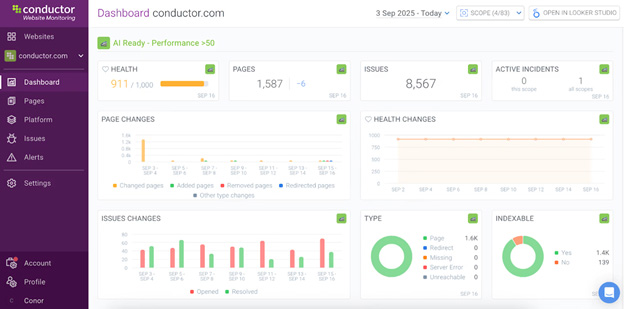
Conductor’s positioning in the market is built around this operational problem. It combines keyword intelligence, content workflows, site monitoring, and AI visibility tracking into a single platform designed for coordination across large organizations.
For enterprise teams that need a unified view of performance without using multiple tools, Conductor serves as the attribution layer that translates SEO performance into marketing results.
Who is Conductor for?
Large SEO teams require a central source of truth for workflow management, content governance, and performance attribution across global teams.
Why Choose Conductor?
It excels at unifying disconnected data sources into a single, collaborative dashboard. Unlike infrastructure tools, Conductor focuses on the “human” layer of enterprise SEO — managing cross-departmental tasks, content calendars, and proving SEO ROI to non-SEO stakeholders.
When to Use Conductor
When you need to align regional teams, track campaign performance against marketing KPIs, or manage complex content workflows at scale.
3. Semrush Enterprise
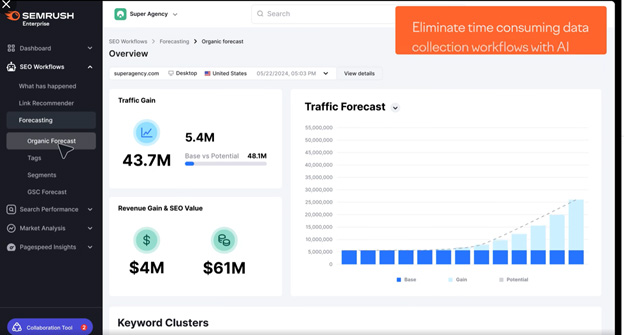
When you’re managing enterprise digital visibility across multiple markets, domains, and languages simultaneously, the core challenge is signal: knowing which shifts require a response before they compound. At this scale, that means continuous monitoring across everything at once, without running parallel tools for each region or business unit.
Semrush functions as a command center for most enterprise teams because it consolidates keyword and ranking data across 160+ countries, with daily granularity by domain and device, and competitive Share of Voice tracking into one workflow.
Where it earns its place in a 2026 stack is the AI Toolkit. A single AI Overview placement can absorb traffic that previously distributed across the top three organic results, yet many teams still monitor only traditional rankings. Semrush surfaces both in the same dashboard, providing unified reporting across traditional and AI search surfaces.
Who is Semrush Enterprise for?
Large organizations that need a massive, daily-updated data command center covering global markets, multilingual sites, and unified AI/traditional ranking data.
Why Choose Semrush Enterprise?
It is the gold standard for sheer data volume. It consolidates ranking intelligence across 160+ countries and provides a comprehensive AI Toolkit that monitors traditional organic visibility alongside AI Overview placement in one dashboard.
When to Use Semrush Enterprise
When you need a single platform that handles everything from daily keyword tracking to competitive intelligence and AI-driven traffic forecasting.
4. Ahrefs
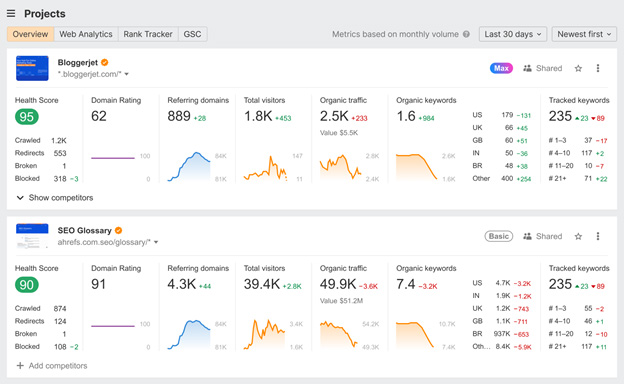
Enterprise sites accumulate content debt faster than most teams can manage it. At hundreds of thousands of URLs, seeing which pages actually hold authority worth keeping becomes difficult.
Ahrefs provides a clear view of that distribution. Its link index and Site Explorer map referring domain quality and PageRank flow at URL level across large, multi-domain portfolios. Teams can identify where authority is stranded and make content and link decisions based on evidence.
That authority signal also matters for AI search, since LLMs cite sources with strong topical authority and consistent references. Ahrefs’ Brand Radar extends this by tracking brand citations across major AI engines, helping teams monitor baseline AI discoverability alongside link research.
Who is Ahrefs for?
Enterprise teams prioritizing backlink health, link-building strategy, and topical authority measurement across massive, multi-domain portfolios.
Why Choose Ahrefs?
Its “Brand Radar” feature offers visibility into how your brand is cited by AI, making it essential for enterprises that rely on authority as a moat against competitors.
When to Use Ahrefs
When your primary growth lever is authority building, or when you need to audit large-scale link networks and identify where PageRank flow is being wasted.
5. Seobility
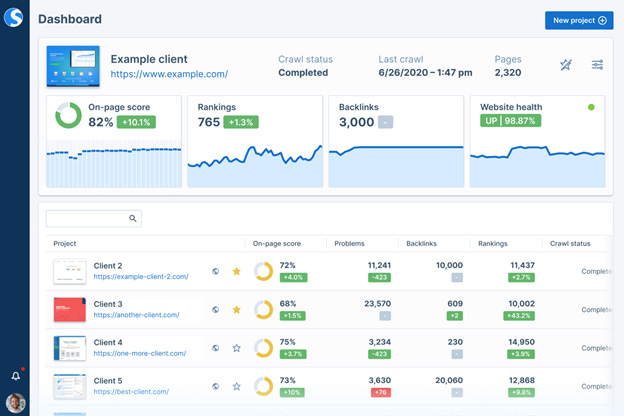
Enterprises often manage a long tail of smaller sites and acquired domains that do not warrant a full enterprise SEO tools license. These properties still require basic technical oversight, and a simple tool is often the right fit.
Seobility is an API-first crawler and site auditor that crawls deep enough to catch issues suppressing crawlability across localized subdirectories and hreflang-heavy international builds.
The TF-IDF content analysis helps teams manage multi-regional sites by showing whether localized pages are semantically competitive in their target markets. For large content audits on sites with messy internal linking or inconsistent structured data, Seobility delivers signal without enterprise-tier pricing.
Who is Seobility for?
Enterprise SEO teams work with secondary domains, acquired sites, or localized projects that don’t require high-cost enterprise suites.
Why Choose Seobility?
It is a lightweight, API-first tool that delivers significant technical audit value without the complex bloat. It is perfect for getting deep insights into technical issues like hreflang errors and internal linking on smaller properties.
When to Use Seobility
When you need efficient, reliable technical auditing for peripheral websites or smaller market subdomains without increasing your enterprise software spend.
6. Screaming Frog
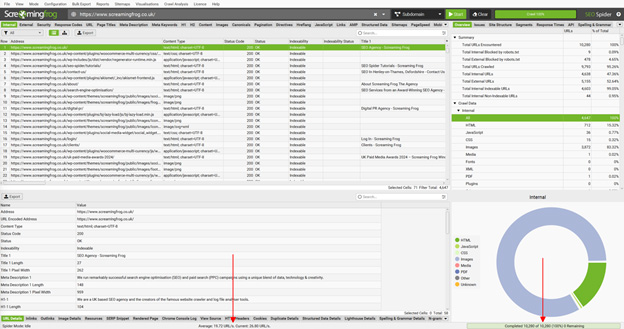
When something breaks at scale, diagnostic precision in minutes matters more than any feature set. Cloud crawlers often trade speed or control for scale, which fails when you’re debugging a specific template across 50,000 URLs.
Screaming Frog is a desktop crawler that gives full control over what gets audited and how, returning configurable crawl data faster than most cloud tools for mid-size audits. Its Chromium-based JavaScript rendering shows a close approximation of what Googlebot sees on CSR-heavy sites, which directly addresses the SSR vs CSR SEO considerations that affect large JS-heavy websites at the template level.
Enterprises can validate whether their rendering layer serves content to bots or diagnose why programmatic pages aren’t indexed. Because configurations save and re-run, teams can use the tool for recurring audits across market variants or template families.
See how many enterprise SEO teams use Prerender.io and Screaming Frog together.
Who is Screaming Frog for?
SEO teams that need precision diagnostics at the template or URL level.
Why Choose Screaming Frog?
It is the ultimate “power user” desktop crawler. It offers total control over audit configurations, allowing you to debug rendering issues, identify broken links, and analyze structured data with a level of speed and granular detail that cloud tools often lack.
When to Use Screaming Frog
When you need to perform deep, rapid technical audits on specific template families or troubleshoot indexation issues in real-time.
7. Otterly
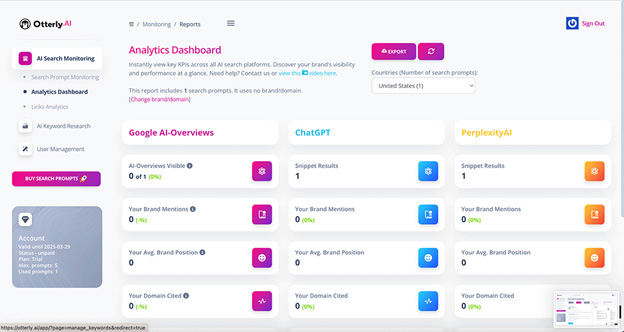
Enterprise search visibility now extends beyond traditional organic listings to AI answers and LLMs driving organic clicks, but the typical enterprise SEO software platforms are only catching up to this layer.
Otterly AI is designed to track brand and domain citations across AI search surfaces, including AI Overviews, Perplexity, and ChatGPT. It provides URL-level data, daily refresh rates, and coverage across 50+ countries.
For enterprises building out AI discoverability as part of their broader SEO infrastructure, Otterly provides a dedicated monitoring layer for LLM-driven visibility.
Who is Otterly for?
Enterprises aiming to win the AI search landscape by monitoring and optimizing their brand presence across LLMs and Generative Engines.
Why Choose Otterly?
It is a specialist tool purely focused on AI search. While traditional tools track Googlebot, Otterly monitors how Perplexity, ChatGPT, and AI Overviews surface your domain, providing the specific data needed to optimize for AEO.
When to Use Otterly
When you need to track AI-driven citations and visibility as a dedicated KPI, distinct from traditional SERP rankings.
8. BrightEdge
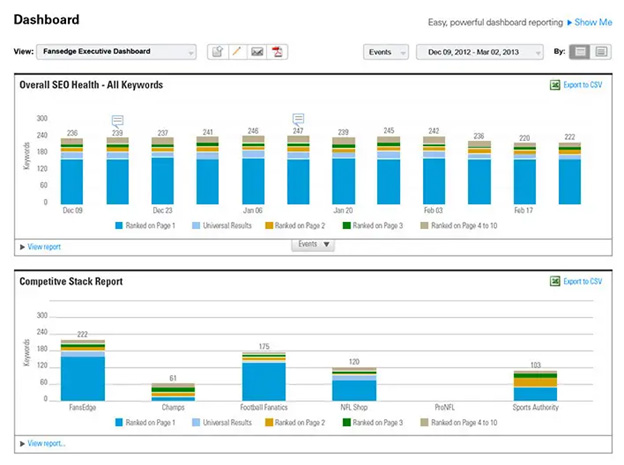
At a certain scale, the SEO optimization backlog grows faster than any team can manually clear. Markets multiply, pages compound, and every on-page fix routed through an engineering queue ends up not shipping for weeks.
BrightEdge addresses this by deploying changes through its tag or edge network once IT approves the initial integration. Its Autopilot feature pushes metadata, on-page copy, and schema updates live across thousands of URLs without another dev ticket. The scope is limited to on-page elements, but that’s where most enterprise backlogs stall.
Beyond execution, BrightEdge tracks daily competitive Share of Voice and models forecasted traffic value by market. Global enterprises can report organic shifts using the same revenue and SoV metrics as leadership reviews, preventing SEO from being deprioritized.
Who is BrightEdge for?
Enterprise teams that struggle to get SEO changes implemented due to engineering bottlenecks and slow deployment cycles.
Why Choose BrightEdge?
Its Autopilot feature allows for the direct deployment of on-page updates (metadata, copy, schema) via their edge network, bypassing the need for traditional developer ticketing for every small change.
When to Use BrightEdge
When your primary constraint is “time-to-live,” you have an SEO strategy ready to execute but are stalled by internal development queues.
9. Oncrawl
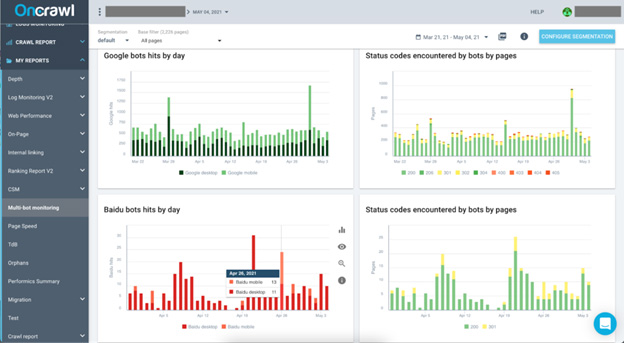
Large enterprise sites generate more enterprise search engine optimization data than most platforms handle cleanly. Crawl metrics, log file data, content performance, and business KPIs end up siloed across tools that export separately.
Oncrawl solves this by joining crawl data, log files, and content metadata in one environment, then routing the unified output to BI pipelines. Consequently, SEO data can be modeled alongside revenue, margin, or inventory—the metrics that give it context.
For a team trying to identify which low-value page templates waste Googlebot’s crawl budget, that means querying logs, template type, and revenue in one table, then feeding the result to workflows that fix it. With unlimited custom reports, Oncrawl lets teams define SEO metrics using their own business logic.
Who is Oncrawl for?
Data-driven enterprise teams that need to integrate SEO metrics into their broader business intelligence (BI) pipelines.
Why Choose Oncrawl?
It acts as a data connector, joining crawl data, logs, and business KPIs into unified tables. It allows you to model SEO performance against real revenue, margin, or inventory data, enabling advanced custom reporting.
When to Use Oncrawl
When you need to perform complex data analysis, such as identifying which page templates contribute the most to revenue versus which ones are wasting your crawl budget.
10. seoClarity
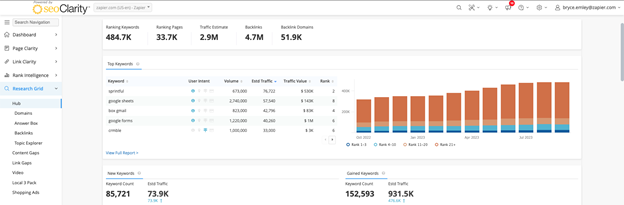
For enterprise programs where coordination overhead is the real constraint, consolidating that tooling into one platform delivers more value than any individual feature it contains.
seoClarity is an enterprise SEO platform that connects rank tracking, technical auditing, content intelligence, and AI search visibility in one system, with modular packaging that lets large, distributed teams configure access around how they actually work.
Regional teams get market-specific insights without operating in silos. Content and technical SEO share the same data layer. The ArcAI suite brings LLM monitoring and AI search visibility into a single workflow rather than treating them as separate problems.
Who is seoClarity for?
Large, highly distributed organizations that need a fully modular SEO platform that can be configured to match their unique team structure.
Why Choose seoClarity?
It offers unparalleled flexibility. It combines ranking data, technical auditing, and content intelligence in a way that can be customized for different regions or departments, ensuring that global and local teams only see the data they need.
When to Use seoClarity
When you need to consolidate multiple regional SEO tools into a single, highly configurable platform that supports both global oversight and local autonomy.
How to Choose Your Enterprise SEO Stack
The enterprise SEO tools above operate across three distinct layers, and understanding how they fit together is key to building a functional SEO infrastructure.
- The crawlability and indexing layer forms the foundation. Prerender.io ensures content is consistently accessible to crawlers, and Screaming Frog provides precise diagnostics. If this layer fails, digital visibility across all channels is compromised.
- The performance and visibility layer sits on top. Semrush, Ahrefs, Conductor, BrightEdge, and seoClarity provide the signals needed to understand market position, track changes, and guide strategic decisions. This is where most of the day-to-day work of large-scale SEO management happens.
- The AI discoverability layer is the newest and fastest evolving. Otterly AI and Prerender.io help teams understand and influence how they appear in AI-generated answers, where traditional metrics often fall short.
Overall, website visibility depends on accessibility first, measurement second, and strategy third. In a fragmented search environment, enterprise SEO is less about any single enterprise tool and more about how well your stack works together to achieve sustainable website growth.
If you’re ready to secure your technical foundation, explore Prerender.io. Check our usage-based pricing and enterprise plans to see how we can help you scale.
Other Enterprise SEO blogs that may interest you: